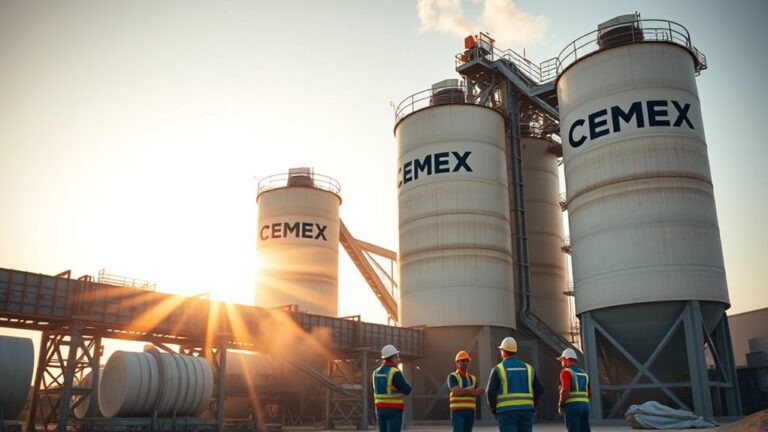

What Is Cemex Stock – The Full Story
Cemex stock, trading under ticker CX with a $19 billion market cap, offers modest yet steady growth in the competitive construction materials sector. You’ll find it priced around $19, backed by a 5.62% one-year gain and strategic U.S. acquisitions targeting 10% EBITDA growth by 2027.
Although its significant $10 billion debt poses risks, strong cash flow and sustainability initiatives underpin its resilience. Explore further to understand how it stacks up against peers and market drivers.
What Is Cemex Stock?

What makes Cemex stock stand out in the market? It’s traded on prominent exchanges like the NYSE under ticker CX and Mexico’s CEMEXCPO.MX, providing diverse access.
As of October 2, 2026, the ADR price hovers around $9.53 USD, reflecting recent volatility.
When you analyze the stock data, you see a 5-year return near 36% and a 1-year return of 5.62%, indicating steady, moderate growth.
Cemex’s stock performance ties closely to global construction demand, commodity prices, and strategic financial management, especially debt control.
Market analysts rate it a “Buy” with a target price around $14.00 USD, signaling upside potential.
Understanding these data points helps you grasp why Cemex stock remains a significant player in the materials sector.
How Has Cemex Stock Performed?
How has Cemex stock navigated the market’s ups and downs over the past year? The stock price has shown notable volatility, swinging between a low of $8.96 and a high of $13.67.
As of February 10, 2026, it sits around $9.53, marking a modest 1.38% daily gain.
Over 12 months, Cemex stock gained approximately 5.62%, despite experiencing a year-to-date decline exceeding 16%.
Trading volume remains steady, averaging 6.56 million shares daily, which shows consistent investor engagement.
While short-term fluctuations make timing tricky, the stock price’s resilience is clear in its 3-year return of roughly 55.53%.
This data tells us Cemex stock has balanced periods of decline with strong recoveries, showing a dynamic performance in a fluctuating market.
What Drives Cemex Stock’s Growth and Strategy?

Cemex’s stock performance reflects more than market fluctuations; it mirrors a well-defined growth strategy focused on expanding value-added building materials and strengthening its U.S. presence through acquisitions like Omega Products International.
You’ll see Cemex targeting around 5% annual sales growth and 10% EBITDA growth by 2026–2027, signaling consistent financial improvement.
The company’s disciplined capital allocation, including up to $500 million in share buybacks and increased dividends, supports shareholder value.
Innovation and sustainability also drive the strategy. Cemex emphasizes carbon neutrality and circular economy practices to stand out in the construction materials sector.
Market analysts rate Cemex as a buy with a $14.00 target price, highlighting profitability recovery and positive free cash flow as key growth drivers. This makes the stock’s trajectory clear and data-backed.
How Does Cemex Stock’s Financial Health Impact Investors?
You need to take a close look at Cemex’s current debt levels and how they stack up against its plan to boost EBITDA by 10% and improve free cash flow by 2027.
Strong cash flow and profitability play a big role here—they’re key to managing debt risks and keeping those dividend payouts steady.
Getting a good grasp of this balance will really help you understand how Cemex’s financial health can impact your investment outcomes.
Debt Levels And Risks
Although Cemex has established itself as a major player in the cement industry, its substantial debt load, totaling around $10 billion USD plus a $450 million perpetual bond, poses significant financial challenges. These elevated debt levels restrict Cemex’s flexibility to invest in growth opportunities or absorb economic shocks.
This directly impacts investor confidence.
You need to closely watch key indicators such as the debt-to-equity ratio and free cash flow. High leverage increases the chance of financial distress or bankruptcy.
Sustained profitability is vital for Cemex to service its obligations, but market volatility and sector risks could undermine this.
Because of these factors, debt concerns often heighten stock volatility and risk premiums.
Cash Flow And Profitability
Managing its substantial debt load hinges largely on Cemex’s ability to generate strong cash flow and sustain profitability. You should note Cemex targets a free cash flow from operations to EBITDA ratio of 47% by 2027, signaling a clear focus on liquidity and earnings quality.
Strategic moves like acquiring Omega Products aim to enhance revenue and bolster cash flow generation. Despite a year-to-date stock dip near 17%, Cemex’s positive 5.41% annual return reflects ongoing profitability efforts.
However, its $10 billion debt and perpetual bonds demand your attention, as they could constrain future cash flow flexibility.
Furthermore, Cemex’s push into sustainable products and digital transformation promises improved operational efficiency, which could strengthen profitability and boost your confidence as an investor in their financial health.
What Are Cemex Stock’s Key Risks and Concerns?

You definitely want to keep an eye on Cemex’s high debt load. They’ve got around $10 billion USD in liabilities, plus a $450 million perpetual bond. That kind of leverage can really increase financial risk.
Then, there’s the fact that market volatility—especially in the construction sector—can make things even tougher. When the market gets shaky, it tends to rattle investor confidence.
Debt Levels and Leverage
Since Cemex carries a substantial debt load, including $10 billion USD in debt and a $450 million perpetual bond, its financial stability faces significant pressure.
You need to understand that these elevated debt levels increase the company’s leverage, making it more vulnerable to interest rate hikes and economic downturns.
If Cemex’s cash flow falters, the risk of default or restructuring rises sharply, threatening its operational continuity.
You should closely monitor metrics like debt-to-equity and interest coverage ratios, as deteriorating leverage ratios could signal worsening financial health.
Discussions around potential bankruptcy stem directly from these debt concerns, emphasizing the urgency of managing leverage effectively.
Ultimately, Cemex’s high debt levels represent a critical risk factor that can substantially impact stock performance, demanding careful scrutiny before investing.
Market Volatility Impact
How does market volatility shape the risks surrounding Cemex stock? You’ll notice Cemex’s stock swings notably, recently fluctuating between $9.30 and $10.20 USD in short periods.
This volatility stems partly from the company’s high debt load, $10 billion USD plus a $450 million perpetual bond, raising concerns about financial instability.
Market fears about potential bankruptcy amplify uncertainty, triggering sharp price drops.
Sector-specific factors, like shifts in construction demand and raw material costs, further influence stock performance amid volatile conditions.
Furthermore, external commodity price swings, especially in crude oil and cement, intensify market volatility, producing unpredictable trading patterns.
Understanding these dynamics helps you grasp Cemex stock’s key risks and the sensitivity of its price to broader market fluctuations.
How Does Cemex Stock Compare to Competitors?
Although Cemex operates on a global scale with a market capitalization of about $19.04 billion, its stock performance over the past year has only risen modestly by 5.41%. This is less dynamic compared to some U.S.-focused competitors.
CX stock trades near $9.55, which is close to its 52-week low. That could suggest potential undervaluation.
When you compare Cemex with industry rivals like CRH and Vulcan Materials, you’ll notice differing volatility and growth patterns. Unlike Martin Marietta and James Hardie, Cemex shows more volatility within a narrow range.
| Company | Market Cap (Billion $) | 1-Year Stock Performance (%) |
|---|---|---|
| Cemex (CX) | 19.04 | 5.41 |
| CRH | 30.50 | 8.25 |
| Vulcan Materials | 15.70 | 12.30 |
This data highlights CX stock’s modest growth amid a competitive construction materials sector.
Analyst Outlook and Future Potential for Cemex Stock
While Cemex’s stock has shown modest gains over the past year, analysts are increasingly bullish, assigning a “Buy” rating with a target price of $14.00. This indicates a potential upside of nearly 47% from current levels.
The analyst outlook reflects confidence in Cemex’s profitability recovery, improved leverage, and positive free cash flow.
You should note these key drivers of future potential:
- Strategic U.S. expansion and bolt-on acquisitions like Omega Products, which fuel growth.
- Market capitalization of $19.04 billion combined with a 1-year return of +5.62%, highlighting solid performance.
- Technical signals showing near-term consolidation but supporting long-term growth prospects.
This data-driven analyst outlook suggests Cemex stock offers compelling upside for investors focused on sustainable growth.
Key Challenges Holding Cemex’s Stock Price Down

Although Cemex has shown some operational improvements recently, its stock price remains depressed due to several key challenges. You need to understand that Cemex’s heavy reliance on the construction industry makes its earnings highly cyclical, tied closely to economic fluctuations.
This volatility is compounded by high fixed costs and variable utilization rates in cement production, which squeeze profits during downturns.
Recent adverse weather events and rising interest rates have further pressured EBITDA and operational results. Investors also worry about a potential recession in 2026, adding to market skepticism.
Valuation metrics show Cemex’s shares trading roughly 15% below intrinsic value, reflecting limited upside and persistent doubts about sustainable growth.
These factors combined keep Cemex’s stock price under pressure, despite operational gains.
How Mexico’s Economy Influences Cemex’s Stock Performance
Since Mexico’s economy has experienced sluggish GDP growth and instability over the past decade, Cemex’s revenue and stock performance have faced significant headwinds. The collapse of the commodity super-cycle, weak oil prices, and strained US-Mexico relations have heightened economic uncertainty.
Mexico’s sluggish growth and economic tensions have posed significant challenges to Cemex’s revenue and stock performance.
You should note that currency fluctuations and rising inflation rates have increased Cemex’s operational costs and debt servicing burdens.
Furthermore, government policies aimed at economic stabilization have had mixed effects, sometimes limiting growth opportunities.
The Mexican stock market’s seven-year bear trend, with a 50% decline in dollar terms including dividends, further pressures Cemex’s stock.
While trade agreements like USMCA offer some support, persistent economic weakness in Mexico remains a critical factor influencing Cemex’s stock outlook and risk profile.
Frequently asked questions
How Does Cemex Stock Pay Dividends to Shareholders?
Cemex pays dividends to shareholders in cash, usually on a periodic basis. Recently, they announced a US$180 million dividend, marking a 40% increase from last year.
You’ll notice their strategy combines dividend payments with share repurchases. They’ve already bought back over US$100 million in shares.
This disciplined approach reflects Cemex’s strong financial performance and cash flow.
The goal is to maximize your shareholder value through consistent returns and strategic capital allocation. It’s a smart way to keep rewarding investors while managing the company’s resources effectively.
What Is the History of Cemex’s Stock Market Listings?
Imagine you bought Cemex ADRs on the NYSE in the 1990s. Cemex first listed on the Mexican Stock Exchange and then expanded internationally by offering ADRs on the NYSE under the ticker CX.
This dual listing strategy really helped Cemex shift from being just a regional cement maker to becoming a global giant.
Over the decades, its stock reflected different market cycles.
For example, it had a 3-year return near 55.5%, showing how its listings supported growth and gave international investors easier access.
How Do Geopolitical Events Affect Cemex Stock Price?
You’ll see Cemex’s stock price fluctuate sharply when geopolitical events disrupt supply chains or trigger tariffs.
Political instability in key markets like Mexico or the U.S. often undermines investor confidence, increasing volatility.
Changes in international relations impact raw material costs, squeezing Cemex’s margins and profitability.
Investors quickly price these changes in. Short-term market reactions reflect reassessed risks, causing notable swings in Cemex’s stock as global tensions evolve.
Can Cemex Stock Be Bought Through International Brokers?
Yes, you can buy Cemex stock through international brokers. You’ll just need to check if your broker offers access to the NYSE for Cemex’s ADRs (CX) or the Mexican Bolsa for its shares.
Not all brokers support foreign stock trading, so it’s a good idea to verify account requirements, fees, and currency conversion costs beforehand.
Some brokers might ask for extra documentation or specific account types to let you trade Cemex securities effectively and compliantly.
It’s worth double-checking these details to avoid any surprises when you start trading.
What Impact Do Environmental Regulations Have on Cemex’s Stock?
Environmental regulations affect Cemex’s stock by increasing operational costs due to cleaner production requirements. This can put pressure on profit margins.
You might also see potential growth delays because regulatory restrictions can limit facility expansion, which impacts stock performance.
On the flip side, investing in sustainable technologies can really boost Cemex’s market reputation and investor confidence. That could drive long-term stock value.
But if Cemex fails to comply, fines or legal actions could hurt its financial stability. And that would negatively influence its stock price.
Final Thought
Steering Cemex stock is like navigating through a shifting landscape. Its growth depends on strategic expansions and solid financials. Yet, risks like market volatility and debt are still there.
You’ll want to weigh its competitive position carefully. Analysts are cautiously optimistic, seeing potential upsides. By tracking key performance metrics and industry trends, you can make informed decisions.
It’s all about balancing Cemex’s strengths against its challenges. This way, you can figure out if it fits your investment map.
More Cemex Guides
Need a Local Concrete Supplier?Tri County Concrete is a family-owned ready mix supplier serving Greater Cleveland for over 50 years. Request a quote or call 440-582-1100.