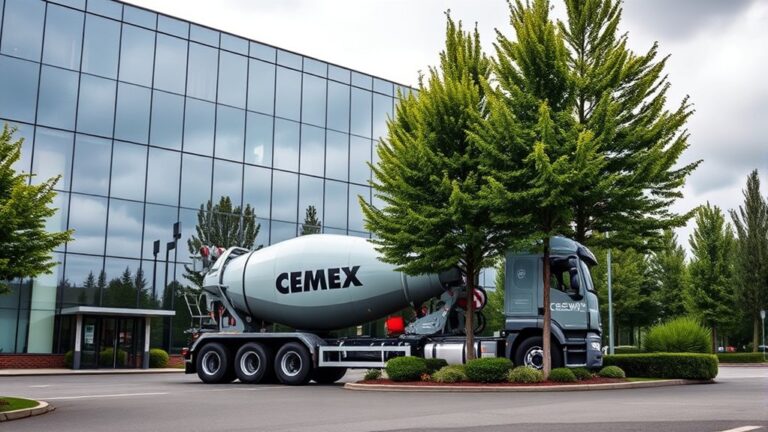
How Much Is Cemex Worth – The Real Numbers
You can value Cemex at around $13.75 billion in market cap and $18.78 billion in enterprise value, reflecting solid revenues of $17 billion and improving profitability with a 19.8% EBITDA margin. The company’s disciplined debt management and a 43% expected EPS growth by 2026 add to its appeal.
Despite some industry risks, recent stock gains and positive earnings show strong investor confidence. Exploring their financial outlook and strategic moves reveals deeper insights into Cemex’s true worth.
Cemex’s Current Market Valuation at a Glance

Although Cemex’s current market capitalization stands at approximately $13.75 billion, matching its enterprise value, the company trades at a P/E ratio of 27.2. This reflects how investors value the company relative to its earnings.
The parity between market capitalization and enterprise value suggests a balanced capital structure, with limited net debt impact on valuation.
You’ll notice the stock price has surged 73% from its 52-week low, which signals improved market sentiment.
Analysts have set an average price target of $14.47 for Cemex’s ADR, above the current $13.10 price. This indicates there’s potential upside in the stock.
Understanding these valuation metrics helps you gauge how the market prices Cemex’s equity and overall business. It provides useful context for investment decisions based on the current market capitalization and enterprise value figures.
Cemex’s Latest Financial Metrics Explained
Since Cemex reported a record first-quarter EBITDA of $794 million, marking a 34% year-over-year increase and expanding its EBITDA margin to 19.8%, you can see the company’s financial performance is strengthening.
Its reported net income reached approximately $210 million, with adjusted net income nearly doubling due to internal efficiencies and disciplined pricing.
Revenues for the trailing twelve months totaled $17.04 billion, supporting a profit margin of 2.8% and a P/E ratio of 27.2.
On the balance sheet, Cemex carries $7.5 billion in total debt against $687 million in cash and equivalents, resulting in a net debt position of $6.8 billion.
The company’s stock has surged 73% from its 52-week low, reflecting strong earnings and positive market sentiment.
What Drives Cemex’s Earnings, Margins, and Valuation

While Cemex faces challenges like fluctuating cement volumes and weather disruptions, its earnings and margins grow chiefly through internal efficiency gains and disciplined pricing. You’ll see margin expansion primarily driven by cost-saving initiatives such as the Project Cutting Edge program, which boosts profitability without relying on volume increases.
Cemex’s focus on high-return markets, including Mexico, the US, and Latin America, strengthens its valuation by targeting regions with better growth potential.
Key financial metrics, including an EBITDA margin of 19.8% and a P/E ratio of 27.2, reflect this disciplined approach.
Although cement volumes vary, the company’s strategic portfolio restructuring helps maintain a solid financial position.
How Debt and Cash Flow Affect Cemex’s Worth
When you examine Cemex’s financial health, its recent reduction in net debt by over US$250 million to about US$4.74 billion signals effective debt management.
The company’s debt-to-total-capitalization ratio improved from 53.0% to 49.6%, reflecting a stronger capital structure. You’ll also note that the debt-to-operating cash flow ratio dropped from 4.39x to 3.87x during 1997, showing enhanced leverage control.
Debt ratios improved, signaling stronger capital structure and better leverage control in 1997.
An increase in EBITD cash flow by 15% in Q4 directly supported this debt reduction.
Furthermore, Cemex’s interest coverage ratio of 2.42x indicates it comfortably meets interest obligations from earnings.
How Cemex’s Strategy Is Driving Its Value

You’ll notice that Cemex’s value growth mainly comes from expanding margins, which they achieve through internal efficiency and sticking to disciplined pricing—not just by selling more volume.
The company really focuses on high-return markets like Mexico, the US, and Latin America, which helps sharpen its competitive edge.
At the same time, they’re smart about where they put their capital, including investments in the green transition, to support sustainable, long-term value creation.
Margin Expansion Drivers
How has Cemex managed to expand its margins despite mixed cement volumes? The key lies in its relentless focus on efficiency and disciplined pricing. Rather than relying on volume growth, Cemex has driven margin expansion through internal cost improvements and strict price controls.
The Project Cutting Edge program accelerated cost reductions, markedly boosting margins. These efficiency gains helped Cemex increase its EBITDA margin by 3.3 percentage points to 19.8%.
Moreover, strategic portfolio restructuring toward high-return markets like Mexico, the US, and Latin America enhances overall profitability.
Strategic Market Focus
Although Cemex faces fluctuating cement volumes, its strategic focus on high-return markets like Mexico, the US, and Latin America has consistently driven financial performance and valuation.
By restructuring its portfolio, Cemex prioritizes investments in markets with strong structural demand such as Mexican industrial building and US infrastructure projects.
This strategic market focus lets you benefit from targeted capital allocation and cost efficiencies that expand margins and boost profitability.
Cemex’s disciplined approach, aiming to make operations “boring,” builds investor confidence and supports stable growth.
Plus, consolidating its presence in nearshoring and infrastructure sectors strengthens its long-term value proposition.
Capital Allocation Priorities
Where does Cemex put its money to maximize value? Cemex focuses its capital allocation on high-return regions like Mexico, the US, and Latin America to fuel growth and drive margin expansion.
The company reinstated a modest dividend, signaling a balanced approach between rewarding shareholders and funding strategic initiatives.
Management targets disciplined investments, particularly in green-transition projects such as decarbonization efforts around Alcanar. Cemex’s cautious stance favors stability and cost efficiencies over aggressive expansion.
This approach supports sustainable long-term value creation.
- Prioritizing high-return markets to boost profitability
- Maintaining a disciplined capital allocation framework
- Reinstating dividends to enhance shareholder value
- Investing in green-transition and decarbonization projects
- Driving margin expansion through cost efficiency and stability
How Industry Trends Influence Cemex’s Long-Term Value
As infrastructure development and nearshoring gain momentum in Mexico and the US, Cemex’s long-term demand outlook strengthens considerably.
Industry trends favor sustainable infrastructure projects over cyclical sectors, which enhances Cemex’s growth prospects. This is reflected in its recent record EBITDA and margin expansion.
You’ll find that ongoing investments in public works and industrial buildings help maintain Cemex’s market share and profitability.
However, rising energy costs and environmental regulations could affect operational expenses and push Cemex toward capital-intensive green shift initiatives.
Embracing decarbonization efforts may position Cemex as an early mover, offering competitive advantages that boost its long-term value.
Risks That Could Impact Cemex’s Valuation Outlook
While Cemex benefits from strong industry trends, several risks could pressure its valuation. You should consider how persistent energy costs and rising fuel prices may squeeze profit margins, given energy’s large role in cement production.
Cemex faces margin pressure from persistent energy costs amid strong industry trends.
A slowdown in North American construction could reduce volumes, hurting revenue growth.
Mexico’s public-works pause threatens demand in key markets. Also, long-term decarbonization efforts require heavy capital expenditures, which could strain finances if not managed well.
Finally, industry cyclical downturns during this late-stage cement cycle might weaken pricing power and profitability.
Key valuation risks include:
- Escalating energy and fuel expenses
- North American construction slowdown
- Infrastructure delays in Mexico
- Capital demands for green shift
- Industry cyclical downturns reducing margins
How Market Sentiment Shapes Cemex’s Stock Price
Understanding the risks that could impact Cemex’s valuation helps frame how market sentiment influences its stock price.
After strong Q1 earnings, Cemex’s stock price rose 5% to $6.21, reflecting investor optimism despite mixed results.
This positive market sentiment pushed the stock up 73% from its 52-week low.
On May 7, 2025, the NYSE ADR peaked at $6.49, signaling short-term momentum.
Intraday activity showed a 3.8% increase, indicating shifting confidence among investors.
Even with RBC’s cautious price target raise to $5.25 and an underperform rating, the market sentiment remained upbeat.
You see, these data points illustrate how investor perceptions and reactions to financial performance actively shape Cemex’s stock price movements over time.
What Analysts Say About Cemex’s Future Valuation
You’ll notice that analyst price targets for Cemex tend to cluster around Mex$20.17. This shows a sense of cautious optimism, even though the targets range from Mex$17.03 to Mex$24.03.
When you look at valuation multiples and earnings forecasts, they suggest a solid 43% increase in EPS by 2026. This growth is supported by an expected 5.5% annual revenue increase, which is above the industry average.
Market sentiment also seems to reflect confidence in Cemex’s long-term value. This positive outlook holds up despite some recent earnings misses, indicating that investors are looking beyond short-term fluctuations.
Analyst Price Targets
Although analysts show varied expectations for Cemex’s future valuation, the average price target stands at approximately $14.47, with individual estimates ranging from $17.03 to $24.03. This spectrum of analyst price targets reflects differing views on Cemex’s growth trajectory.
The consensus price target holds steady around Mex$20.17 despite recent stock gains, signaling cautious optimism.
Analysts project 2026 revenue of $17 billion and an EPS of $0.09, supporting a positive long-term outlook.
Most analysts recommend buying, with 10 out of 15 endorsing the stock. However, the wide range of forecasts underscores the uncertainty you should consider before investing.
- Diverse analyst price targets indicate market uncertainty
- Majority view Cemex as a buy, signaling confidence
- Consensus price target steady amid recent gains
- Projected growth with $17 billion revenue by 2026
- Long-term prospects remain promising despite variability
Valuation Multiples Analysis
While analysts’ price targets for Cemex vary widely, from Mex$17.03 to Mex$24.03, the consensus holds steady at Mex$20.17. This signals cautious optimism about its future valuation.
Looking at Cemex’s valuation multiples gives us more insight. Its P/E ratio is 27.2, which is pretty high compared to industry peers. That suggests the market expects above-average earnings growth.
On the other hand, the price-to-sales ratio of 0.52 shows a more moderate valuation based on revenue.
This contrast in multiples reflects mixed views on Cemex’s earnings stability and growth potential.
The wide range of price targets and valuation multiples highlights uncertainty around Cemex’s future performance.
Market Sentiment Trends
Examining analyst opinions offers a clearer picture of Cemex’s market sentiment and future valuation prospects. You’ll find that 10 out of 15 analysts currently rate Cemex as a buy, with a consensus target price of $14.47 versus the $13.10 stock price.
Analyst ratings reflect cautious optimism despite recent earnings misses.
Price targets vary widely, from $17.03 to $24.03, indicating differing views on Cemex’s potential. The steady consensus target near $20.17 signals stable valuation expectations with upside potential.
Recent stock gains of about 73% from its 52-week low have also bolstered market sentiment, showing investor confidence.
- Majority analyst buy ratings inspire confidence
- Wide price target range highlights valuation uncertainty
- Stable consensus target suggests steady long-term outlook
- Recent stock gains improve investor sentiment
- Earnings misses haven’t shaken analyst ratings
Key Indicators Investors Should Watch for Cemex
Because Cemex’s stock has surged 73% from its 52-week low to around $13.10, you should focus on key financial indicators like its enterprise value of $18.78 billion and market cap of $13.75 billion to gauge its valuation.
Cemex’s stock jumped 73% to $13.10; key metrics like enterprise value and market cap reveal its valuation.
The market cap reflects Cemex’s size and investor confidence, while its enterprise value accounts for debt, providing a fuller picture.
Assess the company’s financial health by examining its $7.5 billion total debt and $6.8 billion net debt, which highlight leverage levels.
Profitability ratios like a 27.2 P/E and 2.8% profit margin reveal valuation and earnings efficiency.
Also, note the EBITDA margin increase to 19.8%, signaling operational improvements.
Monitoring these metrics helps you make informed investment decisions on Cemex’s growth and risk profile.
Frequently asked questions
How Does Cemex’s Dividend Policy Affect Its Stock Attractiveness?
Cemex’s dividend policy boosts its stock attractiveness by offering a 1.34% yield, signaling stable cash flow and financial health. You’ll find this modest but consistent income appealing if you seek regular returns amid market fluctuations.
The dividend reinstatement shows management’s confidence and commitment to balancing growth with shareholder value. This makes Cemex’s shares more appealing for income-focused and long-term investors.
If you prioritize stability in the cyclical construction sector, Cemex’s approach could be a good fit for your portfolio.
What Is Cemex’s Environmental Impact and Sustainability Approach?
You’re hitting the nail on the head by asking about Cemex’s environmental impact. Cemex actively reduces its carbon footprint through green projects like the Alcanar plant upgrades. It’s committed to cutting CO2 emissions and boosting energy efficiency, aligning with strict industry regulations.
While decarbonization demands heavy investment, Cemex positions itself as a sustainable cement leader. It balances environmental responsibility with long-term operational improvements and compliance.
How Does Cemex’s Management Team Influence Its Valuation?
You’ll find Cemex’s management team directly boosts its valuation through cost efficiency, strategic capital allocation, and geographic diversification. Their disciplined focus on operational stability and high-return markets like Mexico and the US builds investor confidence.
Initiatives like Project Cutting Edge and debt reduction improve financial metrics. While cautious guidance helps mitigate risks.
Recovering its investment-grade rating and pursuing green-transition payments further enhance Cemex’s market appeal and valuation.
What Role Do Cemex’s International Operations Play in Its Growth?
You’ll see Cemex’s international operations play a vital role in its growth, driving about 5% sales increase via Samper’s consolidation alone.
They diversify cash flow, balancing regional downturns and boosting stability, with markets like Spain and Colombia contributing considerably.
This global spread lets Cemex tap into infrastructure projects and nearshoring trends, fueling consistent growth.
How Do Currency Fluctuations Impact Cemex’s Financial Performance?
Currency fluctuations impact Cemex’s financial performance by changing the dollar value of its revenues and expenses. When the US dollar strengthens, you’ll notice lower reported earnings from operations in weaker local currencies.
On the flip side, weaker local currencies can actually inflate dollar revenues.
Exchange rate volatility also affects your debt servicing costs, especially if you have foreign-denominated debt. These ups and downs cause variability in profitability and cash flows.
Final Thought
Assessing Cemex’s valuation is like reading shifting tides: earnings, debt, and strategy form the currents beneath its surface. You’ll want to watch key financial metrics and analyst insights as your compass, guiding you through market sentiment’s waves. While risks loom like storm clouds, strong cash flow and focused strategy act as anchors.
Staying data-focused helps you see beyond the horizon. It lets you make informed decisions as Cemex’s worth evolves in a dynamic landscape. Keep an eye on the numbers and the bigger picture — that’s how you’ll navigate this ever-changing market.
More Cemex Guides
Need a Local Concrete Supplier?Tri County Concrete is a family-owned ready mix supplier serving Greater Cleveland for over 50 years. Request a quote or call 440-582-1100.