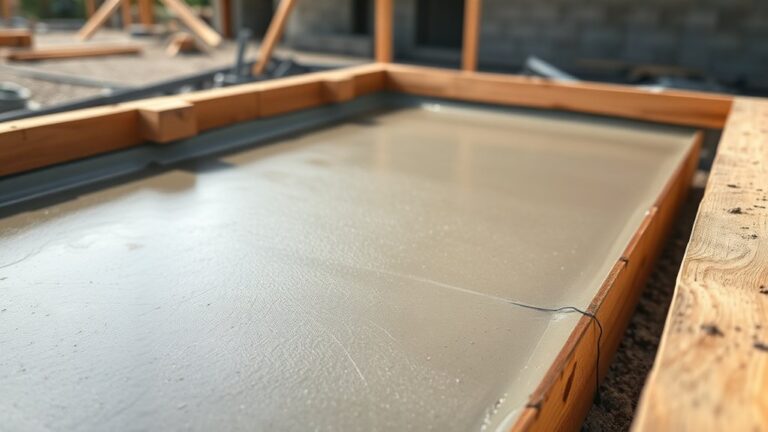
How Long Does Concrete Take To Dry – Full Breakdown
Concrete hardens within 24 to 48 hours but needs around 28 days of controlled curing to reach full strength and ideal moisture levels. Drying time depends heavily on slab thickness, roughly 28 days per inch. Environmental factors like temperature, humidity, and airflow also play a big role.
Improper moisture management or drying too soon can cause cracking and weaken the structure. Whether indoors or outdoors, precise moisture testing is key to making sure the flooring installation is safe.
Understanding these variables will help you get the best drying results and ensure your concrete lasts a long time.
Concrete Drying vs. Curing: What’s the Difference?

Although drying and curing both involve water in concrete, they represent distinct processes with different impacts on the material’s performance. Curing is the chemical process of hydration, where moisture content must be maintained to allow cement particles to react fully, promoting concrete strength. This curing process typically lasts about 28 days and guarantees full curing is achieved.
Curing chemically hydrates cement by maintaining moisture, ensuring full strength development over approximately 28 days.
In contrast, drying refers to the evaporation of excess water from the concrete surface after curing is complete. While concrete hardens within 24-48 hours, it gains maximum strength through proper curing.
Improper drying too soon can reduce moisture retention, causing surface cracks and compromising durability.
Understanding these differences is critical. Curing develops strength through hydration, whereas drying involves moisture loss that can affect the concrete’s long-term integrity.
How Thickness Affects Concrete Drying Time
You need to consider slab thickness because it directly affects how long the concrete takes to dry. Thicker slabs slow down the movement of moisture from the inside to the surface.
So, as the slab gets thicker, it takes more time—usually more time per inch—for the concrete to reach acceptable moisture levels.
That’s why it’s important to schedule curing and drying phases carefully, based on a good estimate of this relationship.
Thickness Impact On Drying
When concrete slabs increase in thickness, their drying time extends proportionally due to slower moisture migration from the interior to the surface. As concrete thickness grows, internal moisture requires more time to travel through the slab depth before surface drying can effectively occur.
This reduced evaporation rate directly impacts the curing process, prolonging the period before ideal concrete strength develops. For instance, doubling slab thickness roughly doubles drying time under similar conditions, reflecting a linear relationship between slab depth and moisture evaporation duration.
You’ll notice that while surface drying may appear complete, significant internal moisture remains trapped in thicker slabs, delaying full cure. Understanding this interplay helps you anticipate longer drying times for thicker pours, ensuring proper timing before load application or finishing work.
Slab Depth And Cure
Since slab thickness directly influences moisture retention, understanding how depth affects drying time is essential for accurate curing schedules.
As slab depth increases, internal moisture remains trapped longer, extending the drying period and curing time considerably.
For example, a 4-inch slab typically requires about 20–21 days, while a 6-inch slab demands approximately 28 days to achieve ideal concrete strength.
Beyond 4 inches, drying time generally increases by one day per additional inch of thickness.
Slabs exceeding 12 inches can take several months to dry fully, depending on environmental conditions and mix design.
Managing moisture content during the curing process is critical to prevent incomplete curing, which compromises concrete strength.
Drying Time Per Inch
How does slab thickness specifically impact drying time? In concrete slabs, drying time per inch is approximately 28 days under ideal conditions. This drying duration correlates directly with thickness, as thicker slabs contain more moisture content requiring longer moisture evaporation.
For example, a 4-inch slab demands around 112 days to fully dry, assuming standard curing period and environmental factors. The drying process slows in thicker slabs because moisture migrates from the interior to the surface at a reduced rate.
Each additional inch of thickness extends the drying duration by roughly 28 days, reflecting the increased volume of water needing evaporation.
Understanding this linear relationship helps you accurately predict drying time and plan accordingly when working with various slab thicknesses. It’s a handy rule of thumb that can save you from surprises during your project timeline.
Just remember, the thicker the slab, the longer you’ll wait.
What Affects Concrete Drying Time? Key Environmental and Mix Factors
Although concrete drying time depends on multiple variables, understanding the key environmental and mix factors is essential for accurate project planning. Slab thickness profoundly affects drying time since thicker slabs retain moisture longer, slowing evaporation.
Also, a higher water-to-cement ratio increases residual moisture, which extends the curing period. Environmental conditions like humidity and temperature critically influence moisture evaporation rates. For example, elevated humidity above 65% RH and lower temperatures tend to hinder drying.
On the other hand, ideal temperature and good airflow can speed things up. Managing these variables on-site lets you control drying time more effectively.
How Temperature and Humidity Influence Concrete Drying

You’ll notice that temperature has a direct impact on how quickly hydration happens. When it gets below 40°F, the chemical reactions can slow down a lot or even stop altogether.
On the other hand, humidity is super important because it controls the moisture gradient needed for evaporation. If the humidity is high, it can really slow down the curing process.
Temperature Effects On Hydration
Because temperature directly influences the rate of chemical reactions in concrete, it plays a critical role in hydration and drying times. Higher temperatures accelerate hydration, reducing drying time by 25-50%. On the other hand, low temperatures slow chemical reactions, extending curing periods by weeks.
Thermal effects from extreme temperature fluctuations induce internal stresses. This can risk cracks and weaken durability. So, suitable ambient conditions between 50°F and 90°F are necessary for consistent hydration and to avoid rapid moisture loss.
Although humidity also affects drying, its impact will be detailed later.
| Temperature Range | Effect on Hydration |
|---|---|
| 50°F – 90°F | Suitable curing, steady hydration |
| Above 90°F | Faster drying, risk of rapid moisture loss |
| Below 50°F | Slowed hydration, prolonged drying time |
Managing temperature precisely ensures structural integrity and ideal drying time.
Humidity Impact On Curing
How does humidity influence the curing process of concrete? Humidity directly affects drying time by controlling moisture evaporation from the surface. High relative humidity (above 65%) slows moisture evaporation, which means the curing process takes longer.
Conversely, lower humidity speeds up surface drying but can cause premature moisture loss. This early drying might stop the concrete from fully hydrating. Temperature also plays a role here: warmer conditions increase evaporation rates, while colder ones slow them down.
You really need to think about these environmental factors to find the right balance between keeping moisture in and letting it evaporate. High humidity reduces evaporation rates, which prolongs drying time.
On the other hand, low humidity speeds up surface drying but can lead to shrinkage. Temperature affects both evaporation and how fast hydration happens. When humidity and temperature fluctuate, curing can become inconsistent.
The sweet spot for curing is usually around 30-60% relative humidity and temperatures between 50-90°F.
Understanding how humidity works helps you control the curing process and get stronger concrete in the end.
Managing Environmental Conditions
Although temperature and humidity might seem like simple environmental factors, they play a critical role in controlling the drying rate of concrete by managing moisture evaporation and hydration kinetics.
When the temperature rises above 25°C, moisture evaporation speeds up, which makes drying faster. On the other hand, lower temperatures slow this process down quite a bit.
High humidity levels, especially above 60%, reduce the vapor pressure gradient and that ends up prolonging the drying time. You should also keep an eye on air movement because increased airflow helps remove saturated air from the surface, which improves drying efficiency.
It’s best to maintain ideal ambient conditions—usually around 18-22°C and 50-60% relative humidity—to keep drying rates consistent.
When you’re dealing with extreme environmental conditions like freezing temperatures or excessive heat, you need to take protective measures to prevent damage and control the drying process.
Managing these environmental factors carefully lets you maximize concrete curing and avoid delays or structural problems. It really pays off to keep everything balanced.
Why Moisture Retention Is Crucial During Concrete Drying and Curing

When you maintain proper moisture retention during concrete curing, you enable the hydration process to proceed uninterrupted. This is critical for developing the material’s strength.
During the curing process, sustaining adequate moisture levels prevents premature drying and ensures continuous chemical reactions within the mix.
Maintaining moisture during curing stops early drying and supports ongoing chemical reactions in the concrete mix.
Using curing compounds or coverings helps control moisture loss. This avoids excess moisture or rapid drying that can compromise concrete strength.
Proper curing is different from just drying because it preserves the internal moisture essential for durability and resistance against environmental stresses.
Visualize moisture retention’s impact:
- A sealed surface minimizing evaporation
- Uniform moisture distribution within the slab
- Controlled application of curing compounds
- Prevention of surface cracks from early drying
- Strength gain progression over 28 days
This controlled environment optimizes drying and curing. It secures long-term structural integrity.
When Is Concrete Dry Enough for Flooring? Moisture Testing Explained
Since flooring materials react differently to moisture, you can’t rely on surface dryness alone to determine if concrete is ready for installation. Proper moisture testing is essential to assess the internal moisture levels of the concrete slab accurately.
Typically, after a minimum 28-day curing process, moisture levels should be at or below 75% RH. This is verified through in-situ RH measurements or moisture content (MC) probes.
Surface moisture can be misleading, so these tests ensure the slab meets flooring installation requirements.
Manufacturers often specify maximum moisture content limits, commonly 4% MC or 85% RH, that must be achieved to prevent adhesive failure or finish damage.
Environmental factors influence drying time, making objective moisture testing the most reliable method to confirm when your concrete slab is truly dry enough for flooring installation.
How to Speed Up Concrete Drying Safely
To speed up concrete drying safely, you need to control environmental conditions and use appropriate equipment that enhances moisture removal without compromising concrete integrity. Optimizing airflow, temperature control, and applying curing compounds are key safe drying methods that reduce drying time effectively. Use moisture testing to monitor progress and avoid premature finishing.
Implement these techniques:
- Deploy dehumidifiers and air movers to enhance moisture removal and airflow.
- Maintain ambient temperatures between 20-25°C (68-77°F) and humidity below 60%.
- Apply curing compounds or breathable sealers that permit controlled evaporation.
- Use curing blankets or plastic sheeting to balance moisture retention and evaporation.
- Avoid rapid drying or excessive heat to prevent surface cracking and structural compromise.
Following these steps ensures you speed up concrete drying while preserving long-term strength. It’s all about finding the right balance so your concrete sets well and stays strong.
Protecting Concrete From Weather to Ensure Proper Drying
You need to shield concrete from rain to prevent surface washout during the initial set. This step is crucial to guarantee the concrete’s structural integrity.
Also, managing temperature extremes with insulation or shading really helps maintain ideal curing conditions. It prevents the concrete from losing moisture too quickly.
Controlling these factors is essential because it ensures the concrete dries evenly and reaches its maximum strength.
Shielding Concrete From Rain
How do you prevent rain from compromising concrete during its critical curing phase? Protecting concrete from rain during curing is essential to avoid surface weakening and cement washout in the initial curing phase. To effectively shield your concrete, you must cover fresh concrete immediately after pouring to minimize water infiltration and maintain proper moisture balance.
Consider these weather protection methods: use plastic sheeting or tarps to cover fresh concrete. You can also install temporary shelters to shield it from heavy rain.
Another good idea is to employ windbreaks to reduce environmental exposure.
Make sure to secure covers tightly to prevent water pooling. And don’t forget to monitor weather forecasts so you can time your protection measures right.
These strategies ensure consistent curing conditions, preserving strength and durability while preventing surface damage and premature drying. Following them helps your concrete stay strong and last longer.
Managing Temperature Extremes
Although concrete curing depends heavily on moisture control, managing temperature extremes plays an equally critical role in ensuring proper drying and strength development. You need to apply temperature control strategies tailored to the curing conditions.
In cold weather, insulating blankets and heated enclosures keep concrete within the ideal 50-90°F range. This helps prevent freezing and hydration loss. During hot weather, shading and misting reduce evaporation and surface cracking.
Monitoring ambient temperature and humidity lets you adjust interventions promptly.
| Weather Condition | Protection Method | Effect on Concrete |
|---|---|---|
| Cold Weather | Insulating blankets | Maintains hydration |
| Cold Weather | Heated enclosures | Prevents freezing damage |
| Hot Weather | Shading & misting | Reduces evaporation |
| Hot Weather | Plastic sheeting | Minimizes moisture loss |
| All Conditions | Sensors monitoring | *Best* curing control |
Preventing Rapid Moisture Loss
Why does rapid moisture loss pose such a significant risk to freshly poured concrete? Excessive moisture loss interrupts proper hydration, which leads to incomplete curing and surface cracking. To prevent this, you need to control evaporation rates and keep the moisture in through effective curing methods.
Using curing blankets or plastic sheeting helps minimize moisture loss by shielding the slab from wind and sun. This also supports consistent temperature effects that are essential for strength development.
In hot, dry conditions, continuous moist curing with water misting or wet burlap is really important.
When it’s cold and windy, insulating blankets or enclosures help protect against moisture loss. These methods make sure the concrete cures properly no matter the weather.
Here are some protective strategies to consider:
- Cover slabs with plastic sheeting or curing blankets
- Use shading to block direct sunlight
- Employ windbreaks to reduce evaporation rates
- Apply continuous moisture with wet burlap or misting
- Insulate with blankets or temporary enclosures to stabilize temperature effects
How Concrete Drying Time Differs Indoors vs. Outdoors
Because indoor environments limit airflow and regulate climate, concrete drying times inside generally take longer. They also require stricter moisture testing before you can proceed with flooring installation. Indoor concrete drying involves controlled environmental factors like consistent temperature and humidity management to optimize curing.
But this control actually slows down the evaporation rate.
On the other hand, outdoor concrete drying benefits from natural ventilation, sunlight, and wind, which speeds up moisture loss. However, the drying time can vary a lot because of unpredictable weather conditions like rain or changes in humidity. You have to keep these factors in mind carefully.
Indoor settings offer more predictability but need active moisture testing to avoid installing flooring too soon. Outdoor drying is faster on average but less controlled, so temperature swings and humidity changes can delay the process.
Knowing these differences helps you plan your project better and ensures quality results.
Mistakes That Slow Concrete Drying (And How to Avoid Them)
When you apply too much water or use the wrong curing methods, you end up increasing the concrete’s moisture content. This can really stretch out the drying time.
Moisture gets trapped when curing blankets or plastic sheets are used incorrectly, which slows down evaporation and delays the surface from drying.
High humidity in the air also makes evaporation slower, adding to the delay. Using the wrong curing compounds that seal in moisture without letting vapor escape just makes things worse.
Plus, putting finishes on the concrete before it’s dry enough traps leftover moisture, which can cause surface problems.
Here are some mistakes to watch out for:
- Adding too much water during mixing or finishing
- Using curing blankets that trap moisture without letting air circulate
- Overlooking how high humidity slows evaporation
- Applying curing compounds that block vapor from escaping
- Installing heavy overlays before the surface moisture is at the right level
Keeping moisture under control and using the right curing methods are key to speeding up drying time.
Frequently asked questions
Can Additives Reduce Concrete Drying Time Without Compromising Strength?
Yes, you can use additives like chemical accelerators to reduce concrete drying time without compromising strength, provided you apply them correctly. These additives speed up hydration and curing, cutting drying time by 20-50%.
However, you must carefully balance dosage because overuse can cause shrinkage and cracking, which weakens the concrete.
How Does Concrete Drying Affect Its Long-Term Durability?
You should know that improperly dried concrete can lose up to 30% of its intended strength, which has a big impact on durability. When you let concrete dry thoroughly, it cuts down on internal moisture that leads to cracking and freeze-thaw damage.
This process also makes the bond between the concrete and surface finishes stronger. That means better resistance to wear and chemical attacks.
What Are the Signs of Improperly Dried Concrete?
You’ll notice improperly dried concrete through surface dusting, cracking, or a soft, crumbly texture. Persistent white salt deposits, called efflorescence, signal excess moisture.
If the surface stays glossy or appears wet beyond the expected drying time, moisture hasn’t fully evaporated.
High relative humidity or moisture content readings confirm this. Ignoring these signs risks adhesion failures, mold issues, and faster surface deterioration.
This can really compromise your concrete’s integrity and lifespan.
Is Drying Time Different for Colored or Stained Concrete?
No, drying time for colored or stained concrete generally matches standard concrete. It takes about 28 days to fully cure.
You need to wait until moisture levels drop below specific thresholds, typically under 75% relative humidity or 4% moisture content, before applying stains.
Rushing this process risks uneven color and surface defects.
Proper curing guarantees the stain bonds effectively.
This helps prevent long-term issues like peeling or blotching, so patience is essential.
How Does Concrete Drying Impact Subsequent Painting or Sealing Processes?
Concrete drying directly impacts your painting or sealing success. If moisture levels exceed 75% RH or 4% MC, your coatings won’t adhere properly, causing bubbling, peeling, or mold.
You need to test moisture at least 28 days after pouring to confirm readiness.
Proper drying guarantees a durable, crack-free finish.
Using vapor barriers or sealers helps manage residual moisture, improving the longevity and appearance of your decorative coatings. It’s a simple step that makes a big difference in how your surface holds up over time.
Final Thought
Understanding that concrete typically needs at least 28 days to cure properly highlights why rushing the drying process can compromise strength and durability. You should remember that factors like thickness, temperature, and humidity considerably affect drying times.
By controlling these variables and avoiding common mistakes, you’ll guarantee your concrete reaches ideal performance. Keep in mind, even a 10% increase in moisture retention can drastically improve curing quality. Precision matters in every step of the process.
More Pouring & Curing Guides
Need Concrete in Greater Cleveland?Tri County Concrete delivers ready mix from plants in North Royalton and Twinsburg, Ohio. Request a quote or call 440-582-1100.