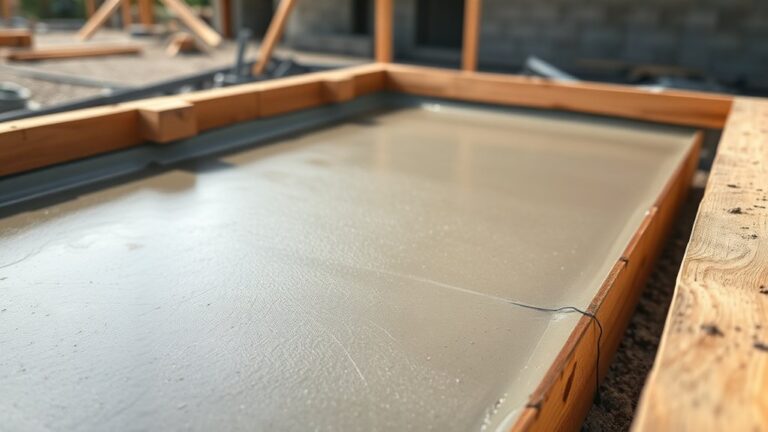
How Long Does Concrete Take To Cure – The Real Numbers
Concrete typically takes about 28 days to fully cure and reach its designed strength under ideal conditions. You’ll see roughly 70% strength by 7 days and around 90% by 14 days, but exact times vary with slab thickness, weather, and mix. Proper moisture and temperature control are vital throughout curing to prevent cracking and guarantee durability.
Understanding these factors helps you optimize timelines and project outcomes. It’s important to know how conditions and best practices impact curing success. This way, you can manage your project more effectively and avoid common pitfalls.
What Is Concrete Curing and Why Does It Matter?
What exactly is concrete curing, and why should you prioritize it in your construction projects? Curing is the critical chemical process called hydration, where water reacts with cement to develop the concrete’s strength and durability.
You must maintain adequate moisture and temperature to support ongoing hydration, ensuring the concrete attains its full designed strength, typically over a 28-day period.
Proper curing prevents surface cracking, shrinkage, and long-term deterioration, preserving structural integrity. It’s important to understand that curing is a continuous process influencing long-term performance, not merely initial hardening.
Proper curing prevents damage and ensures concrete’s strength and durability for lasting structural integrity.
By prioritizing curing, you guarantee that the concrete’s strength and durability meet design specifications.
Ultimately, this careful attention extends the lifespan and safety of your construction projects. So, don’t overlook curing—it’s key to building strong, lasting structures.
How Long Does Concrete Take to Reach Strength Milestones?
You’ll notice that concrete reaches about 70% of its design strength within the first 7 days.
Then, it usually hits full strength around the 28-day mark.
Early strength tests can give you a pretty good idea of how the concrete will perform in the end.
But keep in mind, things like slab thickness and how well the concrete is cured can change how quickly it gains strength.
Knowing these milestones helps you plan your construction schedule and ensures the structure will be solid.
Early Strength Development
Although concrete continues to gain strength over time, it typically reaches about 70% of its full strength within the first 7 days of curing. This early strength development is critical for evaluating whether the concrete can support partial loads, enabling construction to proceed safely and on schedule.
The curing time directly influences the rate of strength gain, which varies based on mix design, ambient temperature, and curing methods employed.
By 14 days, concrete generally attains approximately 90% of its designed strength, marking a significant milestone in strength development.
Understanding these early strength parameters allows you to make informed decisions regarding formwork removal, load application, and overall project progression. This helps ensure structural integrity and keeps the project on track with safety standards throughout the construction process.
Standard Strength Timeline
When you monitor concrete curing, you’ll find that it reaches key strength milestones at specific intervals. The 28-day mark serves as the industry standard for full strength development.
Typically, concrete attains about 70% of its full strength by 7 days. By the 28-day milestone, it achieves roughly 90-100% of its designed strength, which is considered full strength.
Intermediate measurements at 3, 7, and 14 days provide useful data to predict the ultimate strength at 28 days.
This standard strength timeline enables precise scheduling and quality control in construction projects.
It ensures the concrete meets structural specifications. Understanding this progression is essential for accurate assessment and decision-making during the curing process.
Factors Affecting Strength
Understanding the standard strength timeline provides a foundation for evaluating concrete curing, but various factors influence how quickly concrete reaches these milestones. Curing time directly affects hydration, the chemical process responsible for strength development. Adequate moisture content is critical; insufficient moisture slows hydration, delaying strength gain.
Temperature also plays a key role, as lower temperatures reduce hydration rates, extending curing time. Moreover, the composition and thickness of the concrete element impact strength milestones. Larger or thicker slabs retain moisture longer but hydrate more slowly internally, which can delay reaching full strength.
Early strength measurements at 3 or 7 days usually predict 28-day strength accurately, but deviations in curing conditions can alter this. So, controlling moisture content and maintaining ideal curing conditions are essential to ensure concrete achieves its designated strength efficiently.
What Factors Speed Up or Slow Down Concrete Curing?
Because environmental conditions and mix composition critically influence the hydration process, several factors can either speed up or slow down concrete curing. You need to consider how curing time changes with these elements to ensure the concrete reaches its best strength.
First, weather conditions play a big role. High temperatures speed up curing by increasing evaporation rates, but this can cause surface cracking if moisture isn’t kept in. On the other hand, cold weather slows hydration. When it drops below 40°F, curing can stop altogether, and freeze damage becomes a risk.
Next, moisture retention is super important. If the humidity is high, curing happens faster because less moisture evaporates. But in dry conditions, the concrete loses moisture, which makes curing take longer.
Lastly, the mix composition and slab size matter too. Using accelerants can cut down curing time, but they might affect how durable the concrete ends up. Bigger slabs need more time to cure properly since they’ve to manage internal heat and keep moisture inside.
Knowing these factors helps you control curing time better so your concrete turns out strong and long-lasting.
How Does Weather Affect Concrete Curing Time?
Weather conditions directly impact the rate and quality of concrete curing by influencing moisture evaporation and hydration reactions. Elevated temperatures speed up moisture loss, which can increase the risk of surface cracking and incomplete internal hydration. This means curing time gets shorter, but the concrete’s strength might be compromised.
On the other hand, low temperatures slow down the chemical hydration process. This extends curing time and can make it harder for the concrete to reach full strength. If it gets cold enough to freeze, curing can stop entirely, and internal cracking might happen because water expands inside the mix.
Heavy rain early on can wash away the cement paste, weakening the surface and creating the need for protective measures. So, to ensure the best curing time and concrete strength, it’s important to control temperature and moisture.
Using methods like sheltering or insulating can help, no matter what the weather’s doing outside.
When Is Concrete Cured Enough to Walk, Drive, or Build On?
While concrete may look solid soon after pouring, it actually needs specific curing times before it can safely handle different kinds of loads. It’s important to understand these curing periods so you don’t put stress on the material too early.
Generally, light foot traffic is okay after 24 to 48 hours. By then, the concrete has gained some initial hardness but hasn’t reached full strength yet.
Passenger vehicles can usually drive on it after about 7 days. At this point, the concrete is roughly 70% cured and strong enough to support cars without getting damaged.
For heavy equipment or structural loads, you’ll want to wait the full 28 days. This lets the concrete reach almost 100% strength, which helps make it durable and prevents cracking.
If you build or drive on concrete before these times, you risk settlement and long-term damage. So, it’s best to stick to these timeframes for safety’s sake.
Best Practices for Proper Concrete Curing
To make sure your concrete cures properly, it’s important to keep it moist. You can do this by misting it regularly, covering it with wet burlap, or using plastic sheeting. Try to keep this going for at least seven days.
Also, be sure to protect the concrete from extreme weather. Too much heat, cold, or heavy rain can interrupt the curing process and cause problems.
Moisture Retention Techniques
Although concrete curing is a chemical process, you need to actively keep consistent moisture on the surface for at least seven days. This helps guarantee the ideal strength development. Moisture retention plays a big role in hydration and the success of the curing period.
Here are some effective ways to keep that moisture in:
- Right after finishing, apply wet burlap, plastic sheeting, or curing compounds to stop the surface from drying out too soon.
- Use misting or sprinkling regularly to make sure the surface stays evenly moist during the entire curing time.
- When temperatures get extreme, use curing blankets or insulation to control moisture loss and keep things thermally stable.
It’s important to check regularly and reapply water or compounds as needed to maintain the right curing environment. Following these moisture retention tips will help your concrete gain strength and durability properly.
It’s all about sticking to best practices for curing concrete successfully.
Weather Protection Strategies
Maintaining consistent moisture during curing is only part of the equation. Protecting concrete from adverse weather conditions also has a big impact on its strength and durability. Implementing effective weather protection strategies guarantees the best outcomes for the curing process.
During cold weather, use insulated blankets or heated enclosures to prevent freezing and help the concrete hydrate properly. In hot or windy conditions, cover the concrete with plastic sheeting, wet burlap, or apply curing compounds that create a moisture retention membrane. This helps reduce evaporation.
It’s a good idea to schedule pours during moderate temperatures to minimize environmental stress on the concrete. You can also use shading and windbreaks to keep moisture levels steady and control evaporation rates throughout curing. These steps work together to protect the curing process and ensure the concrete develops the strength and durability you want over the long haul.
Concrete Cure Times for Different Projects and Thicknesses
When working with concrete, understanding the cure times for various projects and slab thicknesses is essential for guaranteeing structural integrity. Concrete curing varies considerably with thickness and project type.
Thinner slabs, like driveways and patios, usually achieve about 70% strength within 7 days. They reach full cure time at 28 days, which is pretty standard for most small-scale projects.
Thinner slabs typically gain 70% strength in 7 days, fully curing by 28 days for small projects.
Thicker slabs, such as foundation walls or heavy-duty floors, need the full 28-day period because the internal hydration process happens slower. It’s important not to rush this part.
Massive concrete elements hold onto heat and moisture longer, which can extend cure time unless you manage it properly. So, keeping an eye on temperature and moisture is key here.
For slabs 6 inches or thicker, maintaining even moisture distribution through proper curing methods like moist or membrane curing is critical. This helps prevent uneven curing and internal cracking.
Understanding how thickness influences cure time makes sure your project achieves the ideal strength and durability. It’s all about giving the concrete the right conditions to do its job well.
Common Concrete Curing Mistakes That Delay Strength: And How to Avoid Them
If you fail to properly manage moisture and environmental conditions during curing, you risk considerably delaying concrete’s strength development. Common curing mistakes include insufficient water application and premature drying, which cause moisture loss and hinder hydration.
Improperly covering concrete or removing curing coverings too early accelerates drying, leading to surface cracks and reduced durability.
Ignoring weather factors such as high temperatures and strong winds makes these problems worse by promoting uneven curing.
Also, using unsuitable curing methods, like skipping moisture retention or trying to speed up the process, prevents complete hydration and lowers strength.
Applying traffic or heavy loads before the standard 28-day cure period can cause internal damage and further delay strength gain.
To avoid these issues, keep moisture levels consistent, protect the concrete from environmental exposure, and allow enough time for proper curing.
Frequently asked questions
Can Additives Reduce the Overall Concrete Curing Time?
Yes, additives can reduce the overall concrete curing time. By incorporating accelerators, you can speed up the hydration process. This allows the concrete to reach sufficient strength in as little as 7 to 14 days instead of the typical 28 days.
However, you should carefully control the type and dosage of these additives. Improper use may compromise long-term durability and structural integrity under varying environmental conditions.
How Does Concrete Curing Affect Indoor Air Quality?
When it comes to indoor air quality, concrete curing is the elephant in the room you can’t ignore. Proper curing considerably reduces VOC emissions and airborne dust, which means you’ll breathe cleaner air.
Using moisture-retaining methods like plastic sheeting or curing compounds helps control indoor humidity and prevents surface cracking.
Neglecting curing can cause harmful odors and particulates, degrading air quality and posing health risks over time. So, it’s really important to give curing the attention it deserves to keep your indoor environment healthy and comfortable.
What Are the Environmental Impacts of Concrete Curing?
You should understand that concrete curing impacts the environment mainly through high water consumption and potential runoff. This runoff can carry pollutants into nearby ecosystems.
Using curing compounds might help reduce evaporation, but if not managed properly, they can introduce chemical residues.
Also, the energy-intensive production linked with curing contributes to increased greenhouse gas emissions.
To reduce these effects, you can adopt sustainable practices like using recycled water and eco-friendly compounds. These approaches help minimize both chemical discharge and the carbon footprint in an effective way.
How Is Cured Concrete Recycled or Reused?
You know what they say: one man’s trash is another man’s treasure. You can recycle cured concrete by crushing it into aggregate, which retains much of its original strength.
This recycled concrete aggregate is then used in new construction projects, landscaping, or as base material for paving.
By processing concrete debris properly, you reduce landfill waste and conserve natural resources.
This helps minimize environmental impact while still maintaining structural integrity. It’s a smart way to give old concrete new life.
Are There Visual Signs That Concrete Is Curing Properly?
Yes, you can identify proper concrete curing visually. You should observe a uniform, slightly matte surface without excessive gloss or shine. The color will shift evenly from dark and moist to lighter and dry.
Avoid cracks, scaling, or surface roughness, as these indicate improper curing.
Consistent surface color without dark patches or streaks also confirms effective moisture retention and curing conditions.
Final Thought
Concrete curing is like nurturing a seed. Time and care transform it into a solid foundation. By understanding the curing timeline and factors influencing it, you guarantee your project’s strength and longevity.
Rushing the process risks cracks and weakness. Patience, on the other hand, guarantees durability. Follow best practices diligently, and your concrete will stand firm, supporting your vision for years.
Remember, curing is not just a step; it’s the cornerstone of lasting success.
More Pouring & Curing Guides
Need Concrete in Greater Cleveland?Tri County Concrete delivers ready mix from plants in North Royalton and Twinsburg, Ohio. Request a quote or call 440-582-1100.