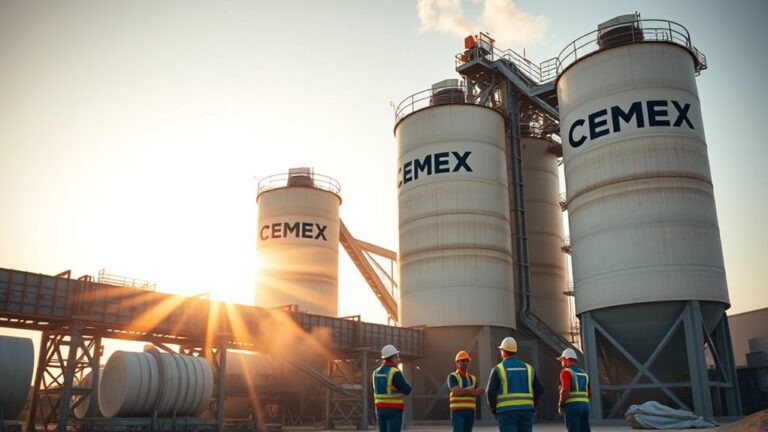

How Big Is Cemex – Guide
Cemex is one of the world’s largest cement producers, operating 64 plants and generating over $16 billion in annual revenue. It ranks third globally with a capacity of about 65 million metric tons, supported by 1,348 concrete facilities and operations in over 30 countries.
The company has expanded through strategic acquisitions and sustained growth. You’ll also find insights on Cemex’s financial strength, sustainability goals, and legal challenges ahead.
Cemex’s Global Production Capacity and Market Ranking
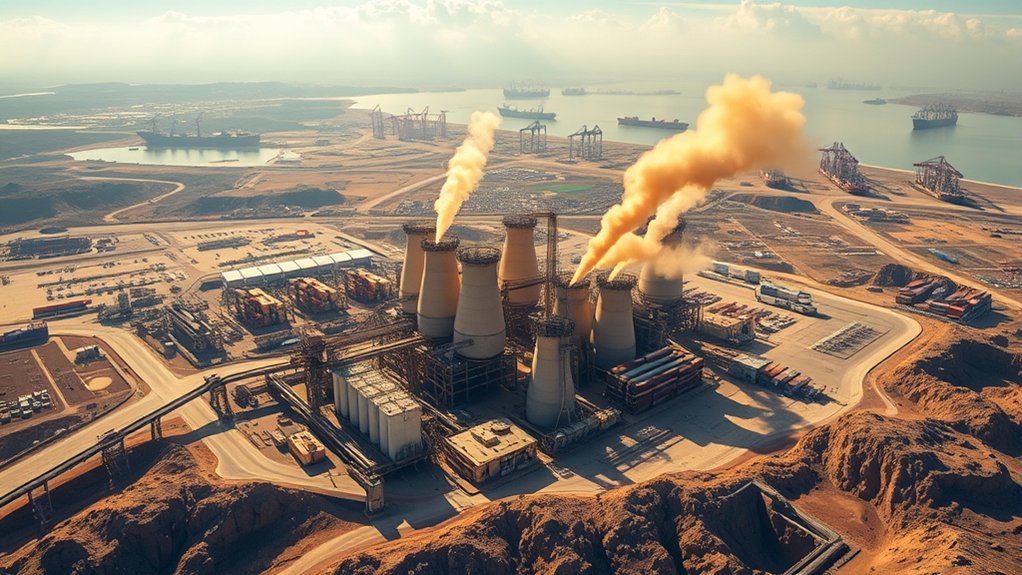
How does Cemex stand among the giants of the cement industry? Cemex holds a prominent industry position with a global cement capacity of approximately 65 million metric tons. This multinational construction materials company operates 64 cement plants worldwide, enabling a substantial production volume.
Over the past decade, Cemex’s market ranking surged from No. 28 to No. 3, reflecting its expanding market share within the cement industry. In 2020, it ranked as the fifth-largest cement producer globally, with a production volume of 87.09 million tonnes.
Cemex climbed from 28th to 3rd in a decade, producing 87 million tonnes by 2020.
This growth underscores Cemex’s commitment to sustainable construction by optimizing its resources and expanding capacity.
When evaluating global cement capacity and market ranking, Cemex clearly ranks among the top companies driving innovation and scale in the cement industry. It’s impressive to see how far they’ve come and how they continue to shape the future of construction materials.
Cemex’s Revenue Breakdown by Product Line
You’ll find that cement sales make up a substantial portion of Cemex’s revenue, with around 48 million tonnes sold in 2025 alone.
Ready-mix concrete also contributes considerably, especially in key markets like Mexico and the US.
Understanding these product lines really helps clarify how Cemex drives its overall earnings.
It’s interesting to see how each segment plays a role in the company’s financial health.
Cement Sales Revenue
Where does Cemex generate the bulk of its revenue? Cement sales stand out as a primary revenue source, contributing approximately US$16.1 billion in 2025. Cemex’s strong presence in the global cement market is supported by its extensive manufacturing capacity and diverse sales channels.
The company operates 64 cement plants worldwide with a combined capacity of about 65 million metric tons. Cement products are sold both as branded bagged products and via bulk distribution.
Mexico is the most profitable region, driving significant cement sales revenue.
Cement sales form a core segment alongside ready-mix concrete and aggregates. Cement revenue plays a critical role in Cemex’s overall financial performance.
Understanding this breakdown helps you appreciate Cemex’s position and scale in the cement products sector.
Ready-Mix Concrete Earnings
Although cement sales dominate Cemex’s revenue, ready-mix concrete earnings have become a pivotal growth driver, generating approximately US$4.59 billion in Q2 2026.
Cemex’s ready-mix concrete segment plays an essential role in its revenue breakdown, supported by a vast network of over 1,348 facilities across global operations.
You’ll notice Cemex targets diverse construction markets, with infrastructure development in key regions like the U.S. and Mexico fueling demand.
The company emphasizes customized solutions, delivering high-performance materials tailored to project specifications, which enhances profitability.
This focus on ready-mix concrete aligns with trends in the construction industry, where durable, efficient materials are necessary.
As a core product line, ready-mix concrete substantially contributes to Cemex’s growth, reflecting its strategic commitment to concrete-based construction solutions worldwide.
Geographic Reach and International Operations
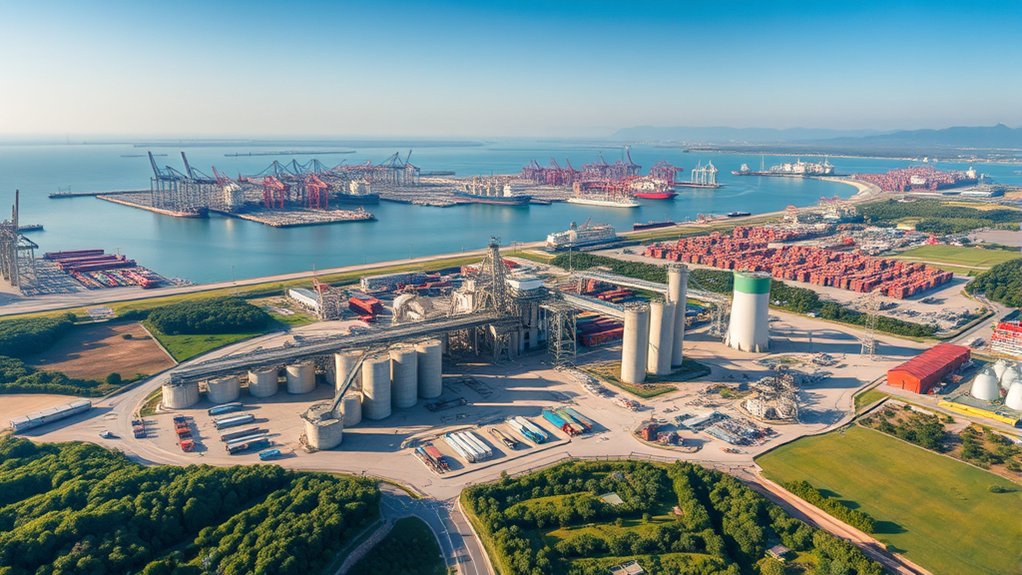
Since expanding internationally in 1992, Cemex has established a vast geographic footprint, operating subsidiaries in 30 countries and trading with over 60 nations worldwide.
You’ll find Cemex’s global presence marked by significant assets and regional expansion across multiple continents. Its international operations include 64 cement plants supporting a production capacity of approximately 65 million metric tons, 1,348 ready-mix concrete facilities serving diverse markets, 246 quarries supplying raw materials, and 269 distribution centers ensuring efficient logistics.
Operations span North America, Latin America, Europe, Asia, and Africa. This extensive network strengthens Cemex’s trade relationships and positions it as the third-largest cement producer globally.
Milestones in Cemex’s Growth and Expansion
You’ll see that Cemex’s growth really hinges on some key acquisitions, like when they bought RMC Group back in 2005. They also kicked off a strategic international expansion starting way back in 1992.
Over the past decade, the company climbed the ranks from No. 28 all the way up to No. 3 globally by boosting their capacity to 65 million metric tons.
When you track these milestones, it’s clear how Cemex managed to solidify its market position across 30 countries and work with 60 trade partners.
Key Acquisition Highlights
When Cemex began its international expansion in 1992 with acquisitions in Spain, Venezuela, and the U.S., it set the stage for substantial growth through strategic acquisitions. These moves accelerated market expansion and strengthened its industry footprint globally.
Key acquisition highlights include purchasing the RMC Group in 2005, which markedly boosted European operations and presence in the UK. They also acquired Southdown in Houston, Texas, to reinforce their U.S. market position.
In 2022, Cemex obtained a majority stake in a German aggregates producer, enhancing its European aggregates business.
They divested the U.S. reinforced concrete pipe unit in 2016 for $500 million to focus on core businesses.
Overall, Cemex has leveraged international expansion to build a diversified portfolio of cement and concrete assets.
These acquisitions clearly show Cemex’s commitment to strategic growth and consolidating its core businesses worldwide.
Geographic Expansion Timeline
How did Cemex transform from a local Mexican cement company into a global industry leader? It started with strategic geographic expansion and acquisitions.
In 1992, Cemex entered the international market by acquiring companies in Spain, Venezuela, and the U.S. This initial move set the stage for further growth.
By the late 1990s and early 2000s, Cemex expanded into Asia and Africa, acquiring operations in the Philippines, Indonesia, and Egypt. A key milestone was the 2005 acquisition of RMC Group, which boosted Cemex’s global footprint considerably.
After selling U.S. assets in 2009 to reduce debt, Cemex refocused on Europe with investments in Germany. Today, Cemex operates subsidiaries in 30 countries and maintains trade relationships in over 60, marking a diversified global presence across Europe, Asia, and Africa.
Market Position Milestones
Although Cemex began as a regional Mexican cement producer, it has rapidly climbed the global ranks to become the third-largest cement company worldwide, boasting about 65 million metric tons of capacity. You can track its market leadership through key milestones that highlight impressive growth and international expansion.
Cemex’s evolution in the global cement industry includes advancing from No. 28 to No. 3 in global industry ranking over a decade and operating subsidiaries in 30 countries with exports to over 60 nations.
It achieved nearly US$5 billion in net sales and over US$1 billion in net profits in 1999.
The company carried out strategic acquisitions like RMC Group and Southdown to boost capacity. It also expanded its capacity and footprint, solidifying its position in the competitive global cement market.
These milestones really reflect Cemex’s focused strategy on growth and sustained market leadership.
Cemex’s Financial Performance and Market Capitalization
Since 1999, Cemex has demonstrated remarkable financial growth, increasing its net sales from nearly US$5 billion to approximately US$16.1 billion in 2025. This growth really highlights Cemex’s expanding scale and strong market position within the industry.
The company’s net profits surpassed US$1 billion in 1999, reflecting solid profitability that has sustained over the years.
In 2025, Cemex achieved a record operating EBITDA of US$3.1 billion, showing just how efficient its operations have become.
Its trailing twelve months revenue reached about US$17.04 billion by 2026, which further emphasizes its financial robustness.
Cemex’s market capitalization stood at approximately US$13.75 billion in mid-2026. That marks it as a substantial player in the global cement and construction materials market.
These figures together really showcase Cemex’s consistent financial performance and significant market capitalization.
Social Responsibility and Sustainability Efforts
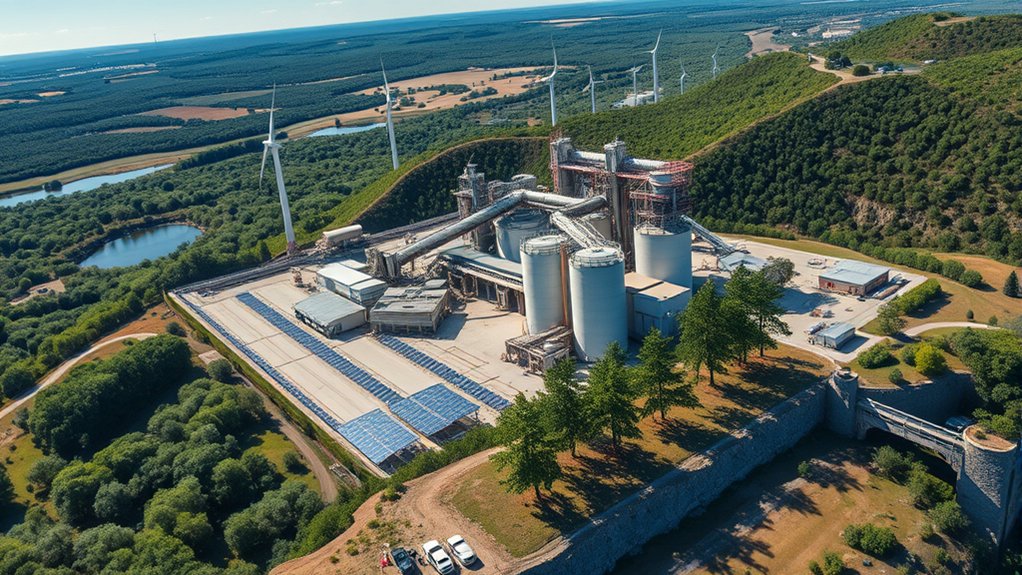
What impact does Cemex have beyond its financial success? Cemex’s social responsibility efforts emphasize sustainability and community development. They focus on addressing both environmental impact and stakeholder value.
Through targeted social initiatives, the company enhances lives and promotes sustainable construction.
Key highlights include:
- Patrimonio Hoy has helped over 150,000 low-income families build homes since 1998.
- Social initiatives reached 23 million people globally by 2020, aiming for 30 million by 2030.
- Education programs fund architecture and sustainability courses at ITESM, Universidad Iberoamericana, and Barcelona School of Architecture.
- Premio CEMEX recognizes excellence in sustainable construction and architecture.
- The Centro CEMEX-Tecnológico de Monterrey drives sustainable community R&D.
These efforts show how Cemex is committed to integrating social responsibility and sustainability into its core operations. It’s clear they’re making a real difference beyond just business success.
Legal and Regulatory Challenges Impacting Operations
When you examine Cemex’s operational landscape, legal and regulatory challenges play a significant role in shaping its business decisions. The company has faced multiple EPA lawsuits related to pollution control failures, including hazardous dust fines in the UK and emissions of Chromium VI in Davenport, California.
Cemex settled EPA lawsuits in Victorville with fines reduced from £400,000 to £50,000 after compliance improvements. These environmental violations prompted divestment, such as selling the Lyons, Colorado plant.
Furthermore, ongoing regulatory challenges include antitrust charges and legal investigations in Europe, particularly concerning admixtures in France and Germany. These legal pressures compel Cemex to continuously adapt its operations to meet stricter environmental regulations, manage fines, and mitigate reputational risks while maintaining compliance across diverse jurisdictions.
Future Outlook and Investment Considerations for Cemex
Legal and regulatory pressures have pushed Cemex to adopt more sustainable and financially disciplined strategies, shaping its future outlook. You’ll find Cemex’s investment considerations attractive due to its commitment to sustainability and strong financial performance.
Highlights include targeting net-zero CO2 emissions by 2050, which enhances long-term market value. The company is also achieving a record EBITDA of US$3.1 billion in 2025, signaling resilience.
Plus, strategic asset sales are reducing debt and improving leverage to 2.08x.
There’s been a AAA ESG rating upgrade too, which increases appeal to socially responsible investors. Ongoing innovation and global expansion continue to support market growth.
All these factors collectively strengthen Cemex’s position for sustainable growth. When evaluating investment potential, consider how its focus on ESG, financial health, and innovation aligns with future market trends and your portfolio goals.
Frequently asked questions
What Are Cemex’s Most Popular Cement Products?
Cemex’s most popular cement products include high-performance Type I and Type V cements, alongside blended cements tailored for durability and specific environmental needs. You’ll find these cements designed for strength, workability, and long-term resilience. They’re ideal for large infrastructure and commercial projects.
Cemex also offers eco-friendly, low-CO2 formulations, reflecting their commitment to sustainability. These products are distributed globally through exclusive and nonexclusive channels, ensuring wide availability for diverse construction demands.
How Does Cemex Innovate in Construction Technology?
You’ll find Cemex innovates in construction technology by investing heavily in R&D to develop durable, sustainable materials like high-performance cements and ready-mix concretes.
They leverage digital tools such as BIM for efficient project planning and execution.
Plus, Cemex partners with tech firms to create eco-friendly solutions, including waste-to-fuel and low-carbon cements.
Their projects, like the Sixth Street Viaduct, showcase advanced concrete formulations that enhance durability and aesthetics.
Who Are Cemex’s Main Competitors Globally?
You’ll find Cemex’s main global competitors are LafargeHolcim, HeidelbergCement, and Anhui Conch.
LafargeHolcim leads the market with over 300 million metric tons capacity.
HeidelbergCement operates in more than 50 countries, producing around 170 million metric tons annually.
Anhui Conch, China’s top cement producer, also exceeds 300 million metric tons.
Together, these companies rival Cemex with vast production and distribution networks worldwide.
They all have a huge presence in the global cement industry, making competition pretty intense.
What Community Programs Does Cemex Support Locally?
You’ll find Cemex supports local communities through programs like Patrimonio Hoy, helping over 150,000 low-income families build homes since 1998. They also fund architecture courses at institutions such as ITESM and Universidad Iberoamericana.
On top of that, they established the Centro CEMEX-Tecnológico de Monterrey for sustainable research. It’s a great way to push innovation that benefits everyone.
Furthermore, they run the Premio CEMEX, which recognizes excellence in sustainability, accessibility, construction, and architecture within local communities. This program impacts millions worldwide.
How Does Cemex Ensure Employee Safety on Sites?
You’ll find Cemex builds safety like a fortress: strict protocols and regular training form its strong walls. They use advanced gear and monitoring tech as shields to protect you from hazards.
Frequent audits and risk checks act like vigilant sentinels, spotting dangers early. A dedicated safety team enforces rules and investigates incidents, keeping accidents low.
This data-driven approach has earned Cemex industry safety awards, proving their commitment to your well-being. It’s clear they take your safety seriously every step of the way.
Final Thought
You should know Cemex produces over 90 million tons of cement annually, ranking it among the top global leaders. This scale reflects its vast geographic reach and diversified product lines, driving consistent revenue growth.
Despite some regulatory challenges, Cemex’s commitment to sustainability and innovation positions it well for future expansion. Keeping an eye on its financial performance and market trends will help you make informed investment decisions in this dynamic industry.
More Cemex Guides
Need a Local Concrete Supplier?Tri County Concrete is a family-owned ready mix supplier serving Greater Cleveland for over 50 years. Request a quote or call 440-582-1100.