How Many Cubic Feet In A Yard Of Concrete – Facts & Figures
One cubic yard of concrete equals 27 cubic feet and typically weighs around 4,000 pounds, depending on the mix. You can calculate volume by measuring length, width, and thickness in feet and dividing by 27. Remember, slab thickness affects coverage because thicker slabs reduce the area one cubic yard covers.
Always include a 10–15% safety margin for accuracy. Understanding these basics helps you order precisely. Further details cover conversion methods and handling irregular shapes.
Understanding a Cubic Yard of Concrete
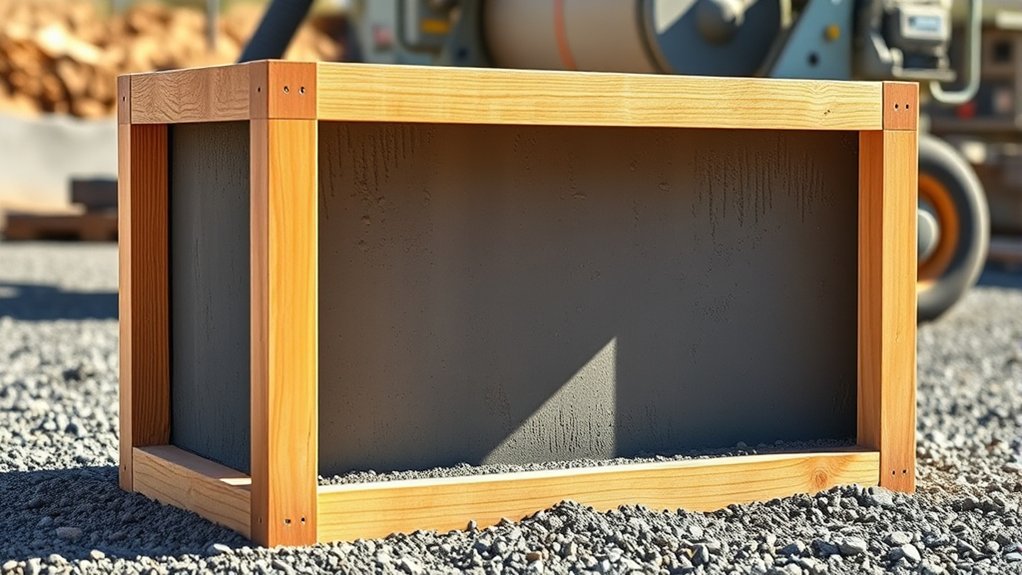
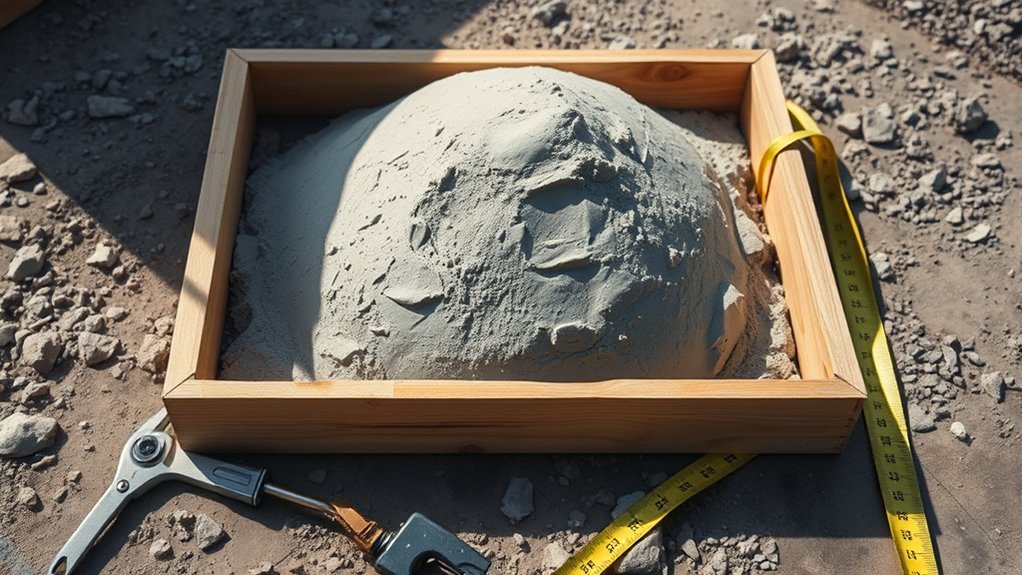
When you work with concrete, it’s important to know that a cubic yard measures 3 feet in length, width, and height. That adds up to 27 cubic feet. This measurement is key for accurate volume calculations.
A cubic yard is the standard unit used to quantify concrete volume in construction projects. Each cubic yard of concrete weighs about 4,000 pounds, though this can vary depending on the mixture and additives.
Concrete volume is measured in cubic yards, each weighing around 4,000 pounds, depending on mixture and additives.
To figure out how much concrete you need, you’ll want to convert between cubic yards and cubic feet easily. Just multiply the number of cubic yards by 27 to get the volume in cubic feet. This helps you order the right amount and avoid waste.
Getting comfortable with this basic measurement lets you manage your concrete volume better. It ensures your project stays accurate and cost-effective from start to finish.
How to Calculate Concrete Volume Using Cubic Feet and Yards
How do you accurately determine the volume of concrete needed for your project? First, measure the project dimensions precisely: length, width, and thickness in feet. Then calculate the concrete volume in cubic feet by multiplying these three values.
To convert cubic feet to cubic yards, divide the total cubic feet by 27, since one cubic yard equals 27 cubic feet. Use this formula: Volume (cubic yards) = (Length × Width × Thickness) / 27.
For an accurate concrete calculation, include a safety margin of 10-15% to cover any variations.
For example, a 4-inch thick slab covering 81 square feet requires about 1 cubic yard of concrete.
How Slab Thickness Changes Concrete Coverage

Accurately calculating concrete volume requires understanding how slab thickness affects coverage area. As slab thickness increases, the concrete coverage per cubic yard decreases. This happens because a thicker slab demands more cubic feet of material per square foot.
For example, a 4-inch slab covers approximately 81 square feet per cubic yard, while a 6-inch slab reduces coverage to roughly 54 square feet. To perform precise project calculations, divide 81 square feet by your desired slab thickness in inches to estimate coverage.
Each additional inch beyond 4 inches decreases coverage by about 13 to 14 square feet per cubic yard. Grasping this relationship lets you determine the exact amount of concrete required. This ensures efficient material use and accurate volume measurement for your project.
Converting Bagged Concrete to Volume
Since bagged concrete comes in various weights and yields different volumes when mixed, converting the number of bags to cubic feet means multiplying the bag count by the specific volume each bag produces.
For example, an 80-pound concrete mix yields about 0.6 cubic feet per bag, while a 50-pound bag gives you around 0.375 cubic feet.
When converting bagged concrete to volume, you calculate the total volume by multiplying the number of concrete bags needed by the yield per bag.
For accurate volume calculation, always include a 10% safety margin to cover spillage and mixing inconsistencies.
This method guarantees a precise determination of how many bags you require. It really helps streamline project planning and resource allocation when working with bagged concrete.
Why Concrete Weight Matters for Your Project
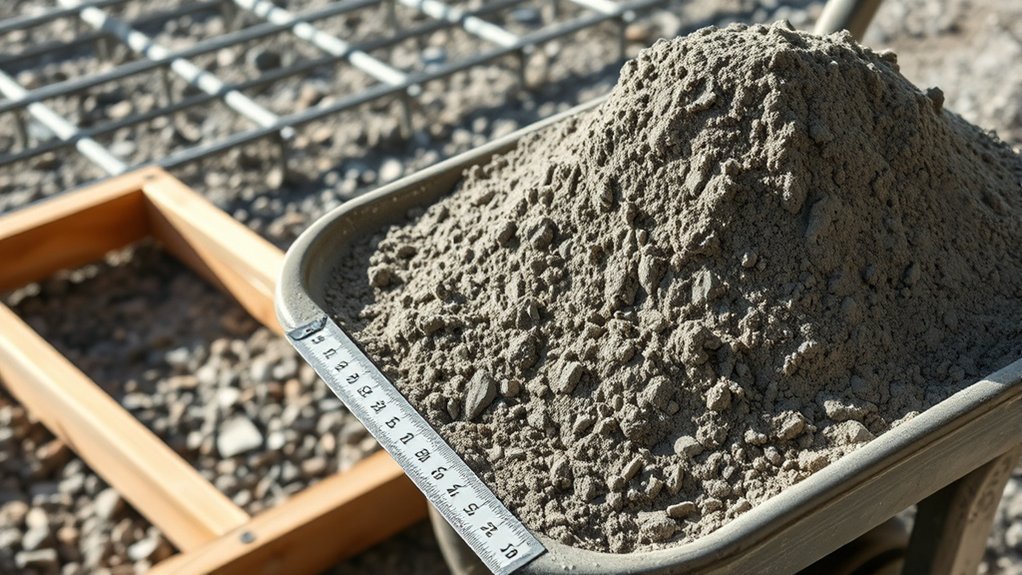
Calculating the volume of concrete needed is only part of the planning process. Understanding the weight of that volume directly impacts your project’s structural and logistical considerations.
Concrete weight is about 4,050 pounds per cubic yard. This number is critical when you’re evaluating load capacity and making sure your structure has the support it needs.
Knowing the weight accurately also helps with handling requirements. It guides decisions around transportation and machinery selection, which are essential for efficient project planning.
| Aspect | Importance |
|---|---|
| Concrete Weight | 4,050 lbs per cubic yard |
| Load Capacity | Ensures foundation and structure safety |
| Structural Support | Determines design and material reinforcement |
| Handling Requirements | Guides equipment choice and transport logistics |
Tips for Ordering the Right Amount of Concrete to Avoid Waste
You’ll want to calculate your concrete volume with a safety margin of at least 10% to cover any spillage or compaction.
It’s important to make sure your project dimensions are converted accurately first.
Then, round up your total order to the nearest quarter yard.
Ordering a little more than the exact volume helps prevent delays and keeps waste to a minimum during the pour.
Calculate With Safety Margins
How much extra concrete should you order to avoid costly shortages and delays? When you calculate how much concrete your project requires using a concrete calculator, always add a safety margin of 10-15%. This helps cover spillage, uneven subgrade, and form adjustments.
To accurately measure your project and determine the cubic yards needed, keep in mind that a yard of concrete weighs about 4,000 pounds.
Follow these steps to make sure you order enough:
- Calculate the exact volume of concrete required.
- Add a 10-15% safety margin to the cubic yards needed.
- Round up to the nearest quarter or half yard when placing your order.
Doing this avoids waste, prevents emergencies, and keeps your construction process running smoothly.
Convert Dimensions Accurately
Ensuring accurate concrete orders depends heavily on precise measurement conversions. To convert dimensions correctly, measure the length, width, and thickness of your project in feet and inches. Convert inches to feet by dividing by 12 for an accurate calculation.
Use the formula: volume in cubic feet = length (ft) × width (ft) × thickness (ft) to determine the total volume of concrete required.
Next, convert the volume from cubic feet to cubic yards by dividing by 27, since one cubic yard equals 27 cubic feet.
By accurately measuring and converting dimensions, you make sure your order matches the project’s volume needs precisely. This helps minimize waste and avoid shortages.
Following this methodical approach guarantees you order the right amount of concrete for efficient project completion.
Order Slightly More
When ordering concrete, account for an additional 10-15% beyond your calculated volume. This helps compensate for spillage, uneven subgrade, and compaction.
To effectively order slightly more and avoid shortages, follow these guidelines:
- Use a concrete calculator for precise volume estimation. This ensures you determine the exact cubic yards of concrete needed.
- Incorporate a project safety margin by rounding up to the nearest quarter yard when ordering concrete. This helps accommodate unforeseen variables.
- Avoid ordering exactly the calculated amount. Doing so reduces the risk of costly emergency deliveries or rework caused by insufficient material.
Handling Irregular Shapes for Concrete Volume
When you’re dealing with irregular concrete shapes, it’s best to break the area down into smaller, manageable sections. This way, you can calculate the volume of each part more accurately.
A handy tip is to estimate the average width of these sections—it makes your measurements simpler and helps improve precision.
And don’t forget to add a safety margin, usually around 5%, to cover any measurement errors or irregularities you might encounter.
Dividing Irregular Shapes
How do you accurately calculate the volume of concrete for an irregular-shaped slab? To handle irregular shapes effectively, you must divide the slab into simpler geometric sections such as rectangles. Then, use measured dimensions from a scaled drawing or direct measurement to calculate each section’s area.
Finally, sum these areas and multiply by the slab thickness to determine the total volume.
Follow these steps:
- Divide the irregular shape into rectangles or other basic shapes to simplify volume calculation.
- Record the measured dimensions of each section carefully to calculate individual areas.
- Add the areas of all sections, then multiply by thickness to find the total volume in cubic feet.
This method ensures precise volume estimation for irregular shapes. It helps minimize errors and waste, making your project more efficient.
Estimating Average Width
Accurately estimating the average width of an irregular-shaped concrete area simplifies volume calculations and improves precision. To estimate average width, begin by sketching a scaled drawing of the concrete slab, breaking it into smaller rectangles when necessary.
Measure each section’s width and length to calculate the number of square feet accurately.
For curved or radius sections, approximate the shape with the smallest enclosing rectangle to determine square footage effectively. Once you have the total square footage, divide it by the slab’s total length to find the average width.
This approach streamlines estimating the volume of irregular-shaped slabs and reduces errors associated with complex geometries.
Adding Safety Margins
Although calculating the exact volume for irregular concrete shapes can be challenging, adding a safety margin guarantees you account for variations like uneven subgrades and spillage.
To accurately calculate volume for irregular shapes, divide the area into smaller rectangles or use bounding rectangles for curved sections.
Then, apply a safety margin of 5-10% to your total volume to cover unexpected factors.
Always round up your final volume to the nearest quarter yard to ensure you have sufficient additional concrete.
Key steps include:
- Divide irregular shapes into simpler segments to calculate volume precisely.
- Add a safety margin of 5-10% to accommodate spillage and surface irregularities.
- Round up your volume estimate to the nearest quarter yard to secure extra concrete.
Frequently asked questions
What Is the Environmental Impact of Producing One Cubic Yard of Concrete?
You should know that producing one cubic yard of concrete considerably contributes to concrete pollution through carbon emissions and dust generation. It demands substantial energy consumption and water usage, accelerating resource depletion.
Cement manufacturing, a core process, releases high CO2 levels, impacting air quality and climate.
Furthermore, extracting raw materials disrupts ecosystems.
Being aware of these factors helps you understand the environmental burden associated with concrete production and encourages greener alternatives.
How Long Does Concrete Take to Fully Cure at Different Temperatures?
Like patience shaping a masterpiece, concrete’s curing time varies with temperature. At 50°F to 77°F, expect full curing in about 28 days. This ensures ideal concrete color and strength.
Above 85°F, rapid drying can cause cracks. So, you’ll want to adjust mixing techniques and reinforcement methods accordingly.
Below 40°F, slow curing means you need added heat or insulation to secure structural integrity.
Manage surface finishing carefully throughout the drying process to get the durability you want.
Can Additives Change the Weight of a Cubic Yard of Concrete?
Yes, additives can change the weight of a cubic yard of concrete because they affect the density and cause chemical reactions within the mixture.
Depending on the type of additive, like lightweight materials such as perlite or dense metallic fibers, you’ll notice some weight differences.
These additives change the mixture’s consistency and specific gravity, which leads to slight increases or decreases in the overall weight.
But honestly, these changes are usually pretty minimal compared to the total weight of a cubic yard of concrete.
What Safety Precautions Should Be Taken When Mixing Concrete?
You wouldn’t want to turn mixing concrete into a hazardous adventure, so always wear personal protective equipment like gloves, goggles, and masks. Guarantee proper ventilation to avoid inhaling dust or fumes.
Handle chemicals carefully and adhere strictly to site safety protocols.
Also, maintain equipment routinely to prevent accidents.
Familiarize yourself with emergency procedures in case of exposure or injury.
Following these steps keeps you safe and your project on track without unnecessary risks.
How Does Concrete Density Vary With Different Aggregate Types?
You’ll find concrete density varies considerably with aggregate strength, moisture content, particle size, and mineral composition.
Denser aggregates like basalt increase density variations, while lightweight ones such as pumice reduce it.
Particle size affects compaction, influencing density and durability factors.
Moisture content can alter aggregate weight, impacting overall density.
Understanding these variables guarantees you select the right aggregates to optimize concrete’s strength, durability, and performance for your specific application.
It’s all about matching the materials to what your project needs.
Final Thought
You might think measuring concrete is as simple as guessing a yard or two, but as you’ve learned, one cubic yard equals exactly 27 cubic feet. Overlooking slab thickness or irregular shapes could turn your project into a concrete jungle of miscalculations.
So, don’t just throw bags or order blindly. Precision saves both money and headaches. After all, concrete isn’t just heavy; it’s unforgiving when you get the math wrong.
More Quantities & Weights Guides
- How Many Yards of Concrete in a Truck
- How Much Concrete Do I Need
- How Much Concrete per Fence Post
- How Much Does a Concrete Block Weigh
See all Quantities & Weights guides · All concrete resources
Need Concrete in Greater Cleveland?Tri County Concrete delivers ready mix from plants in North Royalton and Twinsburg, Ohio. Request a quote or call 440-582-1100.