How Much Does A Yard Of Concrete Cover – Here’s the Math
A cubic yard of concrete covers between 54 and 81 square feet, depending on your slab thickness. Thicker slabs reduce coverage. For example, a 4-inch slab covers about 81 sq ft per yard, while a 6-inch slab covers roughly 54 sq ft.
To find concrete needs, multiply area by thickness (in feet), then convert to cubic yards. Always add 10-15% extra to account for spillage and site conditions.
You’ll also want to take into account bagged versus ready-mix options and precise ordering strategies. It helps to plan ahead and make sure you get the right amount.
How Slab Thickness Affects Concrete Coverage
Although it might seem straightforward, slab thickness considerably impacts how much area a cubic yard of concrete can cover. When you increase slab thickness, the concrete coverage per cubic yard decreases due to greater volume measurement requirements.
For example, a 4-inch slab covers about 81 square feet per cubic yard, while a 5-inch slab reduces coverage to roughly 65 square feet. At 6 inches thick, coverage further drops to 54 square feet.
This inverse relationship means thicker slabs demand more concrete per unit area, which you have to factor into project planning.
Using a concrete calculator helps you accurately adjust material estimates based on slab thickness, so you don’t underestimate quantities.
Understanding these dynamics optimizes your concrete coverage calculations and resource allocation.
Calculating Square Footage for Your Concrete Project
Knowing how slab thickness affects concrete coverage, the next step is calculating the square footage of your project to estimate the necessary material accurately. Start by measuring the length and width in feet, then multiply these dimensions to determine the square footage. For a 10 ft by 10 ft slab, the area calculation results in 100 square feet.
Remember, slab thickness influences coverage per yard, with a 4-inch slab covering roughly 81 square feet per cubic yard and a 6-inch slab about 54 square feet.
For complex concrete projects featuring irregular shapes, use scaled drawings or divide the area into rectangles to improve accuracy.
Precise square footage measurement guarantees you estimate material needs effectively, avoiding waste or shortages in your concrete project. Taking the time to get this right will save you money and headaches later on.
Converting Square Footage to Cubic Yards of Concrete
When you convert square footage to cubic yards of concrete, you multiply the area in square feet by the slab thickness in feet to calculate the volume in cubic feet. Then, divide that volume by 27 to get cubic yards. This conversion is critical since thickness greatly impacts the concrete volume needed.
Using a calculator can streamline this process by automatically converting your inputs into cubic yards. It makes figuring out how much concrete you need way easier and less prone to mistakes.
| Area (sq ft) | Thickness (ft) | Volume (cubic yards) |
|---|---|---|
| 600 | 0.33 | 7.33 |
| 1000 | 0.25 | 9.26 |
| 800 | 0.50 | 14.81 |
Calculating Concrete Volume for Irregular Shapes
To calculate concrete volume for irregular shapes, begin by breaking the area down into rectangles or other simple geometric sections.
Once you have those sections, multiply each one’s area by the slab thickness to get the volume for each part.
After that, just add up all those individual volumes to find your total estimate.
And don’t forget to include a safety margin—usually around 5 to 15%—to cover any spillage or surface irregularities that might come up.
Dividing Shapes Into Rectangles
How do you accurately estimate concrete volume for an irregularly shaped area? Start by creating a scaled drawing of the layout to visualize the dimensions clearly.
Next, divide shapes into smaller rectangles. This simplifies area calculation by transforming complex forms into regular, manageable sections.
Measure the length and width of each rectangle precisely, then calculate each area by multiplying these measurements.
Sum all rectangle areas to determine the total surface area requiring concrete.
Finally, multiply the total area by the desired thickness to find the total volume.
This method ensures you convert irregular shapes into a series of rectangles, making it easier to get accurate total volume estimations. That way, you order just the right amount of concrete without guesswork or overestimation.
Adding Safety Margin
Although calculating the exact concrete volume for irregular shapes requires dividing the area into sections, you should always add a safety margin to your total estimate.
After creating a scaled drawing and performing precise volume measurement for each section, sum these volumes to determine your base concrete estimation.
Then, include an extra 5-15% contingency to cover spillage, uneven surfaces, and form adjustments. This safety margin guarantees you have enough extra concrete, reducing the risk of shortages during pouring.
Rounding up to the nearest quarter yard further safeguards your project planning, minimizing delays caused by insufficient material.
Incorporating this calculated buffer optimizes resource allocation and prevents costly rework, making your concrete volume measurement both accurate and reliable for irregular shapes.
Choosing Between Bagged Concrete and Ready-Mix Delivery
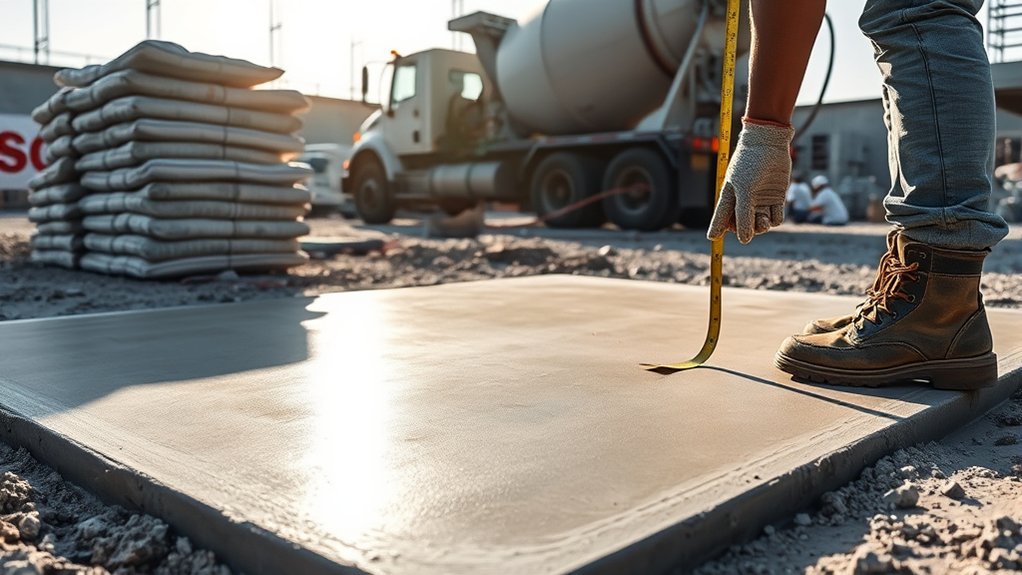
When deciding between bagged concrete and ready-mix delivery, think about the size and specific needs of your project. Bagged concrete is great for small to medium jobs. It lets you buy just the right amount, so you don’t end up with leftover material.
Ready-mix concrete is better suited for larger projects. Usually, you’ll need to order at least 1 cubic yard. This option gives you a consistent mix and faster delivery.
Your choice really depends on how big your project is, your budget, and whether you need an exact volume to make sure you cover the area efficiently.
| Parameter | Bagged Concrete | Ready-Mix Concrete |
|---|---|---|
| Project Size | Small to Medium | Large (≥1 cubic yard) |
| Volume Measurement | Flexible, small increments | Fixed minimum volume |
| Material Waste | Low | Potentially higher |
Pick the option that works best for your efficiency and waste reduction goals.
How Jobsite Conditions Affect Concrete Volume Calculations
You’ll want to keep in mind things like uneven ground and shifting forms on the site because they can actually increase how much concrete you need.
It’s a good idea to always add about 10-15% extra for spillage and waste so you don’t run short when you’re pouring.
Taking the time to measure carefully and plan ahead really helps make sure you order enough material to cover these surprises and keep everything running smoothly.
Site Irregularities Impact
Since jobsite conditions rarely present perfectly level surfaces or uniform subgrades, you need to account for these irregularities when calculating concrete volumes. Irregularities and site conditions often cause measurement inaccuracies and increase waste. To avoid shortfalls, it’s a good idea to add a safety margin of 10-15% in your volume estimation.
This margin helps cover variability, spillage, and form movement, making sure you have enough material on hand.
| Factor | Impact on Volume Calculation |
|---|---|
| Uneven subgrades | Requires additional concrete |
| Measurement errors | Leads to underestimation |
| Site irregularities | Increase spillage and waste |
Accurate project drawings and precise measurements reduce uncertainty, but the safety margin is still essential to handle jobsite unpredictability.
Allowances For Spillage
Although precise calculations provide a solid baseline, jobsite conditions often demand ordering an additional 10-15% of concrete to cover spillage and form movement.
When estimating concrete coverage, you must factor in allowances for spillage and over-excavation, which increase volume requirements beyond initial calculations.
These variances arise from uneven surfaces, shifting forms, and unintentional excess excavation at the project site.
Incorporating extra concrete into your order quantity prevents shortages that cause costly delays and multiple deliveries.
To optimize accuracy and minimize waste, round up your concrete order to the nearest quarter yard.
By systematically accounting for these allowances, you maintain budget control while ensuring sufficient material on-site.
This proactive approach balances precision with practical jobsite realities, improving overall project efficiency and material utilization.
Why You Should Order Extra Concrete for Your Project
When managing a concrete project, ordering 10-15% more material than the calculated requirement guarantees against spillage, uneven surfaces, and last-minute adjustments. This extra concrete prevents project delay caused by shortages and accounts for overage due to waste or unforeseen changes.
By accurately estimating and adding overage, you minimize costly additional deliveries and disruptions. It’s a simple step that can save a lot of headaches later on.
| Factor | Reason for Extra Concrete | Impact on Project |
|---|---|---|
| Spillage | Material loss during handling | Requires surplus to cover |
| Uneven surfaces | Variability in subgrade | Ensures full coverage |
| Unforeseen adjustments | Last-minute design changes | Avoids project delays |
| Form removal waste | Concrete lost during stripping | Requires buffer quantity |
Ordering extra concrete is financially smart. It saves time and expense from rework or delays, making your project run smoother overall.
How Many Bags of Concrete You Need per Cubic Yard
Ordering extra concrete guarantees you have enough material to handle project variations, but knowing exactly how many bags you need per cubic yard helps you plan your purchase accurately.
One cubic yard equals 27 cubic feet, and an 80-pound concrete bag yields about 0.60 cubic feet. Use volume calculation to determine bag quantity based on slab thickness and concrete mix.
Consider this:
- At 4-inch slab thickness, one 80-pound bag covers roughly 1.8 square feet.
- At 6-inch thickness, coverage per bag reduces to about 1.2 square feet.
- You’ll need approximately 45 bags of 80-pound concrete mix per cubic yard.
- Add a 10-15% spillage allowance to accommodate waste and uneven surfaces.
This precise approach guarantees your project has the right amount of concrete bags for efficient execution. It’s always better to have a little extra than to run short halfway through!
Using Online Tools to Simplify Concrete Volume Estimates
Since calculating concrete volume manually can be complex, especially for irregular shapes, online concrete volume calculators provide an efficient solution.
By inputting precise project measurements—length, width, and slab thickness—you can instantly determine the required cubic yards of concrete.
Enter exact length, width, and thickness to quickly calculate the concrete volume needed for your project.
These calculators automatically factor in slab thickness, delivering accurate concrete volume estimates. For example, a 30 ft by 16 ft driveway at 4 inches thick yields about 5.93 cubic yards.
Many tools also allow you to add a spillage adjustment, typically 10-15%, to account for waste and guarantee adequate material.
For irregular or radius-shaped areas, the online calculator segments the space, simplifying calculations while optimizing area coverage.
This precision reduces ordering errors, minimizes material waste, and streamlines project planning with reliable concrete volume data.
Tips for Ordering and Scheduling Concrete Delivery
How much concrete should you order to guarantee your project runs smoothly? Accurate project planning and precise volume calculations are crucial. To optimize your concrete delivery, follow these steps:
First, calculate volume carefully. Then order 10-15% extra to cover spillage and uneven surfaces. Confirm the exact volume before placing your order to avoid costly over or under-ordering.
Schedule delivery early, aligning it with your project timeline to prevent delays. For projects exceeding one cubic yard, use ready-mix concrete delivery for consistency and efficiency.
Clear communication with your supplier about project specifics ensures a timely, scheduled delivery. By using these tactics, you’ll maintain control over your concrete supply, reduce waste, and keep your timeline intact.
Frequently asked questions
What Is the Average Cost of a Yard of Concrete?
The average cost of a yard of concrete typically ranges between $100 and $150, depending on your location and the mix type you choose.
You should also factor in additional fees like delivery, finishing, and additives, which increase the overall price.
If you order in bulk, your cost per yard might decrease.
Keep in mind, specialty mixes or rapid-set concrete will push the price higher than standard mixes.
How Long Does Concrete Take to Cure Fully?
Concrete typically takes about 28 days to cure fully and reach its maximum strength under ideal conditions. You’ll find it gains over 90% of strength within the first four weeks.
But factors like temperature, humidity, and mix composition can affect this timeline.
To guarantee proper curing, you need to maintain adequate moisture and avoid rapid drying.
While concrete continues strengthening gradually over years, the critical curing phase is within that initial month.
Can I Recycle Leftover Concrete From My Project?
Yes, you can recycle leftover concrete from your project. To do this effectively, try to prevent it from setting in buckets or mixers. Hardened concrete is tough to recycle.
You can crush fresh leftover concrete into aggregate for new mixes or base material. Many local recycling centers accept and process it. Just make sure the concrete is free of contaminants.
Also, consider reusing it on-site for fill or grading. This helps minimize waste and reduces environmental impact. It’s a smart way to make the most of your leftover concrete.
What Additives Can Improve Concrete Durability?
You can improve concrete durability by adding fly ash, silica fume, or slag to reduce permeability and resist chemical attacks.
Water-reducing agents lower the water-cement ratio, which enhances strength.
Air-entraining agents create microscopic air bubbles that improve freeze-thaw resistance.
Corrosion inhibitors protect embedded steel from rust.
Meanwhile, plasticizers and superplasticizers improve flow and compaction. This helps minimize voids and effectively increases long-term durability.
How Do Weather Conditions Impact Concrete Pouring?
Weather conditions can make concrete pouring feel like battling a hurricane. Cold delays setting and risks cracking from freeze-thaw cycles. Heat speeds evaporation and weakens strength. Rain can wash away cement particles, compromising the surface.
Wind accelerates moisture loss, so you’ll need extra curing.
You’ll want to adjust mix design or timing based on temperature, humidity, and wind to guarantee proper hydration and durability. Ignoring these factors can jeopardize your project’s integrity.
It’s all about paying attention to the weather to get the best results with your concrete.
Final Thought
So, now that you’ve mastered yard-to-foot conversions and slab thickness math, you’re basically a concrete wizard. Just remember, ordering exactly the right amount is like predicting the weather. Good luck with that.
Always add extra or you’ll be begging for a surprise delivery. Bagged or ready-mix, it’s all about precision and planning.
And if you’re still unsure, there’s an app for that because math without tech is just manual labor.
More Quantities & Weights Guides
- How Much Does Concrete Weigh
- How Wide Is a Concrete Truck
- How Many Bags of Concrete Do I Need
- How Many Bags of Concrete in a Yard
See all Quantities & Weights guides · All concrete resources
Need Concrete in Greater Cleveland?Tri County Concrete delivers ready mix from plants in North Royalton and Twinsburg, Ohio. Request a quote or call 440-582-1100.