How Much Does Concrete Weigh – Exact Amounts
Concrete typically weighs about 145 pounds per cubic foot or between 3,000 and 4,000 pounds per cubic yard, depending on mix design and aggregates. Lightweight concrete can weigh as little as 116 pounds per cubic foot. Moisture and air content also affect weight, with air-entrained mixes reducing density by 10-15%.
Reinforced concrete adds significant mass due to steel. Accurate weight estimates require considering these factors for precise planning. It’s a good idea to explore further to understand calculations and adjustments for your specific project.
How Much Does Concrete Weigh Per Cubic Foot and Cubic Yard?
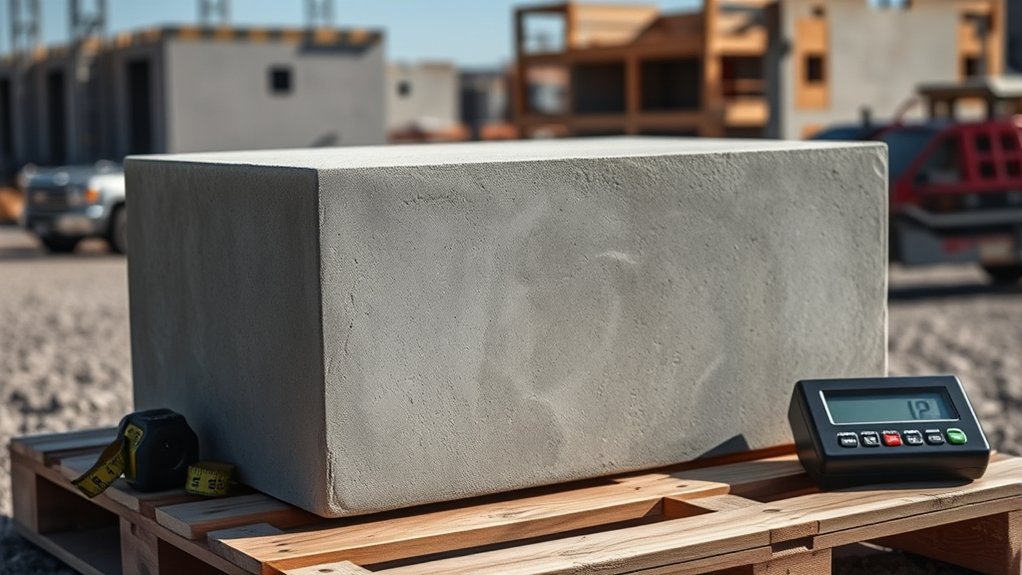
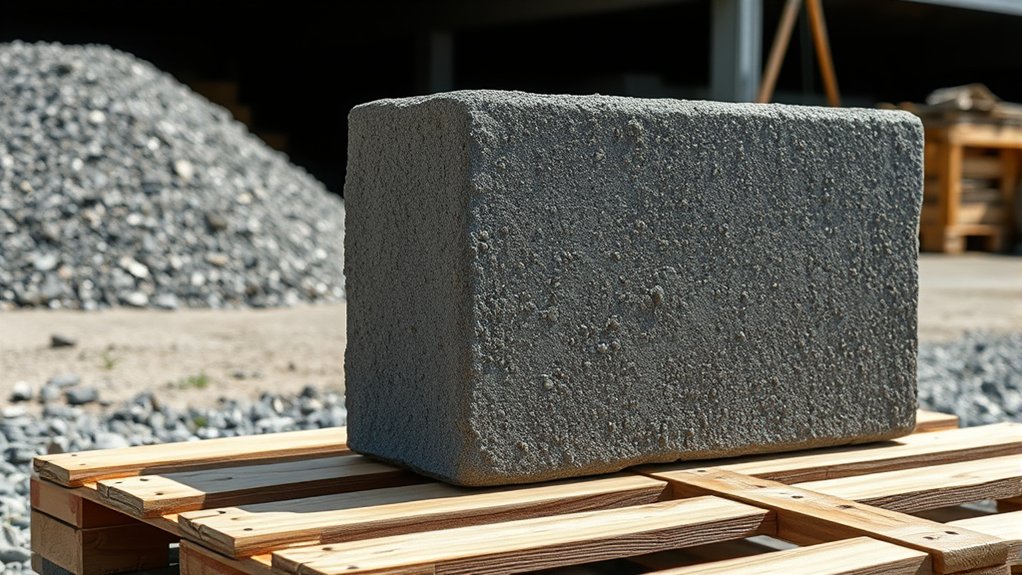
Although the exact weight of concrete varies by composition, you can generally expect one cubic foot of standard concrete to weigh about 145 pounds. This weight provides a baseline for most construction calculations.
One cubic foot of standard concrete typically weighs around 145 pounds, serving as a key construction reference.
When considering larger volumes, a cubic yard of concrete typically weighs between 3,000 and 4,000 pounds, reflecting variations in mix density.
Lightweight concrete, designed for specific applications, weighs approximately 116 pounds per cubic foot. Dense, high-strength mixes exceed the standard weight.
Understanding the weight per cubic foot and cubic yard is essential for accurate structural design and load capacity calculations.
What Factors Affect Concrete Weight?
When you evaluate concrete weight, several factors come into play that directly influence its density and mass. The type of aggregate you use is critical. Denser aggregates like gravel increase overall weight, while lightweight aggregates such as pumice or expanded clay reduce it considerably.
Water content also impacts density. Higher moisture slightly lowers the weight because of the increased water-to-cement ratio. Moreover, air-entrainment introduces microscopic air bubbles, which decrease density and therefore reduce the concrete’s mass.
Cement proportion plays a role as well. Increasing cement content results in a denser, heavier mix.
What Is Concrete Density and Typical Values?

You know, concrete density basically means how much mass is packed into a certain volume. For most standard mixes, it usually falls between 2,400 and 2,500 kg per cubic meter.
But keep in mind, this number can change depending on a few things like the type of aggregate used, how well the mix is compacted, and how much air is trapped inside.
Getting a good handle on these typical density values is super helpful when you’re trying to figure out the weight of concrete for your projects.
Concrete Density Explained
Since concrete’s density directly affects its strength and structural behavior, understanding its typical values is essential for design and construction decisions. Concrete density reflects the mass per unit volume, primarily influenced by its mix design, including aggregate type, water content, and air entrainment.
Standard concrete, with coarse aggregates and ideal compaction, typically exhibits a density near 2,400 kg/m³ (150 lbs/ft³). This density ensures a balance between weight and strength suitable for most structural applications.
When lightweight aggregates such as pumice or expanded clay are used, concrete density decreases, altering structural properties.
Typical Density Values
Although concrete density varies based on mix composition and compaction, typical values provide a reliable reference for design calculations. Normal-weight concrete usually has a density between 2,400 and 2,500 kg/m³ (145 to 150 lbs/ft³). This depends on aggregate type, water content, and compaction quality.
For structural purposes, engineers often use a standard density of about 2,400 kg/m³ (150 lbs/ft³).
Lightweight concrete, which uses aggregates such as pumice or expanded clay, has a lower density around 1,920 kg/m³ (116 lbs/ft³).
Variations in density come from mix design, air entrainment, and placement methods. These factors affect the concrete’s weight and performance.
Understanding these typical density values helps you accurately estimate loads and optimize material selection for your specific project requirements.
How Does Moisture and Air Content Change Concrete Weight?
You’ll notice that moisture really adds to concrete’s weight because water actually adds mass to the mix.
On the other hand, when there’s more air in the concrete, it lowers the density by creating tiny bubbles, which makes the concrete lighter.
Moisture Impact On Weight
When you adjust the moisture content in concrete, you directly influence its weight and density. Increasing the moisture content raises the concrete’s weight by approximately 10-15%, as additional water adds mass.
This change affects the overall density, causing weight fluctuations typically between 2,800 and 3,800 lbs per cubic yard, depending on the precise water quantity.
Maintaining proper moisture content during mixing and curing is essential to avoid excessive weight variations that could compromise structural integrity. Since moisture binds with cement and aggregates, even slight increases lead to measurable weight changes.
Air Content Effects
How exactly do moisture and air content influence concrete weight? When you increase the air content in concrete, you reduce its overall weight because air bubbles replace solid materials, decreasing density.
Conversely, moisture absorbed within the concrete slightly raises weight, particularly in lightweight or porous mixes.
Air-entrained concrete, containing intentionally entrapped air voids, typically weighs 10-15% less than non-entrained concrete of the same volume.
Meanwhile, moisture presence causes weight variation due to saturation in aggregates or the mix itself.
- Higher air content lowers density and total weight.
- Moisture absorption increases weight, affecting density.
- Air-entrained concrete’s entrapped voids reduce volume of solids.
- Weight variation arises from fluctuating moisture and air levels.
You must control air content and moisture precisely for ideal concrete performance. It’s all about finding the right balance to get the best results.
Plain vs Reinforced Concrete Weight: What’s the Difference?
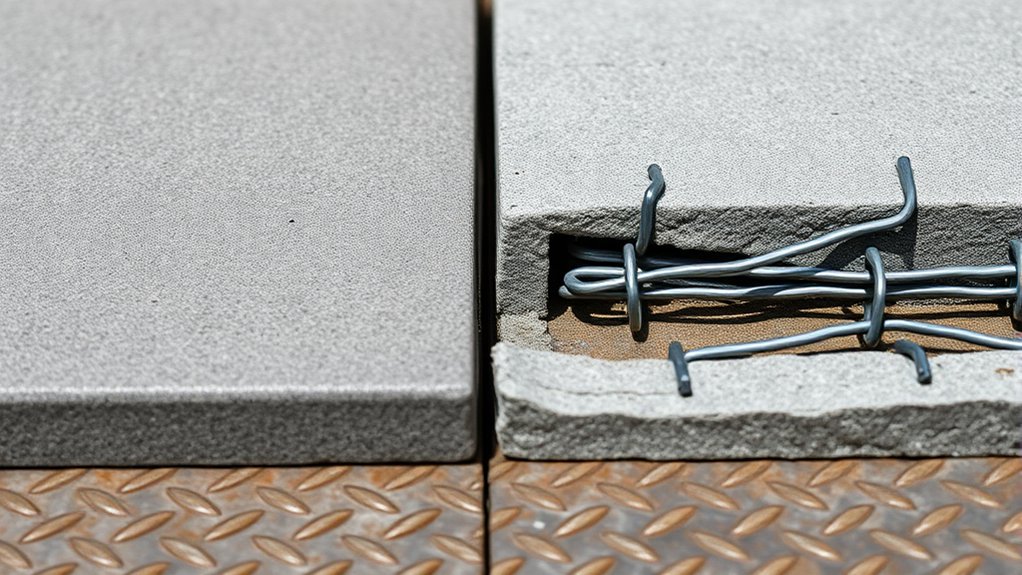
Although plain concrete already possesses substantial weight, adding steel reinforcement increases its density and overall mass considerably.
Plain concrete has a typical unit weight of about 144 pounds per cubic foot (2,400 kg/m³), while reinforced concrete increases to roughly 150 pounds per cubic foot (2,500 kg/m³).
This 4-5% weight increase results from steel rebar’s higher specific gravity, around 7.85, compared to the concrete matrix.
The additional steel notably impacts structural calculations, adding approximately 6,000 pounds per cubic yard over plain concrete.
While reinforced concrete enhances tensile strength, it also demands accounting for this increased weight due to the steel inclusion.
Understanding this distinction in unit weight between plain and reinforced concrete is critical for precise load estimations and design considerations.
How to Calculate Total Concrete Weight for Your Project
Calculating the total weight of concrete for your project means multiplying the volume by the material’s density. Typically, the density averages around 145 pounds per cubic foot for a standard mix.
To find the total concrete weight, start by measuring the volume in cubic feet or convert cubic yards to cubic feet. Then, multiply that volume by the concrete density.
Keep in mind that changes in density can affect weight calculations and how you plan your project.
Consider these factors for an accurate calculation:
- Convert volume correctly (1 cubic yard = 27 cubic feet)
- Use the standard density (~145 lbs/ft³) unless told otherwise
- Adjust for additives or air content that change density
- Think about the structural load and handling needs based on weight
Following this simple approach helps you get a reliable weight estimate for your concrete project.
Estimating Concrete Weight for Different Mixes
When selecting a concrete mix, you’ll find that the weight varies considerably based on its composition. Normal-weight concrete typically weighs about 2,400 kg/m³ (150 lbs/ft³). But this can range from approximately 3,000 to 3,900 pounds per cubic yard depending on the specific mix and aggregate density.
Lightweight mixes, which incorporate pumice or foam aggregates, reduce the weight to around 1,920 kg/m³ (120 lbs/ft³).
On the other hand, higher-density concrete mixes that use dense aggregates can reach up to 4,500 pounds per cubic yard.
The water-to-cement ratio, aggregate type, air content, admixtures, and compaction methods all influence the concrete mix’s density and weight.
Tips for Ordering the Right Amount of Concrete by Weight
Since concrete weight varies with mix design and aggregate type, you need to carefully calculate the total weight required for your project to order accurately. Estimating the weight of concrete precisely helps you select the appropriate delivery truck and avoid costly excess or shortages.
Keep these tips in mind:
- Confirm the specific mix design and aggregate with your supplier to get accurate weight data.
- Use the standard weight range of 3,000 to 4,000 pounds per cubic yard as a baseline, adjusting for lightweight mixes (around 2,500 pounds).
- Include an allowance for waste, spillage, and compaction variability to ensure you have enough material.
- Calculate total weight based on project volume and density to prevent under- or over-ordering.
Tools and Formulas to Calculate Concrete Weight Easily
Although concrete weight varies with mix type and volume, you can quickly determine it by applying straightforward formulas and using reliable tools.
Start by identifying the concrete density, which typically ranges from 2,400 kg/m³ (150 lb/ft³) for standard mixes to lower values for lightweight concrete.
To calculate weight, multiply the volume by the concrete density.
For example, multiply cubic yards by 3,000 to 4,000 lbs or cubic feet by 145 lbs/ft³.
Digital calculators and mobile apps designed for construction can automate these calculations, reducing errors.
Spreadsheet templates also help by allowing you to input volume and select density based on mix type.
Using these precise tools and formulas guarantees you accurately estimate concrete weight for any project dimension or mix specification.
It’s a simple way to make sure your measurements are spot on without any hassle.
How Additives Affect Concrete Weight
When you incorporate additives into concrete, you directly influence its weight by altering the material’s density and composition. Additives like air entrainers and plasticizers reduce concrete weight by introducing controlled air voids or improving workability, which lowers density.
Using lightweight aggregates such as expanded clay or pumice with additives can decrease concrete weight considerably, sometimes below 3,000 pounds per cubic yard.
Incorporating lightweight aggregates like expanded clay or pumice can reduce concrete weight significantly, often below 3,000 pounds per cubic yard.
On the other hand, some chemical additives enhance compaction by reducing air pockets and increasing density, which raises concrete weight.
Water-reducing admixtures adjust water content without substantially affecting weight, but keep in mind that excess water adds moisture weight.
Ultimately, the specific concrete weight depends on the types and amounts of additives used, typically ranging between 3,000 and 4,000 pounds per cubic yard.
Understanding these effects helps you control concrete weight precisely for your project requirements. It’s all about choosing the right mix to get the results you want.
How Vehicle Limits Affect Concrete Weight Delivery
Adjusting concrete weight through additives is just one piece of the puzzle. You also need to account for vehicle weight limits when planning deliveries. These limits directly influence the maximum concrete weight a truck can safely transport, balancing payload with legal and mechanical constraints.
If you ignore these limits, you risk overload, fines, or even damage to the vehicle. So, it’s important to keep them in mind to avoid headaches down the road.
Key considerations include maximum gross vehicle weight and axle load restrictions. Plus, the chassis capacity of typical 8-10 yard concrete trucks usually maxes out around 30,000 lbs.
You also have to factor in legal and local regulatory weight limits. And don’t forget the impact of mix density on the actual concrete weight per load.
Finally, site-specific factors like haul distance and access can affect the permissible load size. These little details make a big difference when planning your delivery.
Estimating Concrete Truck Capacity by Yardage
Although most ready-mix concrete trucks advertise capacities between 8 and 10 cubic yards, you should expect actual delivery volumes to vary based on factors like mix design, water content, and site constraints.
The typical weight of one cubic yard of concrete is about 4,050 pounds, which directly impacts truck capacity due to legal weight limits.
Smaller trucks hold 3 to 4 yards, while larger models can carry up to 10 yards or more. But these figures don’t always reflect real-world conditions.
You need to verify the truck capacity with your supplier, as operational limits often reduce volume below advertised specs.
Frequently asked questions
How Long Does Concrete Take to Cure Fully?
Concrete takes about 28 days to cure fully and reach its maximum strength. You’ll notice it gains roughly 70% of its strength within the first 7 days, but the hydration process continues beyond that.
To guarantee proper curing, you need to keep the concrete moist and at an appropriate temperature.
Skipping these steps can reduce durability and cause cracking.
Can Concrete Weight Affect Foundation Design?
Absolutely, concrete weight can make or break your foundation design. You can’t just guess because it directly dictates load-bearing capacity and stress distribution. Using heavier mixes means you need stronger reinforcement and larger footings.
On the other hand, lighter concrete lets you optimize materials and reduce costs. You have to analyze the density precisely to guarantee stability and prevent catastrophic structural failure.
Overlooking this factor risks under-designing foundations, which isn’t just costly, it’s downright dangerous.
What Safety Measures Are Needed When Handling Heavy Concrete?
When handling heavy concrete, you must wear appropriate PPE like gloves, safety goggles, and steel-toed boots to prevent injuries.
Use mechanical aids such as cranes or wheelbarrows to move loads safely, avoiding manual lifting.
Keep your work area clear and stable to prevent slips or falls.
Apply proper lifting techniques to reduce strain, and always respect equipment weight limits to avoid structural failures or accidents caused by overloads.
It’s all about staying safe and making sure you don’t put yourself or others at risk while handling heavy materials.
Taking these precautions seriously can really make a difference on the job.
How Does Temperature Impact Concrete Weight During Installation?
When it comes to concrete weight during installation, temperature plays a vital role. You can’t judge a book by its cover.
Higher temps speed up water evaporation, slightly reducing moisture and weight.
Cooler temps slow hydration, decreasing density and weight marginally.
Extreme temperatures cause volume shifts without major weight changes.
To keep your concrete’s weight consistent, you’ve got to control the temperature during mixing and curing precisely. It really makes a difference in the final outcome.
Are There Lightweight Concrete Alternatives for Specific Projects?
Yes, you can use lightweight concrete alternatives like aerated autoclaved concrete (AAC) or geopolymer concrete for specific projects requiring reduced structural loads.
AAC offers excellent thermal insulation and weighs considerably less than standard concrete.
Geopolymer concrete provides high strength with lower density and environmental impact.
You should select these based on project demands such as load capacity, durability, and thermal performance.
This way, you can optimize structural efficiency and cost-effectiveness.
Final Thought
Now that you’ve nailed down how much concrete weighs and the factors influencing it, you’re set to avoid any surprises on your project. Remember, even small changes in moisture or reinforcement can tip the scales, so calculate carefully.
With the right tools and formulas at your fingertips, you won’t be left holding the bag. Accurate weight estimates are the cornerstone of efficient planning and ensuring your concrete work stands the test of time.
More Quantities & Weights Guides
- How Wide Is a Concrete Truck
- How Many Bags of Concrete Do I Need
- How Many Bags of Concrete in a Yard
- How Many Bags of Concrete on a Pallet
See all Quantities & Weights guides · All concrete resources
Need Concrete in Greater Cleveland?Tri County Concrete delivers ready mix from plants in North Royalton and Twinsburg, Ohio. Request a quote or call 440-582-1100.