How Much Concrete Per Fence Post – The Real Numbers
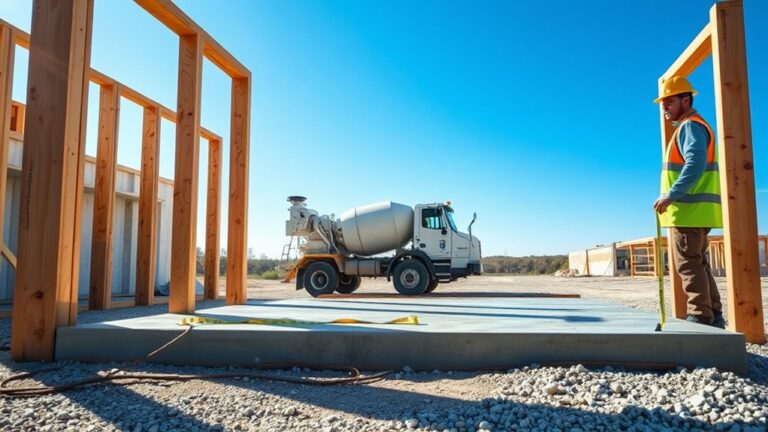
You’ll need about 0.6 to 0.75 cubic feet of concrete per standard 4×4 fence post. These posts are typically set in a 10-inch diameter, 24-inch deep hole.
This usually means using two to three 60-pound bags of concrete. That amount accounts for waste and mixing variations.
Larger posts or deeper holes will increase the volume needed, so make sure to measure accurately using the cylinder formula. Proper mix, curing, and hole sizing are critical for stability.
Understanding these details helps guarantee your installation lasts and performs well. Taking the time to get it right makes all the difference.
How Much Concrete Does a Standard Fence Post Need?
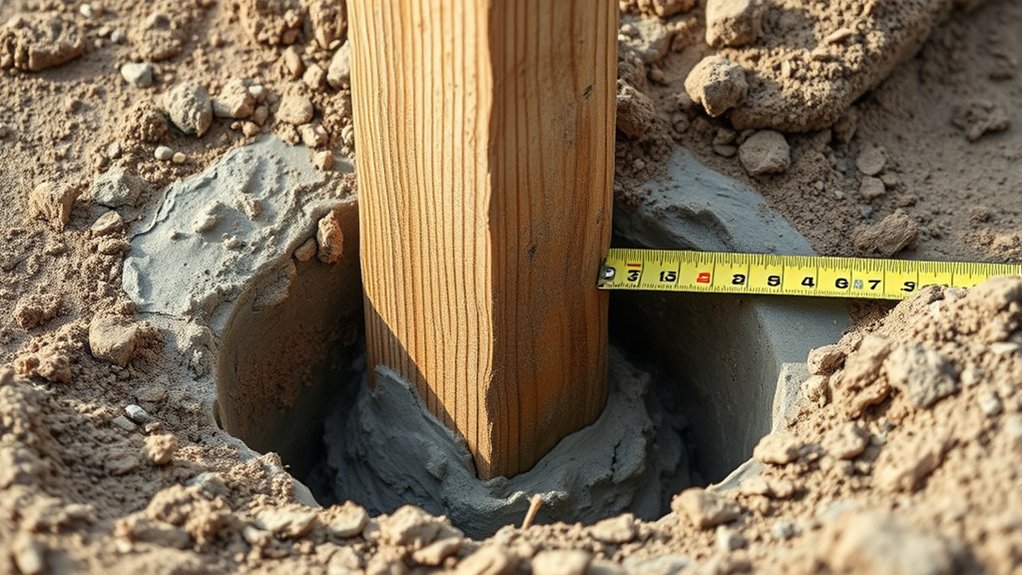
When setting a standard 4×4 inch fence post, you’ll need about 0.6 to 0.75 cubic feet of concrete per hole to make sure it stays stable.
For a 4-foot tall fence post, a 10-inch diameter hole needs around 0.7 cubic feet of concrete. Meanwhile, an 8-inch diameter hole takes roughly 0.6 cubic feet.
A 4-foot fence post requires about 0.6 to 0.7 cubic feet of concrete depending on hole diameter.
Since a 60-pound bag of concrete yields about 0.45 cubic feet, plan on using 1 to 2 bags per post depending on the hole size.
It’s important to estimate the concrete volume accurately for consistent post spacing and solid structure.
Also, always factor in a 10% waste margin to cover any irregularities in the hole.
This way, your fence post will be securely anchored, and you’ll use your materials efficiently while making installation easier.
How Post Size and Depth Affect Concrete Volume
Understanding how post size and hole depth impact concrete volume helps you plan your material needs more accurately. The concrete volume depends directly on both post dimensions and hole depth.
Larger post sizes, like 5×5 inches, increase the cross-sectional area, demanding more concrete compared to 4×4 inch posts.
Similarly, increasing the post depth from 3 to 4 feet raises the concrete volume by roughly 33%, assuming a consistent hole diameter.
You calculate concrete volume by multiplying the hole’s cross-sectional area based on its diameter by the post depth, applying the cylinder volume formula.
For instance, a 4×4 post in a 12-inch diameter hole requires about 0.88 cubic feet of concrete per foot of depth.
Precise consideration of post size and depth guarantees structural stability and accurate material estimation.
How to Measure Post Hole Dimensions Accurately

Accurately measuring post hole dimensions requires careful attention to both diameter and depth to guarantee proper concrete volume calculations. Start by measuring the diameter at the widest point using a tape measure or diameter gauge, ensuring accuracy. Take multiple measurements around the circumference to detect any irregularities or uneven shaping.
For depth, use a marked stick or measuring tape to record from the surface to the hole’s bottom. This is typically half the fence height plus the buried portion. You want to make sure your depth measurement is spot on.
Verify the diameter consistency throughout the hole’s depth by inserting a ground rod or long, straight stick. Confirm all post hole measurements before mixing concrete to avoid errors in volume estimation.
Precise diameter and depth measurements directly impact the accuracy of your concrete calculations and overall fence stability.
How to Calculate Concrete Bags Needed Per Fence Post
Once you’ve measured your post hole dimensions precisely, calculating the amount of concrete needed becomes straightforward.
Accurately measuring post hole dimensions makes determining the right amount of concrete simple and efficient.
First, determine the volume of the hole, which is typically a cylinder, using the formula π × (radius)^2 × depth.
For a standard 10-inch diameter, 24-inch deep hole, this volume is about 0.65 cubic feet.
Next, check your bagged concrete yield. A 50-pound bag produces roughly 0.375 to 0.45 cubic feet.
Divide the hole volume by the volume per bag to figure out how many bags you’ll need.
Usually, this comes out to 2 to 3 concrete bags per fence post.
Don’t forget to add around 10% extra for waste and spillage.
If your post hole size increases, just adjust the calculations to make sure you have enough concrete bags for a stable fence post foundation.
Concrete Mix Types and Bag Sizes Explained
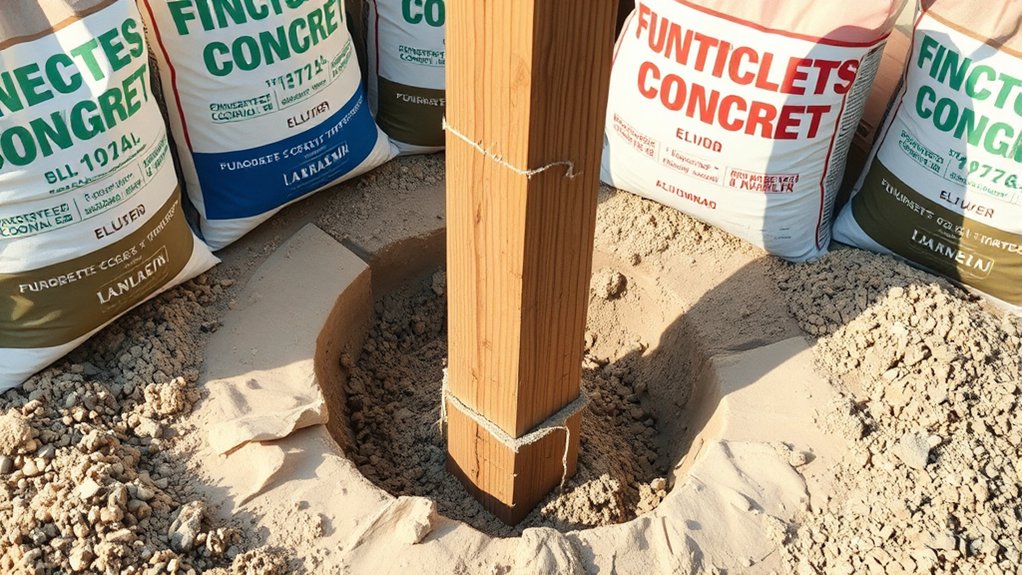
You’ll find concrete bags come in standard sizes, usually 60 or 80 pounds. Each size gives you a different volume of mix.
Picking the right bag size really depends on the size of your post hole and how much concrete you need, which is typically between 0.5 to 0.6 cubic feet per post.
Knowing these differences makes it easier to figure out exactly how many bags you’ll need to buy, saving you time and hassle.
Common Concrete Mixes
Three common concrete mix types: Standard, High-Strength, and Quick-Set address varying fence post installation requirements based on soil conditions and load demands. You’ll select a concrete mix depending on factors like soil stability and anticipated structural load.
Standard mixes suit typical soil and moderate loads, while High-Strength mixes are ideal for poor soil or heavy posts. Quick-Set mixes reduce curing time, allowing faster project completion.
Bag size influences yield; 60-pound bags yield about 0.45 cubic feet, while 80-pound bags yield approximately 0.60 cubic feet of mixed concrete. Accurate mixing ratios guarantee maximum strength and durability.
Proper curing time is critical; insufficient curing compromises post stability.
Bag Size Variations
How do different bag sizes impact your concrete requirements for fence posts? Concrete bags typically come in 60-pound and 80-pound sizes, with a volume per bag of approximately 0.45 and 0.60 cubic feet, respectively. Selecting the appropriate bag size depends on your project scale.
For a single post hole about 12 inches in diameter and 2 feet deep, a 60-pound bag usually suffices.
Larger projects benefit from 80-pound bags due to their cost efficiency and reduced handling. While specialized mixes may slightly alter volume per bag, the difference is minimal.
Always factor in a 10% surplus for waste and spillage when calculating total bags needed. Understanding these bag size variations guarantees accurate material estimation and ideal resource allocation for your fence post installation.
How Fence Length and Post Spacing Affect Concrete Needs
You’ll see that the total fence length directly affects how many posts you’ll need. And since each post requires concrete, that number plays a big role in your concrete needs.
If you increase the space between posts, you’ll have fewer holes to dig, which means less concrete overall.
But keep in mind, bigger gaps might mean you need larger or deeper holes for each post to keep things sturdy. So, it’s all about finding the right balance to make the best use of your concrete based on your fence size.
Fence Length Impact
What determines the total amount of concrete you’ll need for your fence posts? Primarily, the fence length and post spacing dictate the number of posts, which directly affects the concrete required. Each post typically consumes about 0.6 cubic feet of concrete, and this stays consistent across different fence lengths.
As your fence length increases, the total concrete calculation scales linearly because you’ll have more posts to set. It’s a straightforward way to estimate your material needs without any surprises.
| Fence Length (ft) | Post Spacing (ft) | Number of Posts | Concrete per Post (cu ft) | Total Concrete Needed (cu ft) |
|---|---|---|---|---|
| 50 | 6 | 9 | 0.6 | 5.4 |
| 100 | 6 | 17 | 0.6 | 10.2 |
| 100 | 8 | 13 | 0.6 | 7.8 |
| 150 | 6 | 26 | 0.6 | 15.6 |
Understanding this relationship makes sure you get accurate concrete estimates no matter the fence length you’re working with.
Post Spacing Influence
Although the total concrete volume per post remains consistent, adjusting the post spacing considerably affects the overall concrete required for your fence. Post spacing directly influences the number of fence posts needed, which in turn impacts the total concrete volume for the entire fence project.
Each post requires a hole sized based on post dimensions, typically 3 to 4 times the post diameter. This size determines the concrete needed per hole.
When you increase post spacing, for example from 6 feet to 8 feet, you reduce the number of posts, thereby lowering the total concrete needed.
Accurately calculating post spacing alongside precise hole dimensions ensures you estimate concrete requirements correctly. This way, you avoid excess or shortages during installation.
Optimizing post spacing is essential for efficient material use and cost control in your fence project.
Tips for Mixing and Pouring Concrete Around Fence Posts
Since proper mixing and pouring directly affect the strength and durability of your fence posts, you’ll need to follow precise steps. Begin with accurate concrete mixing: combine one part cement, two parts sand, and three parts gravel. Add water gradually to maintain the correct water ratio, ensuring a workable yet firm mix.
Use a wheelbarrow or concrete mixer to achieve uniform consistency, preventing weak spots. When filling the post hole, typically 12 inches in diameter for a 4×4 post, pour the concrete to about 2 inches below ground level.
Then, tamp or vibrate the concrete to remove air pockets, which could compromise strength. These controlled actions guarantee ideal bonding and long-lasting stability for your fence posts.
It might seem a bit detailed, but taking these steps really pays off in the long run. Your fence posts will stand strong and steady for years to come.
How Weather and Soil Affect Concrete for Fence Posts
When you’re setting concrete for fence posts, it’s important to think about both the type of soil and the weather conditions.
For example, clay or sandy soils can change how well water drains and how stable the post will be, which affects how much concrete you’ll need to make a strong foundation.
Also, the temperature and moisture levels play a big role in how quickly the concrete cures and how strong it becomes.
Soil Type Impact
When installing fence posts, soil type plays a vital role in determining the amount of concrete needed for a stable foundation. Different soil types affect concrete requirements because they each have unique load-bearing capacities and support characteristics.
For example, loose or sandy soils need a greater depth of footing and larger concrete volumes to keep posts stable.
On the other hand, compacted clay soils provide better lateral support, so you can usually get away with less concrete.
Rocky soil, however, means you’ll have to dig wider or deeper holes, which increases the amount of concrete needed to secure the posts properly.
Here’s a quick rundown of how soil type impacts concrete needs:
- Sandy or loose soils require deeper footings for lateral stability
- Clay soils allow for smaller concrete volumes thanks to dense soil support
- Rocky soils require wider holes, which increases concrete volume
- Poor drainage soils can cause post movement unless there’s enough concrete reinforcement
Weather Conditions Effects
Although soil type sets the foundation, weather conditions play a big role in how concrete cures and performs around fence posts. Freezing temperatures cause concrete to expand and contract, which can lead to cracks and weaken post stability, especially near the frost line.
Heavy rainfall or saturated soil slows down concrete curing and reduces its strength if moisture isn’t managed properly.
On the other hand, hot, dry weather speeds up curing, which might cause weak bonding and cracking unless you keep the concrete moist.
Soil type matters here too. Sandy soils drain quickly, while clay holds onto moisture, and both affect how the concrete cures.
When extreme weather hits, it’s smart to take precautions like using insulation or delaying installation to protect the curing process.
Knowing all this helps make sure your concrete cures well and stays durable, keeping your fence posts strong no matter what the weather throws at you.
Common Concrete Mistakes When Setting Fence Posts and How to Avoid Them
Since concrete plays a critical role in securing fence posts, using too little or improperly mixed concrete often leads to instability and premature failure. You must use an adequate concrete amount, typically 1 to 1.5 cubic feet per post hole, to guarantee post stability.
Setting the post hole depth correctly, generally half the fence height, prevents leaning.
Make sure to allow sufficient curing time, at least 24 to 48 hours, before applying any stress.
Avoid mixing errors like improper water ratios or using fast-setting mixes in cold conditions. These mistakes can weaken the concrete and cause problems down the line.
Use proper concrete volume to avoid weak footing.
Set posts at the correct depth for maximum support.
Allow full curing time to enhance strength.
Adjust footing size and reinforcement for challenging soils.
Following these steps will help ensure your fence posts are durable and stable.
When to Consult a Professional for Fence Post Installation and Concrete Use
If you encounter challenging soil conditions, such as rocky or sandy terrain, consulting a professional guarantees your fence posts receive proper concrete footing and maintain stability.
You should also hire a professional to install large or irregularly shaped posts, like those for gates or corners. This ensures the concrete volume meets structural requirements.
For high or long fences, experts confirm footings comply with local frost line and wind load criteria.
When dealing with multiple posts or complex layouts, professional installation ensures consistent post height, alignment, and proper concrete curing.
Ultimately, if you’re uncertain about local building codes, concrete volume, or post depth requirements, always consult a professional. Their expertise ensures your fence posts are installed safely, meet all concrete and structural requirements, and achieve long-term durability.
Frequently asked questions
Can I Reuse Leftover Concrete for Another Project?
You can reuse leftover concrete only if it’s still fresh and workable, typically within an hour of mixing. Once it starts setting or hardens, reuse isn’t viable because its structural integrity diminishes.
Don’t add water or remix it, as that weakens the mix.
Always make sure the leftover concrete is free from contaminants before applying it to small projects. Otherwise, dispose of hardened concrete properly to avoid compromising your work.
It’s better to be safe than sorry when it comes to the strength of your project.
How Long Does Concrete Take to Fully Cure Around Fence Posts?
When you set fence posts with concrete, expect full curing to take about 28 days.
For example, a homeowner in Minnesota noticed his posts were stable after 48 hours but waited the full month before hanging a heavy gate. This timeline guarantees the concrete reaches its maximum compressive strength.
Factors like temperature and moisture can slow curing, so keep the mix damp.
Also, avoid stressing the posts prematurely to prevent cracks and assure durability.
Taking these steps helps make sure your fence lasts.
Are There Eco-Friendly Concrete Alternatives for Fence Posts?
Yes, you can use eco-friendly alternatives like geopolymer concrete. It cuts CO2 emissions by activating industrial by-products such as fly ash. This makes it a greener choice compared to traditional concrete.
Recycled plastic composites are another option. They offer durable, cement-free posts that last a long time without harming the environment. Plus, hempcrete, which is a mix of hemp fibers and lime, provides a breathable and biodegradable option.
It’s not as strong for heavy loads but works well for lighter fencing needs.
You could also go with natural stone or sustainably sourced wood posts. These avoid concrete entirely and fit right in with green building principles. They still maintain the strength you need for sturdy fencing.
What Tools Are Best for Mixing Concrete by Hand?
You’ll want a mixing hoe or a sturdy shovel for hand-mixing concrete. They give you the leverage and control needed to blend everything thoroughly.
If you have a power drill, you can attach a paddle to it. This makes the mixing more efficient and helps get a uniform mix every time.
Use a bucket or container with volume markings. It makes measuring the right ratios much easier.
After mixing, grab a trowel or float to smooth and level the concrete. These tools are especially handy in tight spots like fence post holes.
How to Remove a Fence Post Set in Concrete?
Removing a fence post set in concrete is like solving a puzzle. Start by loosening the soil around the base with a shovel or a post puller to expose the footing.
Then, use a sledgehammer or hydraulic puller to break or lift the concrete, applying steady force.
For stubborn posts, drill holes and apply a concrete dissolver or hot water to weaken the bond.
Always wear safety gear and proceed carefully to avoid injury.
Taking your time makes the process a lot easier and safer.
Final Thought
Now that you know how much concrete each fence post requires, you can avoid costly mistakes. For example, a homeowner installing 6×6 posts at 3 feet deep in clay soil used 2 bags of 80-lb concrete per hole. This ensured stability and longevity.
Accurate measurements, proper mix selection, and accounting for soil type are essential. When in doubt, consulting a professional prevents structural failures and saves time.
Precision in your calculations guarantees a durable, secure fence. So take your time and do it right!
More Quantities & Weights Guides
- How Much Does a Concrete Block Weigh
- How Much Does a Pallet of Concrete Weigh
- How Much Does a Yard of Concrete Cover
- How Much Does Concrete Weigh
See all Quantities & Weights guides · All concrete resources
Need Concrete in Greater Cleveland?Tri County Concrete delivers ready mix from plants in North Royalton and Twinsburg, Ohio. Request a quote or call 440-582-1100.