How Much Does A Pallet Of Concrete Weigh – Quick Facts
A pallet of concrete blocks typically weighs between 3,000 and 4,800 pounds, depending on the block type and density. Lightweight pallets usually average around 3,024 lbs with 18 lb blocks. On the other hand, normal weight blocks can push pallets above 4,100 lbs because they’re denser.
Knowing the accurate weights helps you plan for handling, transportation, and safety. Different weights also influence installation speed and project costs. So, understanding these factors makes sure you choose the right blocks for your specific project needs.
What Is the Typical Weight of a Pallet of Concrete Blocks?

How much does a pallet of concrete blocks typically weigh? The pallet weight varies a lot depending on the block type. For example, lightweight concrete blocks weigh around 3,024 pounds per pallet when loaded with 108 units.
Medium weight pallets bump that up to about 3,672 pounds.
Normal weight concrete blocks have the heaviest pallets, ranging from 4,100 to 4,800 pounds for the same number of blocks. This difference mainly comes down to the block density and the type of aggregate used.
Knowing these weights is really important for planning transportation and making sure you don’t exceed truckload limits. When handling concrete blocks, always consider the specific pallet weight to keep your logistics smooth and your operation safe.
How Does Block Density Affect Pallet Weight?
You’ll find that block density directly impacts the weight of each unit. Lightweight blocks weigh considerably less than normal weight ones. Because of this, the total pallet weight can vary quite a bit — from about 3,000 lbs to nearly 4,800 lbs for the same number of blocks.
Knowing these density differences really helps when you’re planning for transportation and handling.
Density Impact On Weight
Several factors influence the weight of a pallet of concrete blocks, with block density being a primary determinant. The unit weight, or weight of concrete per cubic foot, directly affects pallet weight. Higher-density blocks increase the total pallet load, while lower-density blocks reduce it.
Variations in mineralogy and aggregate types also impact density. So, it’s not just about the block type but what’s inside them that matters too. Understanding these details can help you get a better estimate of pallet weight.
| Block Type | Density (lb/cu ft) | Approximate Pallet Weight (lbs) |
|---|---|---|
| Lightweight CMU | < 125 | 3,024 |
| Medium Weight Block | 105 – 125 | 3,672 |
| Normal Weight CMU | 125 – 144 | > 3,672 |
| Aggregate Variation | Variable | Variable |
| Mineralogy Impact | Variable | Variable |
Knowing these factors will make it easier to estimate the weight of concrete pallets accurately.
Block Types And Weights
Because the density of concrete blocks varies widely, the weight of a pallet can differ considerably depending on the block type you select. Lightweight concrete blocks typically weigh around 18 lbs per hollow block, resulting in a pallet weight near 3,024 lbs for 108 units.
Medium weight blocks range from 15 to 36 lbs each, which proportionally adjusts the pallet weight.
Normal weight concrete blocks, composed of dense mineral aggregates, weigh between 38 and 44 lbs per block, markedly increasing the pallet weight.
Understanding block density is essential because higher density blocks demand more robust handling and logistics planning due to their increased mass.
When calculating pallet weight, always consider the specific block type and density to ensure accurate load management and safety compliance.
Comparing Lightweight, Medium, and Normal Weight Concrete Blocks
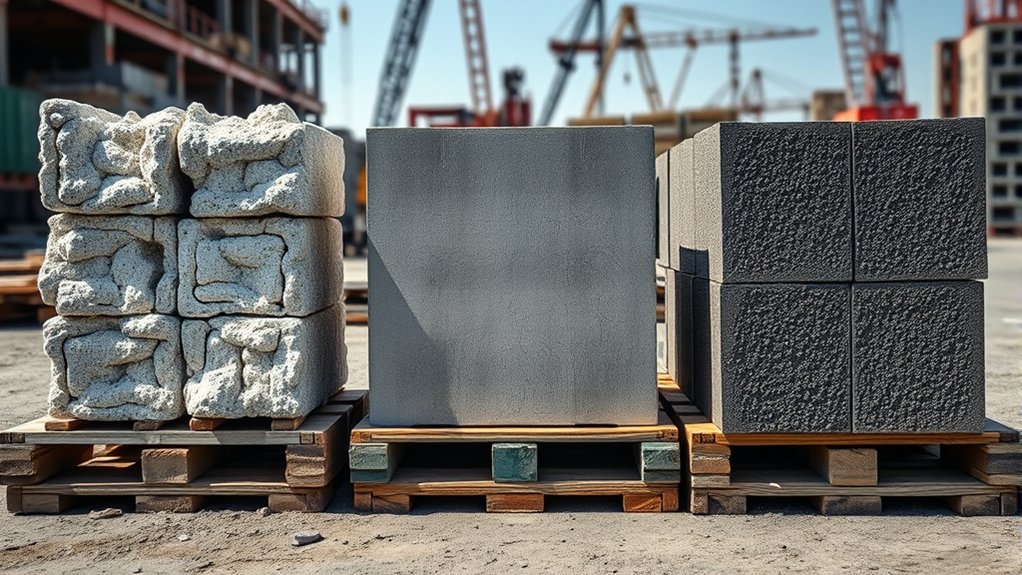
When comparing lightweight, medium, and normal weight concrete blocks, understanding their varying weights is essential for your project’s logistics and structural planning.
Lightweight concrete blocks weigh about 28 pounds each, totaling roughly 3,024 pounds per pallet of 108 units.
Lightweight concrete blocks weigh approximately 28 pounds each, with pallets totaling around 3,024 pounds for 108 units.
Medium weight blocks average 34 pounds per unit, resulting in a pallet weight near 3,672 pounds.
Normal weight concrete blocks are heaviest, with pallet weights ranging from 3,960 to 4,752 pounds depending on unit count and block density.
This weight classification directly influences handling requirements and structural load calculations.
Accurately determining pallet weight based on block type helps guarantee compliance with transportation weight limits and supports sound engineering decisions.
Knowing these distinctions enables you to select the appropriate concrete blocks for your specific construction needs.
It really makes a difference when planning and executing your build.
Why Pallet Weight Matters for Transportation and Handling
Understanding the weight differences among concrete blocks directly influences how you manage their transportation and handling. Pallet weight plays a vital role in determining transportation costs and logistics.
Heavier pallets, such as those weighing up to 3,600 pounds, require specialized equipment and reduce the number of pallets per truckload, increasing expenses.
Knowing exact pallet weights helps you avoid overloading, which can prevent fines and damage to infrastructure. Plus, having accurate weight data guarantees handling safety by allowing you to prepare the correct equipment and protocols. This minimizes the risk of accidents or injuries.
Precise pallet weight calculations also enable efficient delivery planning and ensure compliance with transportation regulations. This way, you optimize both cost-effectiveness and operational safety throughout your concrete block distribution process.
How to Calculate Total Weight for Your Concrete Block Order

To figure out the total weight of your concrete block order, just multiply the weight of one block by the number of blocks on the pallet.
It’s important to remember that block weights can vary quite a bit depending on the material density and how they’re made.
By getting an accurate total weight, you’ll be better prepared for transportation, handling, and storage.
This way, you can plan everything more smoothly and avoid any surprises along the way.
Block Weight Variations
How do you accurately calculate the total weight of your concrete block order? Understanding block weight variations is key. Here’s how to proceed:
First, identify the type of blocks: lightweight CMUs or normal weight CMUs. Then, determine the weight per unit. Lightweight CMUs weigh between 18 and 29 lbs, while normal weight CMUs range from 38 to 44 lbs.
Next, count the number of units in your order.
Finally, apply the formula: Total weight = number of units × weight per unit.
For example, a pallet with 108 lightweight units weighs about 3,024 lbs. The same number of normal weight CMUs comes to approximately 4,752 lbs.
Precise calculations help with proper logistics planning and make sure you comply with transport weight limits.
Always account for these variations so you don’t underestimate your load.
Pallet Load Calculations
Accurately calculating the total weight of your concrete block pallet requires multiplying the weight per unit by the number of units on the pallet. For effective pallet load calculations, begin by obtaining the specific concrete block weight from the manufacturer, as variations in aggregate density influence unit weight.
For example, a standard pallet of lightweight ASTM C90 blocks, containing 108 units, weighs approximately 3,024 pounds. Normal weight blocks of the same quantity often exceed 3,600 pounds.
Multiply the concrete block weight by the total number of units on your pallet to determine the total weight of the pallet. This precise calculation guarantees accurate transportation planning and handling safety, avoiding underestimation or overloading in logistics operations.
Always verify unit counts and weights for your specific block type.
How Block Weight Affects Masonry Productivity and Safety
Several factors related to block weight directly influence masonry productivity and worker safety. When handling concrete blocks, you’ll notice that weight impacts both efficiency and risk management. Consider these points:
Lighter concrete blocks (18-20 lbs) boost masonry productivity by reducing handling effort and time. Pallets of lightweight CMUs (~3,024 lbs) lessen worker strain, lowering injury risk.
Heavier blocks (up to 44 lbs) slow construction pace and increase fatigue, which affects project timelines.
Knowing the exact block weight is essential for designing structural supports and making sure safety measures are in place during installation.
Common Mistakes When Estimating Pallet Weight
When estimating the weight of a pallet of concrete blocks, you need to watch out for common pitfalls that can throw off your calculations. For example, assuming all blocks weigh about 30 lbs can lead to serious underestimation. That’s because normal weight units can weigh up to 44 lbs.
Also, don’t forget to include the weight of the pallet and packaging. Ignoring these can mess up your total weight estimate. And be careful when counting the units on a pallet—miscounts cause big errors.
On top of that, relying on average unit weights without checking specific product specs or regional density differences usually means your estimate won’t be accurate. It really pays to double-check those details before you finalize your numbers.
| Common Mistake | Impact on Pallet Weight Estimate |
|---|---|
| Assuming uniform unit weight | Underestimation or overestimation |
| Ignoring pallet/packaging weight | Inaccurate total weight calculation |
| Miscounting units per pallet | Significant calculation errors |
| Neglecting regional density | Incorrect assumptions on weight |
Tips for Choosing the Right Concrete Block Weight for Your Project
Although selecting the right concrete block weight depends on your project’s structural requirements, you should also consider factors like load-bearing capacity and handling logistics.
To choose effectively, focus on these key points:
- Assess the load-bearing capacity needed to guarantee structural safety and compliance with building codes.
- Decide between lightweight blocks (18-29 lbs) for reduced dead load and easier handling or normal weight blocks (38-44 lbs) for enhanced thermal mass and fire resistance.
- Calculate pallet weight to confirm it aligns with transportation and handling equipment limits.
- Factor in how block weight affects installation efficiency and overall project costs.
Frequently asked questions
What Are the Environmental Impacts of Producing Different Concrete Block Weights?
You’ll find that producing heavier concrete blocks generally results in higher environmental impacts. This is mainly because of greater raw material extraction and increased energy consumption during manufacturing.
Lightweight blocks, which use expanded shale or clay, reduce material use and require less kiln energy. This helps lower their carbon footprint.
Plus, incorporating recycled aggregates into lightweight blocks further decreases environmental effects. It minimizes the need to extract virgin resources.
How Does Moisture Content Affect the Weight of Concrete Blocks?
Moisture content directly increases the weight of concrete blocks because water adds mass. You’ll find lightweight blocks can absorb up to 18 lb/cu ft of water, while normal weight blocks absorb around 13 lb/cu ft.
This added moisture increases total weight, affecting transport and structural calculations.
If you don’t account for moisture, you risk underestimating load requirements. Proper waterproofing helps you control moisture absorption and maintain accurate weight estimates.
It’s really important to keep this in mind when planning your project.
Can Concrete Block Weight Influence Thermal Insulation Properties?
Yes, concrete block weight directly influences thermal insulation properties.
For example, lightweight blocks weighing around 25-29 lbs offer R-values up to 10 with inserts. That’s markedly higher than heavier blocks, which usually range from 1.1 to 1.4.
The reduced density and cellular structure in lighter blocks trap air, which improves insulation.
Are There Regulations on Maximum Pallet Weights for Shipping Concrete Blocks?
Yes, you need to follow regulations on maximum pallet weights when shipping concrete blocks. These limits often align with your region’s truck gross weight restrictions, typically around 80,000 pounds in the U.S.
You must calculate the total pallet weight, including blocks and packaging, to comply with these rules. Proper weight distribution is critical to avoid fines or damage.
How Does Block Size Variation Impact Overall Pallet Weight?
Block size greatly influences the shipment’s substantial weight. When you increase block dimensions from 8-inch to 12-inch units, you boost individual block mass, which increases the pallet’s overall weight by 10-20%.
Even if you keep the unit count constant, larger blocks add more bulk and burden.
You’ll need to factor these fluctuations into load planning and logistics. This helps guarantee safe handling, accurate weight calculations, and compliance with transportation regulations.
It’s all about making sure everything moves smoothly and safely.
Final Thought
Now that you know how block density and pallet weight intertwine, imagine handling your project without precise weight calculations. Delays, safety risks, and added costs could easily pile up.
Don’t let guesswork slow you down. By accurately evaluating pallet weight, you’ll streamline transportation, boost productivity, and ensure safety.
The right choice isn’t just about concrete. It’s about mastering your project’s efficiency. Ready to make every pound count? Your next move shapes success.
More Quantities & Weights Guides
- How Much Does a Yard of Concrete Cover
- How Much Does Concrete Weigh
- How Wide Is a Concrete Truck
- How Many Bags of Concrete Do I Need
See all Quantities & Weights guides · All concrete resources
Need Concrete in Greater Cleveland?Tri County Concrete delivers ready mix from plants in North Royalton and Twinsburg, Ohio. Request a quote or call 440-582-1100.