What Is Cemex – Meaning & More
Cemex, a global leader in cement and concrete, derives its name from “Cemento” and “Mexico,” reflecting its origins. You’ll find Cemex operating in over 50 countries, offering innovative products like self-compacting concrete and fiber-reinforced mixes.
It’s renowned for integrating sustainability through water-saving initiatives and renewable fuels that cut emissions considerably. Beyond materials, the company advances construction efficiency and supports social projects.
Stay tuned to explore how Cemex’s innovation drives sustainable building worldwide.
Who Is Cemex and What’s Behind the Name?

Although you may know Cemex simply as a cement producer, it’s actually a multinational company specializing in cement, concrete, and aggregates. Cemex’s name combines “Cemento” (cement) and “Mexico,” highlighting its origins and core focus in building materials.
Cemex, rooted in Mexico, excels as a global leader in cement, concrete, and aggregates.
It was founded in 1906 in Mexico and has strategically expanded to become one of the global leaders in cement production. Its brand reflects a commitment to innovation and sustainable construction solutions.
Operating in over 50 countries, Cemex wields significant international influence across the building materials sector.
Understanding Cemex means recognizing its evolution from a regional cement manufacturer to an all-encompassing multinational provider of essential construction materials.
They emphasize both technical expertise and global reach, which makes them stand out in the industry.
Cemex’s Core Products and Market Focus
What drives Cemex’s position as a global leader in construction materials? It’s their extensive portfolio, including cement, ready-mix concrete, aggregates, and related products. You’ll find Cemex serving diverse sectors like residential, commercial, and infrastructure, addressing varied project demands worldwide.
With about 40,000 employees, they maintain operational excellence to guarantee consistent quality and innovation. Cemex integrates sustainability into their core product development, focusing on reducing environmental impact while meeting market needs.
How Cemex Leads in Sustainable Building Materials

You’ll see how Cemex’s water-saving innovations, like freshwater-free concrete, drastically reduce resource consumption in construction.
Plus, the company integrates renewable fuels to cut carbon emissions and boost energy efficiency across its operations.
Together, these strategies really position Cemex at the forefront of sustainable building materials.
Water-Saving Innovations
How does Cemex achieve significant water savings in its concrete production? Cemex implements a freshwater-free concrete initiative, reaching a 67% water substitution rate in Mexico by 2025. This water-saving approach is verified by AENOR’s Zero Freshwater and Zero Discharge certification, earned by 31 Cemex concrete plants in Mexico.
These innovative building solutions eliminate freshwater use, enhancing sustainability and operational resilience. Cemex also expands these practices internationally, replicating certification programs in France, Spain, and the United States.
Furthermore, the Evolution™ self-compacting concrete reduces water demand by minimizing vibration equipment use, improving surface quality.
Renewable Fuel Integration
Why is renewable fuel integration essential for sustainable construction? It directly lowers greenhouse gas emissions and reduces reliance on fossil fuels, which is critical for environmental resilience. Cemex leads the way by incorporating renewable fuels like renewable natural gas (RNG) into its operations. This aligns perfectly with its net-zero CO2 goal by 2050.
Here’s how Cemex advances sustainability through renewable fuel integration:
- Fleet modernization reduces approximately 8,822 metric tons of CO2e annually using RNG-powered trucks.
- A private RNG fueling station in Rialto, California, supplies 300,000 gallons of renewable fuels yearly.
- Renewable fuels are used in cement and ready-mix concrete production, cutting the carbon footprint of building materials.
- The strategy promotes corporate social responsibility and sets industry benchmarks for sustainable construction.
You’ll see that Cemex’s commitment drives measurable progress in sustainable building materials. It’s a clear example of how integrating renewable fuels can make a real difference.
Explained: Cemex’s Freshwater-Free Concrete Initiative
You’ll see how Cemex is swapping out traditional freshwater for alternative sources, aiming to hit a 67% substitution rate in Mexico by 2025. This isn’t just about numbers—it’s focused on water-stressed regions where every drop counts.
By doing this, Cemex is helping to boost environmental sustainability and conserve local water resources.
And it gets better: with 31 plants already certified under AENOR’s Zero Freshwater Framework, Cemex is taking this model global.
This approach not only supports the environment but also strengthens operational resilience across their sites.
Freshwater Substitution Rates
Where does Cemex find the water to replace freshwater in its concrete production? Cemex achieves a 67% freshwater substitution rate by using alternative water sources, especially in water-stressed regions. This approach guarantees sustainability while maintaining concrete quality.
You’ll find 31 Cemex plants in Mexico certified under AENOR’s Zero Freshwater and Zero Discharge Framework, showcasing their commitment.
Key aspects of Cemex’s freshwater substitution include:
- Utilizing recycled and non-potable water sources in concrete production
- Targeting water-stressed regions to maximize impact
- Certifying plants to validate freshwater-free processes
- Expanding the initiative to France, Spain, and the U.S.
These efforts highlight Cemex’s technical focus on reducing freshwater dependency while supporting sustainable concrete practices.
Environmental Sustainability Focus
Cemex’s freshwater substitution strategy directly supports its broader environmental sustainability goals by minimizing water consumption in concrete production. By replacing up to 67% of freshwater with alternative sources, especially in water-stressed regions of Mexico, Cemex helps reduce pressure on scarce freshwater supplies.
At the same time, they maintain the quality of their concrete.
The certification of 31 plants under AENOR’s Zero Freshwater and Zero Discharge Framework validates these efforts. It ensures no freshwater use and promotes efficient water management. This initiative clearly shows Cemex’s commitment to operational resilience and environmental stewardship.
On top of that, integrating renewable energy into its processes complements water management efforts. This combination helps reduce the overall environmental impact.
Certification And Expansion
Although the initiative started in Mexico, the certification of 31 concrete plants under AENOR’s Zero Freshwater and Zero Discharge Framework marks a significant milestone in sustainable concrete production.
Cemex’s freshwater-free concrete initiative reached a 67% substitution rate of freshwater with alternative sources in 2025, showcasing tangible progress in sustainable practices.
You’ll find the certification and expansion strategy focuses on:
- Ensuring no freshwater use in certified plants.
- Replicating the certification program in France, Spain, and the U.S.
- Aligning water sustainability with environmental impact reduction.
- Enhancing operational resilience through innovative production methods.
Cemex’s Innovative Concrete Solutions for Construction
When tackling complex construction projects, you’ll find that innovative concrete solutions like Evolution™ self-compacting concrete offer significant advantages by spreading evenly with minimal vibration. This works well even in heavily reinforced or intricate formwork.
Cemex’s self-compacting concrete enhances structural integrity and reduces labor demands, making it ideal for innovative building designs.
Their fibre reinforced concretes use polypropylene, macro, and steel fibres to replace traditional steel mesh. This cuts installation time without compromising strength.
Plus, rapid hardening options like Promptis speed up project timelines by achieving early strength in about six hours.
Cemex also provides factory-produced mortars in various formats, which improve site safety and minimize waste. These high-quality products collectively streamline construction processes.
How Cemex Uses Renewable Fuels to Cut Emissions
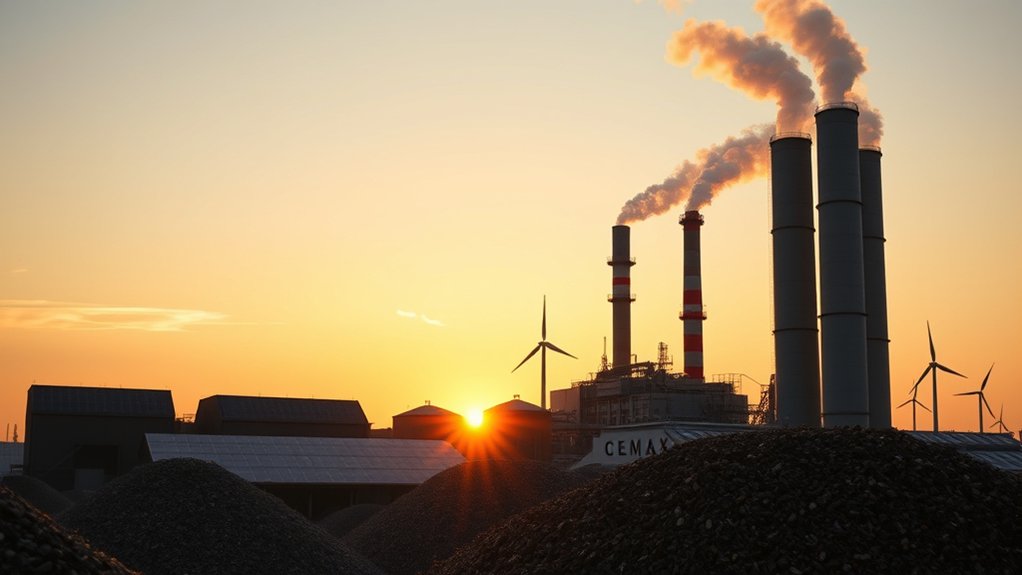
Beyond advancing concrete technologies, reducing environmental impact in construction logistics plays a key role in sustainability. Cemex leverages renewable fuels, specifically renewable natural gas (RNG), to achieve significant emissions reduction in its fleet operations. You can see this approach in four main actions:
- Partnering for RNG fueling in Southern California, cutting greenhouse gases by approximately 300%.
- Building a private RNG fueling station to supply cement and ready-mix trucks by year-end.
- Projecting an annual CO2e reduction of 8,822 metric tons, equal to removing nearly 2,000 gasoline vehicles.
- Aligning renewable fuel adoption with Cemex’s 2050 net-zero CO2 goal, reinforcing its sustainability commitments.
Using RNG derived from organic waste, Cemex decarbonizes transportation, reduces fossil fuel dependence, and strengthens environmental resilience. It’s a smart move that supports both the planet and the future of construction logistics.
Cemex’s Global Reach and Sustainable Growth
You’ll see Cemex operates in over 50 countries, supplying critical construction materials worldwide. Their global footprint supports a variety of markets, which is pretty impressive.
What’s even better is how they drive sustainable growth by using innovations like freshwater-free concrete.
When you understand this international reach, it becomes clear how Cemex balances running a large operation while still being environmentally responsible.
International Operations Overview
How does Cemex maintain its position as a leading global construction materials company? By optimizing its international operations with a strategic global footprint and product diversity. You’ll see Cemex operates in over 50 countries, spanning the Americas, Europe, Africa, the Middle East, and Asia. This ensures market reach and adaptability.
Key factors include:
- Diverse product portfolio: cement, ready-mix concrete, aggregates, and building materials tailored for international markets.
- Robust logistics network: numerous plants, quarries, and distribution centers optimize supply chain efficiency worldwide.
- Innovation-driven growth: continuous development in processes and products supports competitive advantage.
- Integration of sustainable practices across operations, aligning growth with environmental objectives without compromising performance.
This extensive approach enables Cemex to sustain its global leadership and operational excellence.
Commitment To Sustainability
Cemex’s expansive global operations not only drive market reach but also demand a rigorous approach to sustainability. You’ll see Cemex lead with innovative initiatives like freshwater-free concrete production, achieving a 67% substitution rate in Mexico by 2025. They certify 31 concrete plants under the Zero Freshwater and Zero Discharge Framework, emphasizing water conservation and setting a benchmark for sustainable manufacturing.
Cemex’s strategic focus reduces both water and carbon footprints, aligning with its ambition to become a net-zero CO2 company by 2050. By leveraging digital tools and sustainable materials, Cemex guarantees responsible growth across its worldwide markets.
Their repeated recognition by Fortune underscores the tangible social and environmental impacts of their sustainability commitments. This recognition reinforces their role as a global leader in sustainable construction solutions.
It’s clear that Cemex isn’t just talking about sustainability—they’re making it happen.
Certifications and Environmental Commitments at Cemex
What drives a construction giant like Cemex to pursue rigorous environmental certifications? It’s their commitment to sustainability and minimizing environmental impact through verified operational standards.
Cemex has certified 31 concrete plants in Mexico under AENOR’s Zero Freshwater and Zero Discharge Framework, ensuring no freshwater is used in production. Their environmental commitments include replacing freshwater in concrete with alternative sources, targeting a 67% substitution rate in Mexico by 2025.
They’re also expanding these sustainable certifications to markets in France, Spain, and the United States. Using certification processes helps validate their resource efficiency and reduced environmental footprint.
On top of that, Cemex has earned recognition in Fortune’s Change the World list, which shows how they align business growth with sustainability. These certifications really confirm Cemex’s strategic approach to environmental stewardship.
How Cemex Supports Communities Through Social Impact
Beyond environmental initiatives, Cemex actively strengthens communities through targeted social impact programs. You’ll see this in Patrimonio Hoy, which advances community development by providing affordable housing solutions.
Cemex’s commitment extends to health, evident in its award-winning COVID-19 mobile hospitals that improve access to essential medical infrastructure.
Recognized on Fortune’s Change the World list, Cemex leverages sustainable concrete solutions to drive social impact. Its efforts focus on underserved regions, enhancing resource availability and infrastructure.
Furthermore, programs like the Growing Platform of Inclusive Businesses promote economic growth and social well-being at the local level.
By integrating these initiatives, Cemex ensures that its social impact complements its environmental goals. This approach fosters resilient communities through sustainable solutions and community development.
It’s all about making a real difference where it matters most.
What the Future Holds for Cemex and Sustainable Building
As sustainability demands grow, Cemex is accelerating its shift toward net-zero carbon emissions by 2050 through innovations like freshwater-free concrete and renewable fuel integration. You’ll see Cemex shaping the future of sustainable building by expanding eco-friendly practices globally and leveraging innovation in construction materials.
Key future directions include:
- Scaling Zero Freshwater and Zero Discharge certifications to reduce environmental impact.
- Deploying advanced solutions like Evolution™ self-compacting concrete for efficient, labor-saving builds.
- Integrating digital tools to enhance project precision and resource management.
- Increasing reliance on renewable energy sources to power operations sustainably.
Frequently asked questions
What Is the Origin of Cemex’s Company Logo?
The origin of Cemex’s logo stems from its early 2000s rebranding, aiming to highlight its global presence and innovative mindset. You’ll notice the stylized “C” with clean, modern lines representing innovation.
Circular elements and a globe symbolize worldwide reach and environmental focus.
The blue and green palette conveys trust and sustainability. This evolution reflects Cemex’s strategic shift toward a forward-thinking, environmentally responsible identity.
It’s a design that really captures where the company wants to be and what it values.
Who Founded Cemex and When Was It Established?
You should know Cemex was founded in 1906 by a group of Mexican entrepreneurs led by Lorenzo H. Zambrano. Starting as Cementos Hidalgo, it evolved through strategic acquisitions in the 1980s to become a global leader.
Today, Cemex produces over 90 million tons of cement annually, highlighting its massive growth from a regional company to a multinational powerhouse headquartered in Monterrey, Mexico. It’s pretty impressive how much the company has expanded over the years.
How Does Cemex Handle Employee Training and Development?
Cemex handles employee training and development by investing in continuous programs that enhance your skills and guarantee safety compliance. You’ll access technical workshops, leadership training, and sustainability courses through digital platforms and e-learning tools for flexibility.
Regular performance evaluations and feedback sessions help align your growth with company goals.
Innovation training keeps you updated on environmentally responsible practices, making sure you stay competent and aligned with Cemex’s strategic objectives.
What Are Cemex’s Main Competitors in the Industry?
You’ll find Cemex’s main competitors include LafargeHolcim, HeidelbergCement, CRH, and Martin Marietta.
LafargeHolcim dominates globally, especially in Europe, Asia, and the Americas.
HeidelbergCement rivals Cemex with its presence in over 50 countries, offering similar products.
CRH competes strongly in North America and Europe.
Martin Marietta focuses on aggregates and construction materials primarily in the U.S.
Together, these firms shape the global building materials market.
How Can Customers Contact Cemex for Product Inquiries?
You can contact Cemex for product inquiries through their official website’s contact form or customer service email.
They offer dedicated phone lines for technical support and product information, which vary by region.
You can also use the online chat options available on Cemex’s digital platforms.
For more personalized assistance, reaching out to local Cemex offices or sales representatives works well.
Be sure to check their website for detailed regional contacts and service hours.
That way, you’ll know exactly when and how to get in touch.
Final Thought
Think of Cemex as a pioneering architect shaping the blueprint of sustainable construction. Just as a skilled builder molds raw materials into lasting structures, Cemex transforms innovation and responsibility into concrete solutions that support communities and the planet.
By embracing cutting-edge technology and environmental commitments, Cemex doesn’t just build, it constructs a resilient future. You’re witnessing a company that’s not only laying foundations but also setting the framework for sustainable growth worldwide.
More Cemex Guides
Need a Local Concrete Supplier?Tri County Concrete is a family-owned ready mix supplier serving Greater Cleveland for over 50 years. Request a quote or call 440-582-1100.