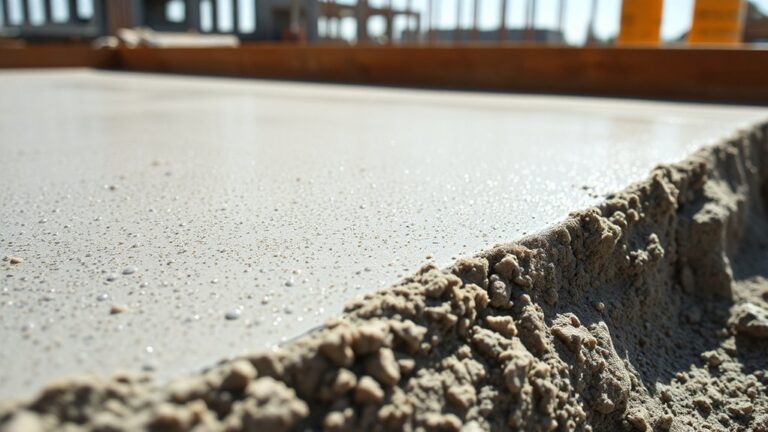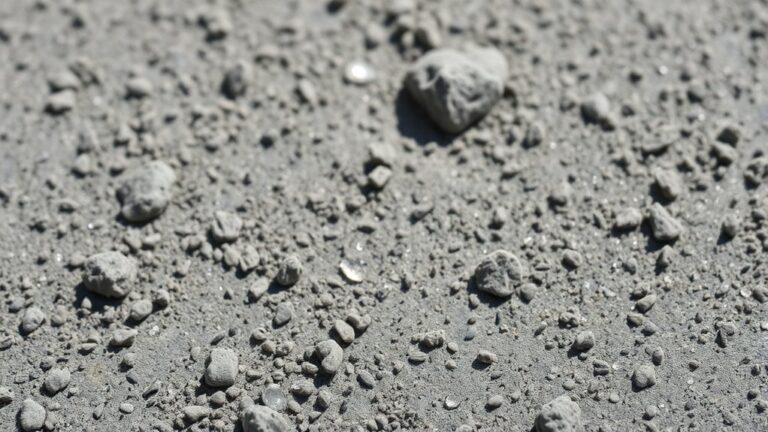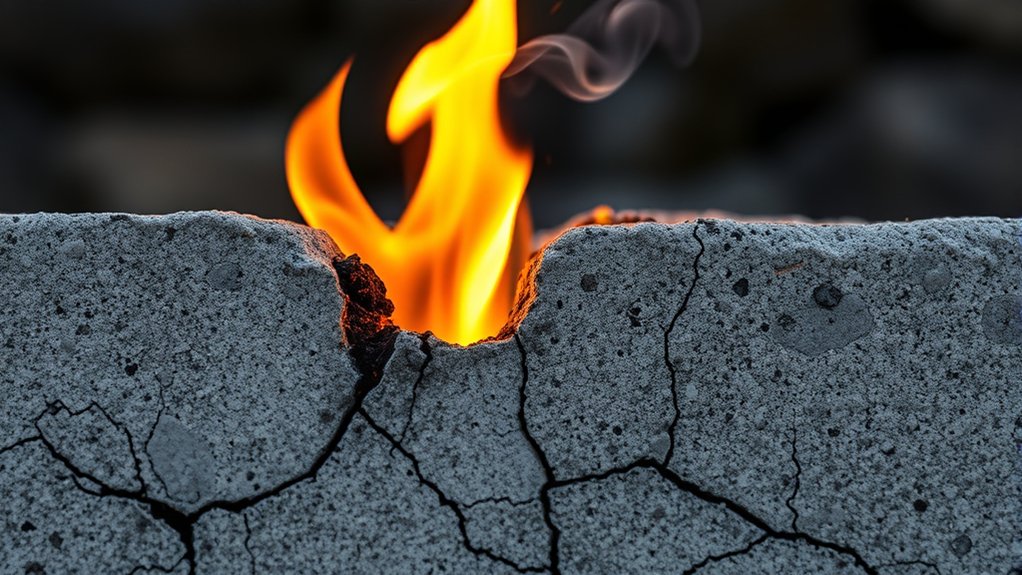
Does Concrete Burn – Straight Answer
You don’t need to worry about concrete burning. It simply won’t ignite or combust under typical fire conditions. Its main components, like cement and silica, have very high melting points well above fire temperatures. This makes it non-combustible and classified as A1 fire-resistant.
While concrete can crack, spall, or weaken structurally when heated, it doesn’t melt or burn. Understanding how concrete reacts to fire shows why it’s so important for fire safety and structural stability.
Why Doesn’t Concrete Burn?
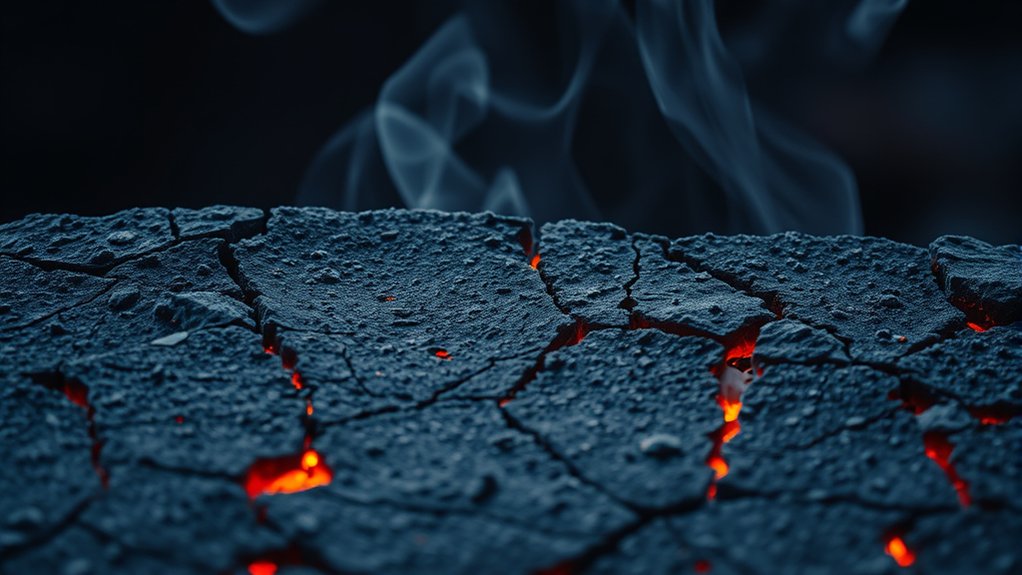
Although many materials ignite when exposed to high heat, concrete doesn’t burn because it’s classified as non-combustible under fire resistance standards like EN 13501-1, earning an A1 rating.
You should know concrete’s main components, cement and aggregates such as silica, have melting points between 1,550°C and 1,710°C. This prevents ignition under typical fire conditions.
The chemical structure of concrete doesn’t support combustion; instead, it undergoes thermal degradation without flames.
Also, concrete’s high thermal mass enables it to absorb and resist elevated temperatures without igniting or sustaining fire.
Because concrete can’t be set on fire, it serves as an effective fire-resistant barrier in construction.
This inherent fire resistance makes concrete a key material for enhancing building safety.
What Does It Mean When We Say Concrete Burns?
You might hear the phrase “concrete burns” and wonder how it applies, given that concrete itself doesn’t ignite or combust. In reality, concrete burns refer to chemical skin injuries caused by contact with wet or dry concrete containing caustic agents.
Chief among these is calcium hydroxide, which forms when cement reacts with water, elevating the pH above 12. This highly alkaline environment damages skin tissue, causing redness, blistering, and potentially deep tissue necrosis.
The damage begins microscopically before you notice pain or visible symptoms. Exposure duration and severity influence the injury’s extent.
Immediate washing and neutralizing affected areas are critical to reduce harm. So, when we say “concrete burns,” we’re really talking about chemical burns from alkaline compounds in concrete, not burns from heat or fire.
How Concrete’s Composition Prevents Burning
You’re working with a material that’s classified as noncombustible under strict fire standards. That means it won’t ignite or keep burning.
Concrete’s main ingredients, cement and silica aggregates, have melting points way higher than typical fire temperatures—about 1,550°C and 1,710°C, respectively.
This high heat resistance is what helps prevent any combustion when concrete is exposed to fire.
Noncombustible Material Properties
Because concrete’s main components, cement and silica-based aggregates, have exceptionally high melting points, the material resists combustion even under extreme fire conditions. Concrete is classified as a noncombustible material with an A1 fire resistance rating per EN 13501-1:2007-A1:2009. Its chemical composition and thermal properties inhibit ignition, preventing fire spread.
Additives further enhance these properties, ensuring concrete maintains structural integrity during fires.
| Component | Melting Point (°C) | Combustibility |
|---|---|---|
| Cement | ~1,550 | Noncombustible |
| Silica Aggregates | ~1,710 | Noncombustible |
| Additives | Variable | Enhance noncombustibility |
You can rely on concrete’s inherent noncombustible nature for fire safety in construction.
High Melting Point
How does concrete’s composition prevent it from burning under extreme heat? Concrete’s components exhibit a high melting point, which is key to its fire resistance. Cement melts around 1,550°C, while silica aggregates withstand approximately 1,710°C.
The combined mixture results in an overall melting point near 1,630°C, making burning under typical fire conditions impossible.
Consider these points about concrete’s high melting point:
- Cement and aggregates’ melting temperatures far exceed standard fire heat.
- Concrete’s formulation can be enhanced with additives to raise its melting point.
- Classified as A1 in fire resistance, concrete neither ignites nor melts during fire exposure.
You’ll find that this composition makes concrete a reliable noncombustible material, ensuring structural integrity in extreme heat.
What Happens to Concrete When It Gets Very Hot?
Although concrete doesn’t burn because it’s non-combustible, it does go through some big physical changes when it gets really hot. When concrete heats up, it expands, which can cause internal stresses. These stresses often lead to cracking or spalling, where the surface layers break off.
Concrete resists fire but expands under heat, causing stresses that lead to cracking and surface spalling.
The cement and aggregates in concrete have melting points well above normal fire temperatures, around 1,550°C and 1,710°C respectively. So, concrete doesn’t melt under typical fire conditions.
But if it’s exposed to extreme heat for a long time, its structure changes and it loses strength. This weakening affects how much load the concrete can bear, but it’s not because the concrete is burning or melting.
Knowing how heat affects concrete helps you understand how it will perform and stay safe in hot environments.
Does Concrete Melt or Crack Under Heat?

You’ll find that concrete doesn’t actually melt when exposed to typical fire temperatures. Its melting point is way higher than what most fires can reach.
Instead, what happens is the heat causes the concrete to expand and creates internal stresses. This often leads to cracking or spalling.
So, rather than melting or burning up, the concrete undergoes these structural changes. These cracks and breaks weaken the material, which affects its overall strength and integrity.
In other words, it doesn’t combust or turn into liquid—it just gets damaged from the heat.
Thermal Behavior Of Concrete
Since concrete is classified as non-combustible with an A1 fire resistance rating, it doesn’t burn under fire conditions. Its thermal behavior under high heat involves physical changes rather than combustion.
You’ll notice concrete can crack or spall due to thermal expansion and moisture evaporation within its matrix.
Although concrete’s melting point is around 1,630°C, typical fires rarely reach this temperature, so melting is uncommon.
Key aspects of concrete’s thermal behavior include cracking and spalling caused by internal moisture vaporization and thermal stress. The melting points of constituent materials like cement (around 1,550°C) and silica (about 1,710°C) also play a role.
Plus, concrete can weaken structurally from prolonged exposure to elevated temperatures without actually melting.
Understanding these factors helps you accurately assess how concrete performs during fire exposure.
Heat-Induced Structural Changes
When exposed to high temperatures, concrete undergoes significant physical changes rather than melting due to its components’ high melting points, typically above 1,500°C. These heat-induced structural changes include thermal expansion and dehydration, which generate internal stresses causing cracking and spalling.
While concrete itself remains non-combustible and doesn’t melt, the structural integrity can be compromised by these physical transformations. In reinforced concrete, elevated temperatures also reduce the strength of steel reinforcement, further weakening the overall stability.
You should understand that heat-induced structural changes don’t involve melting but rather physical degradation that can lead to failure under extreme fire conditions. This behavior underlines concrete’s fire resistance but also its vulnerability to heat-induced damage without reaching melting temperatures.
How Fire Resistance Ratings Relate to Concrete Burns
Although concrete is often associated with fire resistance, its fire resistance rating measures how well it maintains structural integrity under high temperatures rather than its ability to burn.
Concrete is classified as A1 under EN 13501-1, meaning it’s non-combustible and doesn’t burn. This rating focuses on withstanding high temperatures without structural failure, maintaining stability during fire exposure, and preventing fire spread through combustion.
Concrete’s fire resistance comes from its thermal properties and composition, not from any burning capability. Its melting point, around 1,630°C, far exceeds typical fire temperatures, so it stays solid rather than melting or igniting.
When you assess fire resistance ratings, you’re really looking at how concrete performs structurally in fire. It’s not about whether it can burn, because its non-combustible nature naturally prevents combustion and fire spread.
What Real Fires Reveal About Concrete’s Safety
How does concrete perform in real fire scenarios? You’ll find that concrete doesn’t ignite or burn, as it holds an A1 fire resistance rating, classifying it as non-combustible. Even in extreme heat, concrete’s thermal stability prevents it from contributing to fire spread, confirming its safety.
While concrete burns are nonexistent, you should be aware that rapid temperature changes can cause it to crack or spall. Over prolonged exposure, concrete may weaken or deform, but unlike combustible materials such as wood or plastic, it won’t burn.
The high melting points of concrete components, around 1,550°C for cement and 1,710°C for silica, exceed typical fire temperatures, underscoring its fire resistance.
Real fires consistently reveal concrete’s reliability as a fire-safe building material.
Frequently asked questions
Can Concrete Ashes or Dust Be Harmful to Health?
Yes, concrete ashes and dust can pose health risks. When you inhale fine concrete dust, you expose your respiratory system to crystalline silica. This can cause silicosis and chronic bronchitis with prolonged exposure.
You might also experience eye and skin irritation, especially if you’re sensitive. To reduce these health risks, you should always use proper respiratory protection.
It’s also important to implement dust control measures when handling or working near concrete dust and ashes.
How Does Concrete Behave in Chemical Fires?
In chemical fires, concrete undergoes complex chemical reactions but doesn’t ignite. You’ll find it classified as A1 non-combustible, meaning it acts as a fire-resistant barrier.
Although it won’t burn, intense heat causes structural degradation and spalling due to dehydration and thermal stress.
You should note that concrete components like cement resist melting up to about 1,550°C. This provides significant protection despite cracking under extreme chemical fire conditions.
Does Moisture Content Affect Concrete’s Fire Performance?
Yes, moisture content considerably affects concrete’s fire performance and thermal resistance. When you have high moisture levels, steam forms inside the concrete under heat, increasing internal pressure and causing spalling or cracking.
This compromises structural integrity and reduces thermal resistance.
On the other hand, properly cured, low-moisture concrete maintains better thermal resistance. It limits steam buildup and heat-induced damage, which helps ensure improved fire performance and structural stability during high-temperature exposure.
Can Concrete Be Treated to Become Fireproof?
Yes, you can treat concrete to enhance its fireproof qualities. By incorporating fire-resistant admixtures and additives into the mix, you’ll improve its structural integrity under extreme heat.
These treatments don’t make concrete completely fireproof, but they do considerably increase its resistance to thermal degradation. This means the concrete maintains its strength and load-bearing capacity longer during a fire.
Are There Any Fire Safety Codes Specific to Concrete Structures?
Yes, fire safety codes specify requirements for concrete structures to maintain structural strength during fire exposure. You’ll find regulations mandating minimum fire resistance ratings, often 1 to 2 hours. This ensures concrete elements can withstand heat without significant strength loss.
These codes also require testing for fire endurance and may demand fire-resistant additives in critical components. Following these standards helps you guarantee your concrete structures remain safe and stable in fire scenarios.
It’s all about making sure your building can handle the heat when it really counts.
Final Thought
You might wonder if concrete burns, but the truth is, it doesn’t. Not in the way wood or fabric does. Its unique composition acts like a fortress against flames, resisting fire rather than feeding it.
While extreme heat can cause cracking or spalling, concrete won’t melt or ignite. So, when fire tests rage on, concrete stands firm. It proves it’s more shield than fuel in the battle against fire’s fury.
More Concrete Basics Guides
Buying Sand, Gravel or Ready Mix?Portage Aggregate & Supply carries triple-washed sand and gravel, and Tri County Concrete delivers ready mix across Greater Cleveland. Request a quote or call 440-582-1100.