How To Make Roman Concrete – Quick Guide
To make Roman concrete, combine quicklime, volcanic ash (pozzolana), aggregates like crushed tuff, and water in precise proportions. Mix quickly to maintain workability and pour into heat-resistant molds coated with non-petroleum release agents to prevent damage.
Cure at moderate heat (under 200°F) for about four hours without wet curing. Strength develops over weeks thanks to mineral crystals like tobermorite.
This mixture guarantees durability and saltwater resistance. It’s a foundation that opens up advanced insights into its long-term performance and uses.
What You Need to Make Roman Concrete
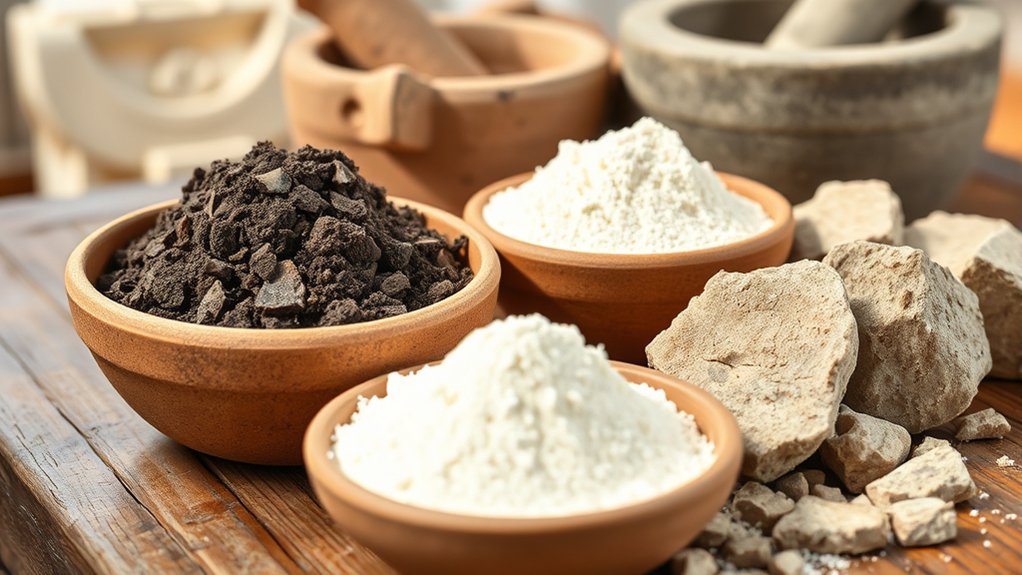
Before you begin mixing Roman concrete, you need to gather specific materials that guarantee its durability and strength. The essential components include lime or quicklime, which acts as a binder by reacting with water to create a hydraulic cement. You also need aggregates such as crushed tuff, brick rubble, or marble chippings to provide structural bulk and support.
Water is vital to hydrate the lime and activate pozzolana, a volcanic ash that notably enhances the concrete’s chemical bonding and resistance to saltwater. While pozzolana improves durability, it’s important to note that other materials like colored marble or stucco may be added later for decorative purposes. These don’t affect the core structural integrity though.
Collecting these materials precisely ensures the concrete sets correctly and maintains longevity. So, make sure you have everything ready before you start mixing. It really makes a difference in how strong and lasting your concrete will be.
The Role of Volcanic Ash (Pozzolana) in Roman Concrete
You’ll find that pozzolana has a high silica and alumina content, which drives chemical reactions with lime. These reactions produce strong calcium silicate hydrates.
This interaction doesn’t just boost resistance to saltwater corrosion—it also allows the concrete to self-heal micro-cracks over time. Understanding these properties is key if we want to replicate the incredible durability of Roman maritime structures.
Pozzolana’s Chemical Composition
Although volcanic ash might seem like a simple natural material, pozzolana’s unique chemical composition plays a crucial role in the strength and durability of Roman concrete. Pozzolana is rich in silica and alumina, which react chemically with lime to form calcium-aluminium-silicate-hydrate (C-A-S-H). This is the primary compound responsible for the concrete’s robustness.
This hydraulic binder hardens underwater and sustains its integrity over time. When you use pozzolana, you benefit from its volcanic origin that triggers pozzolanic reactions, enhancing both durability and self-healing properties.
Key aspects to think about regarding pozzolana’s composition include:
- High silica and alumina content enabling strong cementitious compounds
- Formation of C-A-S-H contributing to mechanical strength
- Hydraulic properties allowing underwater hardening and long-term durability
Saltwater Resistance Enhancement
Because volcanic ash, or pozzolana, contains high levels of silica and alumina, it chemically reacts with lime to form strong, saltwater-resistant compounds in Roman concrete. When you mix pozzolana with lime, it produces calcium-aluminium-silicate-hydrate (C-A-S-H) gels, which enhance durability against saltwater exposure.
These gels create dense crystalline structures, such as tobermorite, that effectively block salt ingress, preventing material degradation.
By incorporating pozzolana, the concrete’s microstructure becomes more compact and less permeable to seawater’s corrosive effects. This chemical interaction explains why Roman marine structures, using pozzolana-based concrete, have endured over two millennia in harsh saltwater environments. It’s pretty impressive when you think about it!
Understanding this saltwater resistance enhancement helps you appreciate pozzolana’s critical role in achieving the longevity and robustness of Roman concrete. It’s not just about the materials themselves but how they work together to stand the test of time.
Self-Healing Capabilities
When cracks form in Roman concrete, volcanic ash, or pozzolana, reacts with water to trigger a chemical process that seals these fissures with newly formed calcium silicate hydrate crystals. This self-healing mechanism relies on pozzolana’s high alumina and silica content, which promotes mineral phases like tobermorite, enhancing durability.
As water seeps through cracks, it activates the ash to generate crystalline structures that fill and strengthen damaged areas.
The ongoing chemical interaction between pozzolana and lime allows the concrete to gain strength and self-repair over decades. Recent studies highlight volcanic ash’s role in forming calcium carbonate crystals inside cracks. This is a critical factor for Roman concrete’s remarkable longevity and self-healing capacity.
- Formation of calcium silicate hydrate crystals
- Production of tobermorite and other minerals
- Calcium carbonate crystal growth inside fissures
Preparing and Handling Ingredients Safely
To prepare and handle the ingredients safely, you must pay close attention to the properties and risks of each component. Handle lye carefully in a well-ventilated area. Add it slowly to water to prevent boiling and splattering.
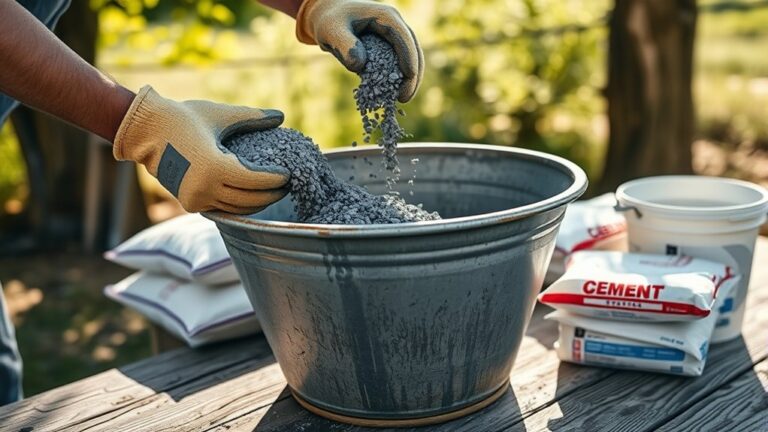
Keep lye pellets dry before use to avoid gumming and guarantee proper dissolution. Use plastic buckets for mixing aggregate, avoiding metal containers that may trigger unwanted chemical reactions.
Mix damp aggregate thoroughly with water and chemicals just before pouring to prevent premature setting. Always wear protective gear, such as gloves and goggles, when dealing with lye and other chemicals to minimize exposure risks.
How to Mix Roman Concrete
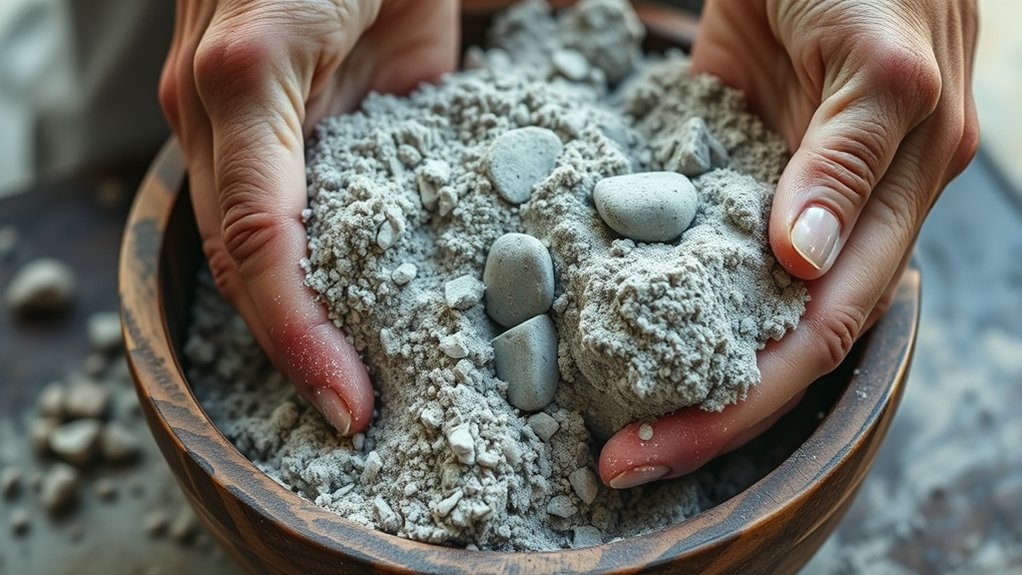
You’ll start by preparing chemical solutions like quicklime and pozzolana to optimize strength and durability. After that, you combine these with aggregates carefully to get a consistent, workable mixture.
Then, you control the curing and setting conditions to make sure the concrete gains long-term stability and resilience.
Preparing Chemical Solutions
Three critical components, lye solution, waterglass, and superplasticizer, must be precisely measured and combined to prepare the chemical solutions necessary for Roman concrete. You start by mixing 41 grams of 14-molar lye solution with 60.7 grams of water. Add the lye gradually to avoid boiling and splattering.
Then, combine this with 41 grams of waterglass and 15.15 grams of superplasticizer in a well-ventilated area. This careful preparation ensures the chemical reaction proceeds uniformly.
Here are some key points to remember. Use aluminum-tipped paddles briefly to mix, which helps minimize hydrogen gas release. Also, maintain precise water ratios to prevent premature setting.
And don’t forget to add the lye solution to flyash and aggregate just before pouring for maximum reactivity.
This methodical approach guarantees the chemical reaction crucial for durable Roman concrete.
Combining Ingredients Properly
After preparing the chemical solutions with careful measurements and mixing techniques, the focus shifts to combining the core ingredients properly to form Roman concrete. Start by mixing the aggregate thoroughly with water, allowing it to dampen before adding the hydraulic binder.
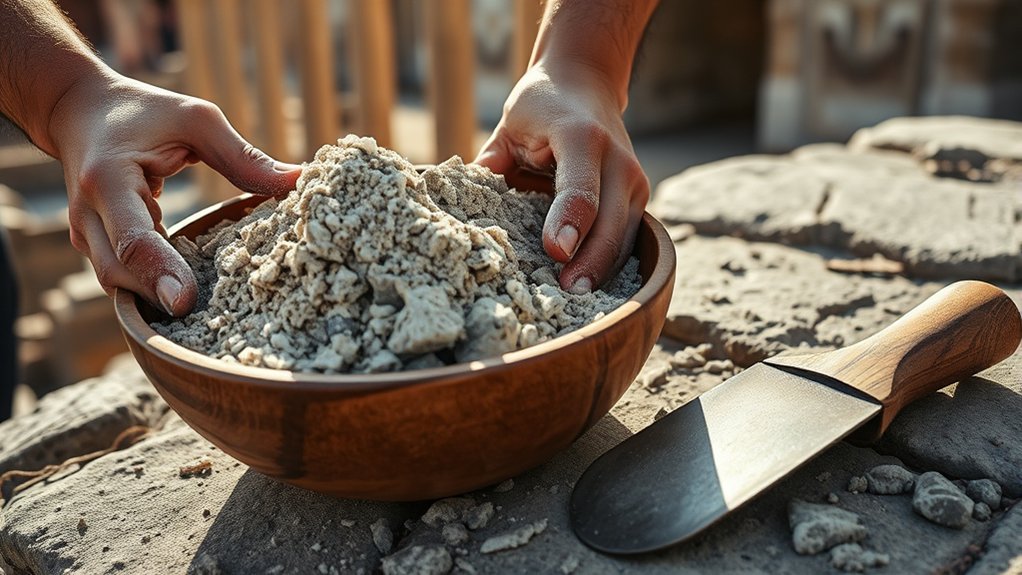
Next, prepare the pozzolanic mortar by combining precise amounts of lime, pozzolana, and water to guarantee proper chemical interaction. Gradually add this mortar to the dampened aggregate, stirring continuously to achieve a uniform, plastic consistency.
During mixing, incorporate additional components like crushed brick or marble to enhance durability and aesthetics. It’s vital that you mix all components thoroughly and uniformly. This promotes ideal setting, self-healing, and structural integrity.
Proper mixing is indispensable if you want to replicate the strength and longevity characteristic of authentic Roman concrete. So, take your time and make sure everything is combined just right.
Curing And Setting Conditions
While the mixing process lays the foundation for Roman concrete’s strength, controlling curing and setting conditions is just as important to achieve its famous durability. You need to pour the hot-mixed blend of volcanic ash, quicklime, aggregate, and water into molds.
Then, cure it by heating at no more than 200°F for about 4 hours. This controlled curing speeds up the chemical reactions that create the strong binder. It also allows the concrete to set underwater and even develop self-healing properties.
The best part? You don’t need any wet curing or covering. The strength keeps building for up to a month.
Make sure to add the chemicals right before pouring. Along with keeping the temperature just right during curing, this timing helps ensure the concrete sets perfectly and lasts a long time.
- Heat curing at ≤200°F for ~4 hours
- No wet curing needed; strength develops over weeks
- Add chemicals immediately before pouring for best results
Tips for Pouring and Molding Roman Concrete
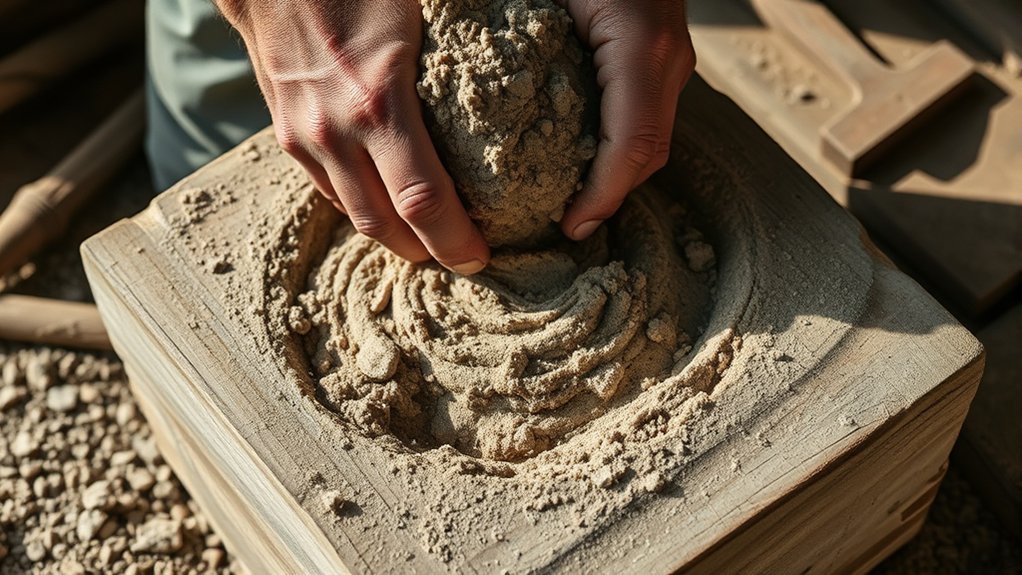
Because Roman concrete begins to set quickly, you need to pour the mixture into molds promptly to maintain its workability. This part of concrete technology requires precision to stop it from setting too soon.
Roman concrete sets fast, so pour swiftly and precisely to keep it workable and prevent premature hardening.
Use heat-resistant molds made from wood or silicone since they conduct heat well and make demolding easier.
Make sure to apply a non-petroleum-based release agent, like cooking spray, so the surface doesn’t get damaged when you remove the mold.
Pour the mixture carefully to avoid trapping air bubbles because those can weaken the structure and ruin the finish. Efficient pouring helps create a dense, uniform mix.
Following these steps will improve the molding process and lead to a durable result. Getting the hang of these tips makes Roman concrete production more effective, connecting ancient materials with modern practical methods in concrete technology.
How to Cure Roman Concrete for Best Results
Once you’ve successfully poured and molded the Roman concrete, controlling the curing environment becomes the next key step to maximize its strength and durability. Curing at a steady temperature, ideally below 200°F for about 4 hours, encourages ideal strength development.
Unlike modern concrete, Roman concrete doesn’t require wet curing or coverings; it naturally strengthens over time.
Just be sure to avoid sudden temperature shifts or excessive moisture, as these can cause cracks and impair the concrete’s self-healing properties. Full curing typically reaches 95% strength within 3 days, and it continues to improve over a month.
Here are some key curing guidelines to keep in mind: maintain consistent, moderate heat during curing. Avoid abrupt temperature fluctuations and excess moisture. And finally, allow the full curing time for gradual strength enhancement.
The Durability of Roman Concrete
How does Roman concrete achieve such remarkable durability that it withstands centuries of harsh conditions? The key lies in mineral crystal formation within the concrete, especially tobermorite and phillipsite, which strengthen the matrix over time.
When volcanic ash, or pozzolana, reacts with seawater, it initiates a self-healing mechanism that notably enhances resistance to saltwater corrosion. You’ll find that ongoing chemical reactions in Roman marine concrete allow it to gain strength decades after construction.
The inclusion of lime clasts and volcanic ash promotes calcium-aluminium-silicate-hydrate compounds, essential for long-term stability. Modern research confirms that these mineral alteration and crystal growth processes are fundamental to the concrete’s ability to endure harsh environments.
This makes Roman concrete a model of sustainable, resilient building material.
Common Roman Concrete Challenges and How to Avoid Them
Although Roman concrete is renowned for its durability, several common challenges can undermine its longevity if not properly addressed. You must carefully select aggregate sizes and materials to avoid weak points that reduce strength. Incorporating pozzolana correctly is essential; improper use diminishes resistance to saltwater and environmental degradation.
Also, controlling curing time and temperature ensures complete hydration, which is indispensable for structural integrity.
To avoid these pitfalls, focus on proper aggregate selection and sizing. Make sure to incorporate pozzolana accurately for chemical stability. And don’t forget to maintain adequate curing conditions to guarantee full hydration.
Neglecting lime clasts’ self-healing properties or reinforcing walls incorrectly can cause persistent cracks and stress fractures.
Modern Applications and Environmental Benefits of Roman Concrete
Addressing the challenges of Roman concrete highlights why its properties remain relevant today, especially in modern construction. You’ll find its durability and resistance to saltwater ideal for marine structures, notably extending their lifespan compared to conventional concrete.
By incorporating volcanic ash and pozzolanic materials, modern formulations mimic Roman techniques, enhancing both durability and environmental benefits.
Roman concrete’s production requires lower temperatures and less cement, which reduces carbon emissions and offers a sustainable alternative.
Moreover, its self-healing properties, driven by mineral reactions like tobermorite formation, lower maintenance costs and improve longevity.
Ongoing research also shows Roman concrete’s mineralogical stability allows it to absorb atmospheric CO2. This suggests it could help mitigate climate change.
Therefore, Roman concrete presents a promising balance of performance and ecological responsibility for today’s builders. It’s exciting to see how ancient technology continues to inspire modern solutions.
Frequently asked questions
Can Roman Concrete Be Made Without Volcanic Ash?
You can make Roman concrete without volcanic ash by using alternative ingredients like fly ash or geopolymers, but you’ll face challenges replicating its full durability.
These substitutes mimic some chemical benefits, yet they often lack the unique mineral reactions, such as tobermorite formation, that volcanic ash facilitates.
While alternative ingredients improve strength and resistance, your concrete may not achieve the same long-term durability or self-healing properties that traditional Roman concrete exhibits.
How Long Does Roman Concrete Last Compared to Modern Concrete?
Think of Roman concrete as a timeless fortress standing against the tides of time. Its historical durability far surpasses modern concrete, lasting over 2,000 years.
Modern concrete, on the other hand, typically endures only 50 to 100 years before major repairs.
This stark contrast owes to Roman concrete’s unique mineralogy and self-healing properties. These features continuously strengthen it, unlike modern mixes that often degrade.
Is Roman Concrete Waterproof or Resistant to Saltwater?
Roman concrete isn’t completely waterproof, but it offers exceptional saltwater resistance and waterproof durability. You’ll find that its unique mineral composition, especially the formation of tobermorite crystals, creates a dense, self-healing matrix that prevents saltwater intrusion.
This mineral alteration markedly enhances its durability underwater.
Compared to modern concrete, you can rely on Roman concrete to maintain structural integrity in marine environments far longer, making it superior for saltwater exposure. It’s pretty impressive how it holds up, right?
This is why ancient Roman marine structures have lasted for centuries.
Can Roman Concrete Be Used for Underwater Structures?
Absolutely, you can count on Roman concrete for marine durability and underwater structures. Its unique blend, including volcanic ash, fosters ongoing mineral hydration and tobermorite crystal growth, which strengthens the material over time.
This distinctive composition curtails crack propagation and boosts self-healing under saltwater stress.
Ancient harbors like Caesarea prove its proven performance, showing that Roman concrete not only withstands but thrives in submerged, saline environments. This makes it a superior choice for marine construction.
What Ancient Roman Structures Still Use Original Roman Concrete?
You’ll find original Roman concrete still in the Pantheon’s dome, showcasing remarkable historical durability after nearly 2,000 years. The Colosseum’s foundations also retain this ancient material, enduring seismic activity and weathering.
Furthermore, Roman aqueducts like Aqua Marcia and marine structures at Caesarea maintain their concrete integrity despite environmental exposure. These examples highlight how Roman concrete’s unique composition delivers long-lasting strength, especially in underwater and heavy-use settings.
It really proves its unmatched resilience over centuries.
Final Thought
Now that you know how to make Roman concrete, you can appreciate its unmatched durability and eco-friendly benefits. By carefully mixing volcanic ash with lime and aggregate, you create a material that withstands time and elements better than many modern alternatives.
Isn’t it fascinating how ancient innovation still informs sustainable practices today? With proper preparation, mixing, and curing, you’ll avoid common pitfalls and harness the full potential of this remarkable building material.
More Concrete Basics Guides
Buying Sand, Gravel or Ready Mix?Portage Aggregate & Supply carries triple-washed sand and gravel, and Tri County Concrete delivers ready mix across Greater Cleveland. Request a quote or call 440-582-1100.