What Is Concrete Used For – Quick Answer
You use concrete daily to build strong foundations, roads, bridges, and durable residential and commercial structures. Its mixture of cement, water, and aggregates hardens through curing, providing high compressive strength.
Reinforced concrete adds steel for tensile strength, supporting heavy loads safely. Concrete adapts to decorative and structural needs, from driveways to industrial projects.
Advanced types enhance longevity and sustainability. There’s much more about its composition, applications, and innovations to explore for a deeper understanding.
What Concrete Is and Why It’s Widely Used

Although it may seem ordinary, concrete is the second-most-used substance worldwide after water because of its exceptional strength, durability, and versatility. You rely on concrete as a composite material consisting of cement, water, and aggregates. This mixture undergoes hydration, a chemical process that initiates hardening and develops strength.
During curing, concrete gains durability essential for construction applications. Its adaptability allows you to cast it into diverse shapes and textures, making it indispensable in building and infrastructure projects. Advances such as reinforced and high-performance concrete have further enhanced its capabilities, enabling you to construct bridges, skyscrapers, and highways.
Concrete’s resistance to environmental factors ensures longevity, reducing maintenance needs. Understanding these properties clarifies why concrete remains foundational in modern construction and building efforts worldwide.
How Concrete Is Made: Composition and Curing
You start by mixing cement, water, and aggregates. Cement acts as the binder through a process called hydration. This chemical reaction kicks off right away and forms crystalline bonds that harden the material.
To get the best strength and durability, you need to cure the concrete properly. That means keeping it moist and at the right temperature.
People usually do this with methods like wet curing or by applying membrane compounds.
Concrete Ingredients Breakdown
How does concrete achieve its remarkable strength and durability? You start with a precise concrete mixture, primarily Portland cement (10-15%) and aggregates (60-75%) like sand and gravel. The key is maintaining a crucial water-to-cement ratio, which balances workability and strength.
When water contacts cement, a chemical reaction called hydration occurs, forming bonds that harden the material over time. Aggregates are selected for size and cleanliness to suit different structural needs.
Proper curing ensures adequate surface moisture and temperature, sustaining hydration and promoting full strength development.
Methods Of Concrete Curing
Since proper curing directly impacts the concrete’s strength and durability, maintaining ideal moisture and temperature conditions is essential. You’ll use various curing methods to assure adequate moisture retention for complete hydration of cement particles.
Wet curing, involving continuous water application, is effective, as are curing blankets and plastic covers that minimize evaporation.
Surface-applied curing compounds form a moisture barrier, aiding hydration without water application.
Temperature control during the curing duration, typically seven days for standard concrete and up to 28 days for high-performance mixes, is critical to optimize concrete strength.
Specialized techniques like electrical or infrared curing accelerate the process under certain conditions.
By selecting appropriate curing methods and monitoring moisture and temperature, you prevent cracking, reduce permeability, and guarantee mechanical properties meet design specifications.
It’s all about keeping the concrete in the best environment to do its job well.
Using Concrete in Building Foundations
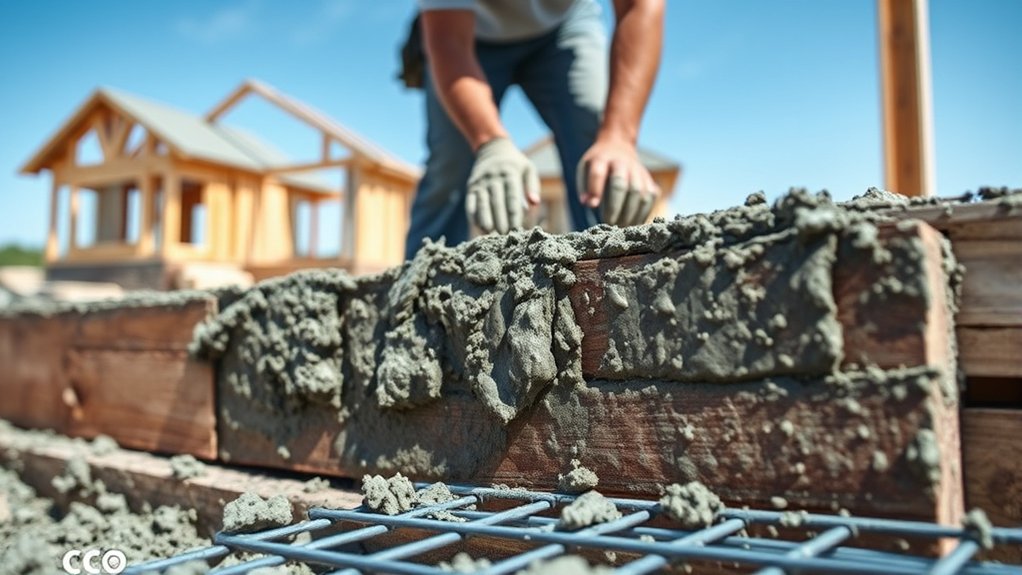
Why is concrete the preferred material for building foundations? Concrete offers high compressive strength, typically 3,000 to 5,000 PSI in residential projects, making it ideal for load distribution and structural stability.
When you use concrete for foundations, you create a durable, stable base that resists settlement and failure. Incorporating reinforcing steel, such as rebar, enhances tensile strength and overall reinforcement.
Concrete foundations can be cast into various formwork shapes, including footings, slabs, and piers, adapting to soil and load demands.
Proper curing is critical because it guarantees the concrete achieves maximum durability and resists moisture-related damage and freeze-thaw cycles.
This combination of compressive strength, reinforcement, and moisture protection makes concrete the material of choice for reliable, long-lasting foundations.
Common Residential Concrete Uses
Although concrete’s strength makes it ideal for foundations, its durability and versatility extend to many other residential applications. You’ll find concrete commonly used in residential driveways, sidewalks, and pathways due to its low maintenance and resistance to wear.
In construction, it forms basement slabs and garage floors, providing stable, stain-resistant surfaces capable of supporting heavy loads. Concrete also serves in building patios and porches, where it can be textured or colored to enhance aesthetics.
Furthermore, it’s frequently employed for stairs and retaining walls, combining functionality with structural integrity. These uses highlight concrete’s adaptability, making it a preferred material in residential construction projects where durability and long-term performance are critical.
How Concrete Builds Roads, Bridges, and Dams

You rely on concrete because it provides the structural strength needed to support roads, bridges, and dams under heavy loads and environmental stresses.
It’s super durable, which means these structures can hold up over time, even with constant use and exposure.
Knowing how concrete’s properties help create long-lasting construction is really important for designing and maintaining these infrastructures effectively.
Structural Strength Benefits
Because concrete provides exceptional compressive strength, it serves as the foundation for load-bearing structures such as roads, bridges, and dams. Its structural strength depends on several critical factors:
Reinforced concrete integrates steel rebar, boosting tensile strength to resist bending and shear forces. High-performance concrete formulations achieve compressive strengths over 14,000 PSI, supporting heavy loads and complex designs.
Optimized mix design and proper curing methods guarantee maximum adhesion and strength development throughout the structure.
Durable concrete withstands environmental stresses, maintaining load-bearing capacity over time.
Durability In Infrastructure
How does concrete maintain its integrity across decades in demanding infrastructure applications? You rely on concrete’s durability, achieved through reinforced concrete in bridges and high-performance concrete in dams.
Proper curing optimizes hydration, strengthening the matrix and reducing permeability, which limits water ingress and chemical attacks.
Reinforcement distributes loads, enhancing resilience against mechanical stresses. Admixtures, such as crystalline agents, further decrease permeability and improve weathering resistance. This is essential for roads exposed to abrasion and environmental factors.
This combination ensures roads last 30-50 years with minimal maintenance. Concrete’s abrasion resistance, coupled with its chemical and weathering resistance, makes it indispensable for infrastructure exposed to heavy loads and harsh conditions.
Decorative and Architectural Concrete Applications
Although concrete is traditionally valued for its strength and durability, decorative and architectural applications considerably expand its functional scope. You can enhance aesthetic appeal using decorative concrete techniques such as stamped concrete, stained concrete, and exposed aggregate finishes.
Architectural concrete further elevates design by incorporating color pigments, textured surfaces, and intricate concrete patterns.
Key applications include:
- Patios, driveways, and interior floors utilizing stamped and stained concrete for visual enhancement.
- Building facades and feature walls employing architectural concrete with colored aggregates and surface finishes.
- Countertops and decorative elements integrating polished, brushed, or textured surfaces.
- Advanced methods like acid staining and laser engraving to embed precise designs directly onto surfaces.
These approaches allow you to customize concrete to meet specific aesthetic and functional requirements efficiently. It’s a great way to mix style with durability and make your projects stand out.
Why Concrete Matters for Industrial and Commercial Buildings
You count on concrete because it offers exceptional structural strength. This means it can support heavy loads and ensures stability in industrial and commercial buildings.
Plus, its durability helps it resist environmental wear, which extends the lifespan of large-scale structures.
When you think about these benefits, it’s clear why concrete continues to be essential in your construction projects.
Structural Strength Advantages
Why does concrete remain the material of choice for industrial and commercial buildings? Its structural strength advantages make it indispensable. You benefit from:
- High compressive strength: Concrete strength supports significant load-bearing requirements in structural applications.
- Reinforcement capabilities: Combining concrete with steel enhances tensile strength, enabling high-rise buildings and large-span structures.
- Volumetric stability: Concrete resists deformation and cracking under stress, maintaining safety and structural integrity.
- Durability: Its resistance to environmental factors ensures consistent performance, critical in industrial settings.
These attributes allow you to rely on concrete for safe, strong, and resilient construction.
By leveraging these properties, you ensure buildings meet rigorous safety standards and perform under demanding conditions without compromising structural stability.
It’s no wonder concrete continues to be the go-to choice when strength and reliability are top priorities.
Durability and Longevity
How does concrete stand up to the demanding conditions of industrial and commercial environments? Concrete’s durability and longevity come from its inherent strength and an optimized concrete mix. Proper curing methods play a big role by enhancing chemical and environmental resistance.
This helps the material withstand extreme weather, heavy loads, and exposure to corrosive substances. Plus, reinforcement elements integrated into the concrete support structural integrity and prevent deformation and failure.
Together, these factors make concrete highly resistant to fire, rot, abrasion, and decay. That resistance is critical for reducing maintenance and replacement costs.
Industrial and commercial buildings really benefit from concrete’s proven ability to maintain structural integrity for 30 to 50 years or more. So, it’s a reliable, cost-effective choice for enduring harsh operational conditions.
How Reinforced Concrete Supports Heavy Loads and Safety
Because reinforced concrete combines concrete’s compressive strength with embedded steel rebar’s tensile capacity, it effectively supports heavy loads while maintaining structural safety.
When you use reinforced concrete, you benefit from enhanced tensile strength due to steel rebar, which prevents cracking and reduces the risk of structural failure. It also improves structural integrity by combining the compression resistance of concrete with the tension resistance of steel.
You get thinner, stronger load-bearing elements that optimize material efficiency without compromising safety. Plus, the critical bonding between steel and concrete ensures load transfer and helps prevent catastrophic failures under heavy loads.
Specialized Concrete Types for Specific Construction Needs
Although traditional concrete suits many projects, certain construction needs demand specialized types like high-performance concrete (HPC) and ultra-high-performance concrete (UHPC). HPC enhances durability and structural strength through optimized mix proportions and chemical admixtures such as superplasticizers.
UHPC goes a step further by incorporating silica fume and fibers, delivering exceptional ductility and longevity for critical infrastructure. Both types help address specific construction needs by improving volume stability and crack resistance.
| Concrete Type | Key Additives | Primary Benefits |
|---|---|---|
| High-Performance (HPC) | Superplasticizers | Enhanced durability, reduced weight |
| Ultra-High-Performance (UHPC) | Silica fume, fibers | Superior strength, ductility, longevity |
| Specialized Mixes | Fly ash, chemical admixtures | Tailored properties for unique requirements |
Using these specialized concretes ensures structures meet advanced performance criteria. It’s a smart way to make sure your build stands the test of time.
Emerging Innovations Expanding Concrete’s Applications
Specialized concrete types like HPC and UHPC have pushed the boundaries of traditional construction materials, enabling new possibilities in structural performance. You can now leverage these innovations to enhance durability and expand concrete’s applications.
Advanced concretes like HPC and UHPC are transforming structural performance and expanding construction possibilities.
- Incorporate mineral admixtures such as fly ash and silica fume to increase strength and reduce permeability for aggressive environments.
- Use self-healing concrete with microcapsules or bacteria that autonomously repair cracks, extending structural lifespan.
- Apply 3D printing technology to create complex, customized architectural elements rapidly and efficiently.
- Integrate recycled materials and sustainable binders to reduce environmental impact while maintaining performance in diverse structural applications.
These emerging advancements in High Performance Concrete and Ultra-High Performance Concrete redefine durability and sustainability in modern construction. It’s exciting to see how these materials are shaping the future of building design and engineering.
Frequently asked questions
How Long Does Concrete Take to Fully Cure?
Concrete typically takes about 28 days to fully cure and reach its maximum strength.
You’ll see it gain around 70% of its strength within the first 7 days, but maintaining proper moisture and temperature during this time is essential for hydration.
Keep in mind, factors like temperature and humidity can speed up or slow down curing.
And high-performance concrete might need up to 90 days to fully cure.
Can Concrete Be Recycled After Demolition?
Yes, you can recycle concrete after demolition by crushing it into recycled concrete aggregate (RCA). You’ll need to remove impurities like steel and dirt before crushing and screening.
Using RCA, you can create base materials for roads, pavements, and even new concrete.
This process reduces landfill waste and conserves natural resources. However, the quality of recycled concrete depends on the original concrete’s composition and the recycling methods you apply.
What Are the Environmental Impacts of Concrete Production?
You should know that concrete production profoundly impacts the environment through high CO2 emissions, mainly from cement calcination and energy use.
It also leads to habitat destruction and resource depletion due to aggregate extraction.
Furthermore, it consumes large water volumes, which can strain local supplies.
To mitigate these effects, you can incorporate supplementary cementitious materials like fly ash and slag.
These materials help reduce carbon emissions and make your concrete projects more sustainable.
How Do Weather Conditions Affect Concrete Pouring?
When you pour concrete in extreme weather, it feels like you’re racing against nature itself. Cold can freeze water inside, cracking your work, while heat might dry it out too fast, causing surface flaws.
High humidity drags out the setting, and low humidity makes it dry too soon. You’ll need to adjust by heating, cooling, or covering the mix to guarantee proper curing and strength development every time.
It’s all about finding the right balance so your concrete holds up strong no matter what the weather throws at it.
What Maintenance Does Concrete Require Over Time?
You need to seal concrete every 1 to 3 years to prevent water penetration and surface damage. Regularly inspect for cracks, surface wear, or spalling, and promptly fill any cracks to avoid further deterioration.
Remove stains using dry or wet cleaning methods depending on the stain type. Applying protective coatings greatly extends the lifespan by shielding against environmental and chemical damage.
Consistent maintenance ensures concrete remains durable and functional over time. It might seem like a bit of work, but staying on top of these tasks really pays off in the long run.
Final Thought
Now that you understand concrete’s role, from sturdy foundations to intricate infrastructure, you see it’s more than just a building material. It quietly supports your daily life, bearing loads and weathering time with subtle resilience. Though often overlooked, concrete’s specialized forms and innovations keep advancing construction’s capabilities.
This means structures remain reliable without fuss. Essentially, concrete’s unassuming presence is a testament to enduring strength and thoughtful engineering you can depend on.
More Concrete Basics Guides
Buying Sand, Gravel or Ready Mix?Portage Aggregate & Supply carries triple-washed sand and gravel, and Tri County Concrete delivers ready mix across Greater Cleveland. Request a quote or call 440-582-1100.