Does Concrete Expand When It Dries – The Real Answer
Concrete primarily shrinks as it dries because water evaporates from its pores, causing moisture loss and contraction. However, it can also expand due to moisture absorption or temperature rises. These cause swelling or thermal expansion.
These movements create internal stresses that may lead to cracking if unmanaged. Proper curing, environmental control, and expansion joints help minimize damage. Understanding these factors and their impact on durability is essential.
Knowing this will help ensure long-term concrete performance and integrity. So, managing moisture and temperature is really important when working with concrete.
How Moisture Loss Causes Concrete Expansion and Contraction
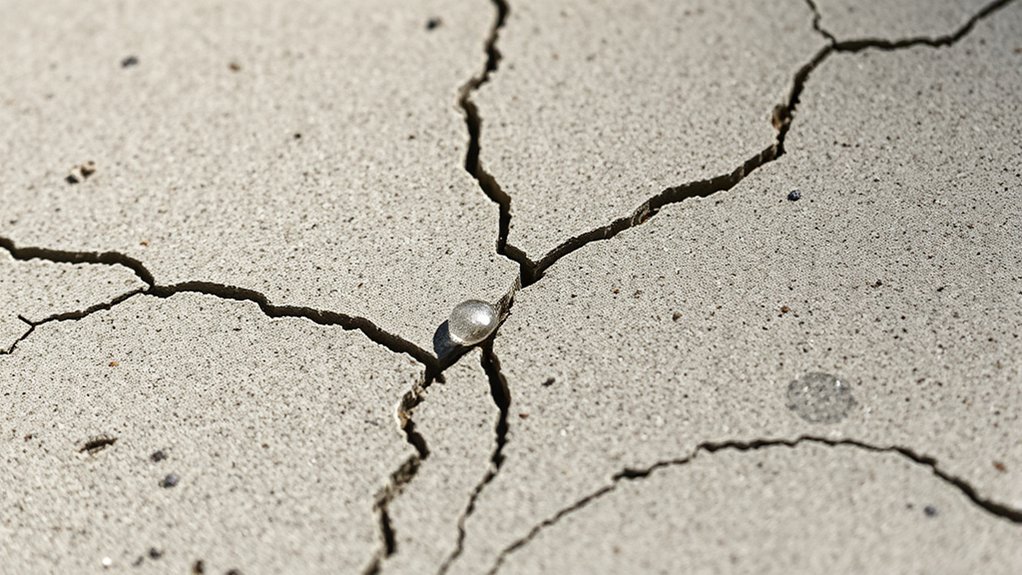
Although concrete generally shrinks as it loses moisture during drying, you should understand that moisture absorption can cause it to expand under certain conditions. When concrete undergoes moisture loss, the contraction occurs due to volume reduction as water evaporates from its pores.
However, if the concrete absorbs moisture from the environment, it can swell, resulting in slight expansion. This balance between moisture loss and moisture absorption critically influences whether the concrete will contract or expand during drying.
Excessive moisture loss during curing can generate internal tensile stresses, potentially leading to crack formation and localized expansion.
How Temperature Changes Affect Concrete Movement
You’ll notice that concrete expands as temperatures rise and contracts when they fall. This happens because of its thermal expansion properties.
This movement is measurable and, if not properly accounted for, can cause stress within the structure.
Thermal Expansion Explained
When temperature changes, concrete moves because of its coefficient of thermal expansion, which averages about 10 millionths per degree Celsius. This means concrete expands and contracts with temperature changes, affecting its dimensional stability.
For example, a 30.5-meter concrete slab will expand approximately 1.7 cm with a 38°C temperature rise.
The degree of thermal expansion depends not just on temperature variation but also on the material’s specific properties, including aggregate type, cement content, and moisture levels.
As temperature goes up, concrete expands; when it drops, concrete contracts. Understanding thermal expansion is really important since restrained movement can cause structural issues.
By knowing how concrete responds to temperature changes, you can better manage its behavior in construction and maintenance applications. This helps prevent problems and ensures structures last longer.
Temperature-Induced Concrete Stress
Since concrete expands and contracts with temperature changes, these movements can generate internal stresses, especially if the concrete is restrained by reinforcement or adjacent structures. Temperature-induced expansion occurs as concrete heats, while contraction happens when it cools.
This behavior is governed by its thermal expansion coefficient of approximately 10 millionths per °C.
For example, a 38°C temperature variation can cause about 1.7 cm of length change over 30.5 meters.
When concrete’s free movement is restricted, these expansions and contractions create stress concentrations that may result in cracking or warping.
To manage temperature-induced concrete stress effectively, engineers incorporate expansion joints and design for expected environmental temperature ranges.
This approach allows controlled movement and helps reduce the risk of structural damage caused by thermal stress.
Why Concrete Shrinks and Expands Over Time
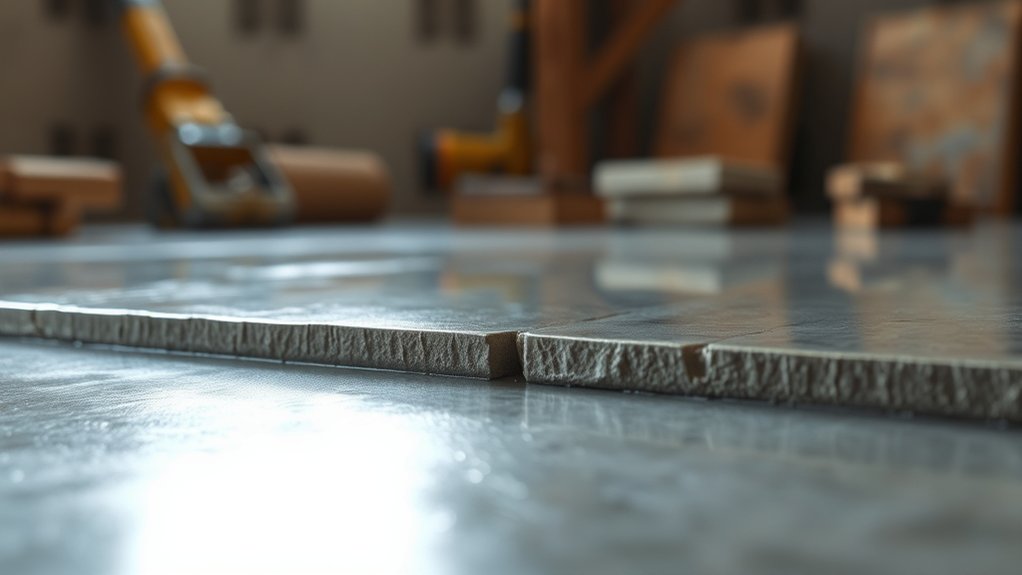
Although concrete often appears rigid and unchanging, it actually undergoes both shrinkage and expansion over time due to varying environmental factors. You’ll observe concrete shrinkage primarily during the curing process as moisture evaporates, reducing volume.
Concrete, though seemingly solid, shrinks and expands over time due to environmental influences.
Thermal expansion also plays a significant role. Concrete’s coefficient of thermal expansion, about 10 millionths per °C, causes dimensional increases with temperature fluctuations.
Changes in moisture content influence size as well. Absorption can cause swelling, while further drying leads to contraction.
Over the concrete’s lifespan, freeze-thaw cycles and chemical reactions may induce additional expansion.
The interplay between drying shrinkage and thermal or moisture-induced expansion dictates the overall dimensional changes you’ll see in concrete. This emphasizes the importance of monitoring environmental conditions in structural applications.
What Happens If Concrete Movement Is Ignored?
Failing to account for concrete movement directly increases the risk of cracking and surface damage, which undermines structural integrity. When you ignore concrete expansion and contraction, internal stresses build up, causing cracks and potential delamination or spalling over time.
These cracks not only compromise the surface but also jeopardize the load-bearing capacity of the structure. Plus, neglecting movement can lead to joint failure, allowing water to seep in and speed up corrosion of the reinforcement steel.
This deterioration cuts down the overall lifespan of the concrete. Without properly managing thermal and moisture-induced shifts, you’re looking at costly repairs and safety concerns down the road.
In short, disregarding concrete movement seriously affects structural integrity and durability. That’s why it’s essential to address these changes early on in the design and construction phases.
How Expansion Joints Control Concrete Movement
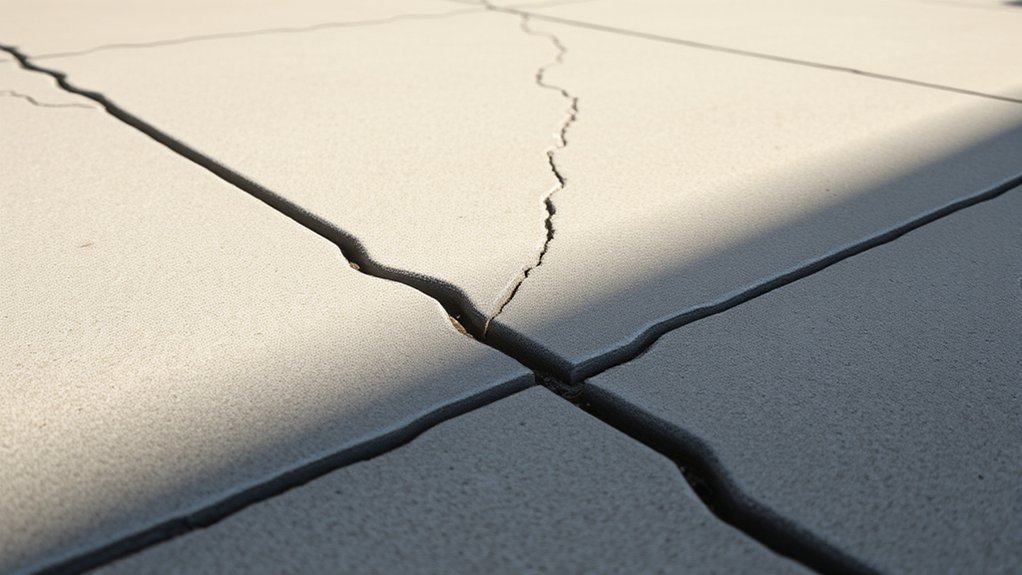
You need expansion joints to control concrete movement because they help accommodate thermal expansion and contraction without causing any damage. Basically, as concrete heats up or cools down, it naturally wants to expand or shrink, and without these joints, that movement can create stress that leads to cracks.
So, where and how often you place these joints really depends on the length of the concrete and how much the temperature changes.
For large slabs, it’s common to set them every 20 to 30 meters. By positioning the joints properly, you allow the concrete to move in a controlled way at specific points, which prevents stress from building up and keeps everything intact.
Purpose of Expansion Joints
When concrete expands or contracts due to temperature changes, expansion joints allow it to move freely without causing damage. These joints accommodate concrete expansion and thermal movement by providing controlled gaps within the structure. You’ll find that expansion joints are filled with flexible materials designed to absorb volume changes, preventing uncontrolled cracking.
Their primary purpose is to manage stresses caused by concrete’s natural response to temperature fluctuations and moisture variations. Without expansion joints, concrete slabs and large structures like bridges risk developing structural faults due to restrained movement.
By incorporating expansion joints, you guarantee that thermal movement doesn’t compromise the integrity of the concrete. This helps maintain durability and functionality over time. Properly implemented expansion joints are essential for effective concrete design and long-term performance.
Placement and Spacing
Expansion joints must be strategically placed and spaced to effectively manage concrete movement caused by thermal expansion and contraction. You determine the spacing based on the concrete structure’s slab thickness, typically placing joints every 24 to 30 times that thickness.
This spacing accounts for expected length changes as temperature rises, which can cause several centimeters of expansion in large slabs.
You position expansion joints at control points like corners, edges, or locations with support changes to control stress concentrations. Proper placement and spacing minimize internal stress buildup, preventing random cracking and structural damage.
Best Ways to Prevent Cracks From Concrete Movement
Three critical strategies can effectively prevent cracks caused by concrete movement. First, properly spaced expansion joints accommodate expansion and contraction, allowing concrete surfaces to move freely without stress buildup.
Properly spaced expansion joints allow concrete to expand and contract, preventing stress and cracks.
Second, optimize the mix design using non-reactive, low-expansion aggregates to minimize dimensional changes.
Third, ensure adequate curing and control environmental conditions during setting to reduce uneven shrinkage and internal stresses. Furthermore, seal and waterproof concrete surfaces to prevent moisture ingress that triggers internal expansion and cracking.
Regular inspection and prompt repair of minor cracks also maintain structural integrity and prevent progression.
Why Proper Planning Ensures Durable Concrete Floors
Preventing cracks from concrete movement starts well before pouring the slab, with thorough planning to guarantee durability. Proper planning involves strategically placing expansion joints at recommended intervals, typically every 20 to 30 feet, to accommodate thermal movement and relieve internal stresses.
You should select appropriate materials and mix designs tailored to the environmental conditions to minimize excessive expansion or contraction. Moreover, controlling moisture and ensuring correct curing processes during installation manage volume changes effectively.
After installation, regular inspection and maintenance help you identify early signs of expansion-related issues. This enables timely repairs that preserve floor integrity.
This way, you ensure your concrete floors withstand thermal cycles and structural stresses. By integrating these steps into your project plan, you maintain durability and prevent costly damage over time.
Frequently asked questions
Can Additives Reduce Concrete Expansion During Curing?
Yes, additives can reduce concrete expansion during curing. You can use shrinkage-reducing agents to minimize volume changes, including expansion.
Incorporating materials like fly ash or silica fume modifies the pore structure, lowering thermal and drying-related expansion.
Plasticizers and water reducers improve workability but may affect curing rates, so you should select and dose additives carefully. This helps control internal stresses, reducing undesirable expansion and improving concrete’s dimensional stability.
It’s all about finding the right balance to get the best results.
How Does Concrete Composition Affect Its Expansion Rate?
You’ll find that concrete’s expansion rate depends heavily on its composition. The type and proportion of aggregates influence thermal expansion, with limestone aggregates typically reducing it.
Cement type and water-cement ratio also play key roles.
Higher water content usually increases porosity and expansion.
Adding supplementary materials like fly ash or slag modifies microstructure, altering expansion behavior.
Admixtures can further adjust expansion rates through their chemical effects.
Does Humidity Influence Concrete Drying Expansion?
Yes, humidity directly influences concrete drying expansion. When you cure concrete in high humidity, moisture evaporation slows down. This causes the concrete to retain water and potentially expand slightly.
On the other hand, low humidity speeds up drying, which leads to shrinkage rather than expansion. But keep in mind, it can also increase the risk of cracking.
Are There Special Tools to Measure Concrete Expansion?
Imagine you’re a detective tracking invisible shifts in a solid fortress. Yes, you’ve got special tools like strain gauges and LVDTs designed precisely to catch tiny expansions in concrete. These instruments measure microstrains by detecting minute length changes.
Electronic sensors feed real-time data to loggers, making it easier to keep an eye on things as they happen.
Dial gauges and digital calipers let you manually check small variations. It’s all about catching those subtle movements.
Proper setup and calibration guarantee your measurements are accurate and reliable. That way, you get a clear picture of concrete’s subtle movements without any guesswork.
How Long Does Concrete Continue to Expand After Pouring?
Concrete continues to expand for several months after pouring, with the most significant expansion happening within the first 28 days.
You can expect minor volume changes to keep going for up to a year because of ongoing hydration and curing.
Temperature changes can cause some extra small expansions, so it’s a good idea to keep an eye on the environmental conditions.
Proper curing and placing joints in the right spots help you manage this expansion.
This way, you can avoid structural problems and cracking as time goes on.
Final Thought
You might expect concrete to simply dry and settle, but it subtly breathes, expanding and contracting with moisture loss and temperature shifts. Ignoring this natural rhythm can lead to unwelcome cracks and structural concerns.
By thoughtfully incorporating expansion joints and planning for these movements, you guarantee your concrete remains resilient and enduring. Embracing these nuances isn’t just smart; it’s essential for maintaining the integrity and longevity of your concrete surfaces.
More Concrete Basics Guides
Buying Sand, Gravel or Ready Mix?Portage Aggregate & Supply carries triple-washed sand and gravel, and Tri County Concrete delivers ready mix across Greater Cleveland. Request a quote or call 440-582-1100.