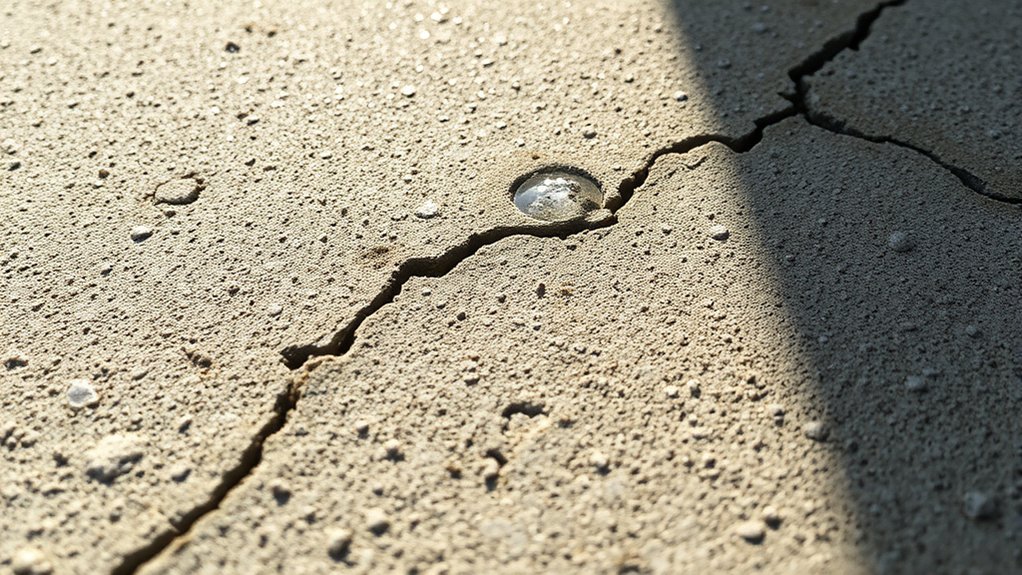
Is Concrete Porous – Myth or Fact
Concrete is porous, and this isn’t a myth. You’ll find microscopic capillaries and voids within its structure that allow water to pass through, even with quality mix design and curing.
Additives like crystalline admixtures can reduce permeability and enhance water resistance, but they don’t make concrete fully waterproof. Proper curing, compaction, and material choices help minimize porosity and protect durability.
Understanding these factors can help you better manage concrete’s interaction with water for longer-lasting performance. It’s all about knowing what’s going on beneath the surface.
What Does Concrete Porosity Mean?
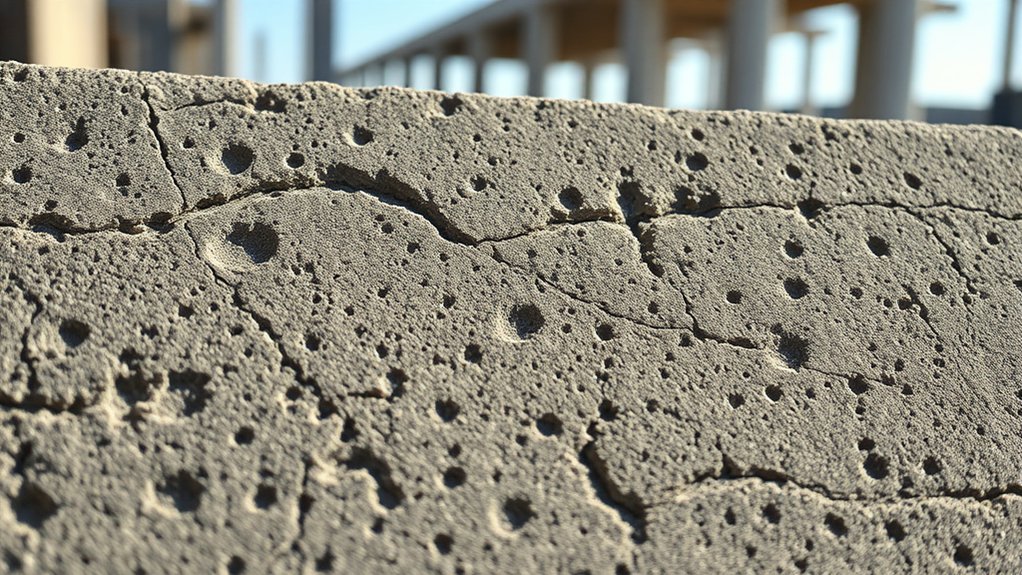
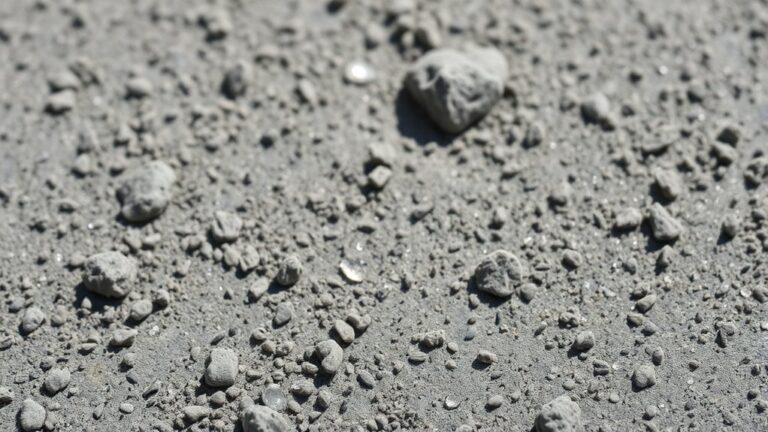
What exactly does concrete porosity mean for your construction projects? Porosity refers to the volume of microscopic capillaries and voids within the concrete matrix that create pathways for water ingress. This inherent characteristic arises from your mix design choices, particularly the water-cement ratio, and is further influenced by compaction and curing methods.
Concrete porosity is the microscopic voids in the matrix that allow water ingress, influenced by mix design and curing.
Higher porosity increases permeability, allowing moisture to penetrate more readily. This can compromise structural integrity if not managed properly.
While you can’t eliminate porosity entirely, optimizing your mix design and quality control reduces it considerably, limiting potential water ingress.
Grasping the nuances of concrete porosity enables you to tailor your construction strategies effectively. It helps ensure you address moisture-related challenges early in the design phase.
That way, you can enhance both performance and longevity.
How Does Porosity Affect Concrete Durability and Performance?
Although you can’t eliminate porosity in concrete, understanding its impact on durability and performance is essential for effective design. Porosity creates pathways for water and aggressive agents, increasing permeability and reducing durability by promoting corrosion and chemical attack.
Lower porosity means fewer capillaries, resulting in dense concrete with superior resistance to environmental stresses.
| Porosity Level | Permeability | Durability Impact | Water Ingress | Chemical Resistance |
|---|---|---|---|---|
| High | High | Rapid deterioration | Easy | Low |
| Moderate | Moderate | Moderate lifespan reduction | Moderate | Moderate |
| Low | Low | Enhanced durability | Difficult | High |
| Very Low | Very Low | Long-term performance gain | Minimal | Very High |
Optimizing mix design and curing reduces porosity, so you control permeability and boost concrete’s durability. It’s all about making the concrete tougher against the elements and chemical attacks.
What Are Common Myths About Concrete’s Water Resistance?
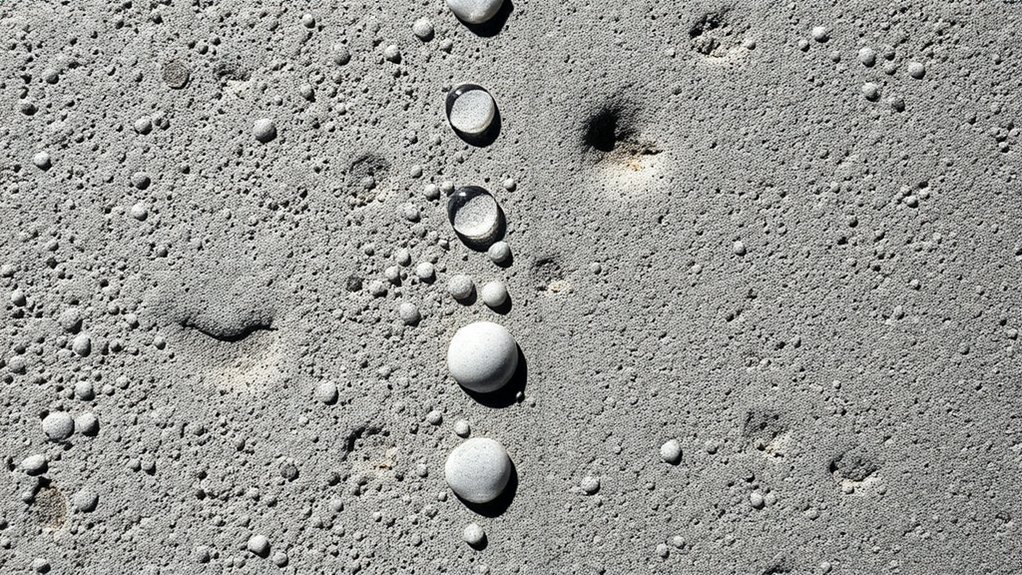
You might think concrete is naturally waterproof, but that’s not really the case. Because concrete is porous, water can actually sneak through tiny microscopic capillaries.
Just making concrete stronger doesn’t stop water from getting in. That’s why using proper sealing is super important to keep moisture out.
Concrete Waterproofing Myths
Since concrete contains microscopic pores and capillaries, many assume it’s naturally waterproof. But this misconception can lead to costly water damage. Concrete is inherently porous, allowing water to penetrate unless properly treated.
You can’t rely solely on concrete strength for waterproofing. Microcracks still permit moisture ingress. Also, impermeable concrete won’t prevent seepage if joints and cracks are neglected.
To effectively mitigate water penetration, you must understand these common waterproofing myths:
- Concrete’s porosity demands the use of sealants or membranes to block water pathways.
- Higher compressive strength doesn’t equal enhanced water resistance.
- Proper detailing and application of crystalline admixtures or sealants are essential for durable waterproofing.
You need to combine these methods. Ignoring them risks structural deterioration and moisture damage.
Porosity Misconceptions Explained
Why do so many people believe concrete is waterproof when it clearly isn’t? The truth is, concrete has tiny capillaries and voids that let water in, despite how solid it looks.
Many assume that making concrete stronger will stop water from getting through. But even high-strength concrete is still porous and can absorb moisture.
Some think that compaction or curing gets rid of porosity, but they only reduce how easily water passes through—they don’t eliminate it.
A lot of folks also believe sealant isn’t needed because concrete looks solid. In reality, its porosity means you need proper sealing to keep chemicals and water out.
Sealing Importance Clarified
Understanding concrete’s inherent porosity reveals why many misconceptions about its water resistance persist. You might think concrete is naturally waterproof, but its microscopic capillaries allow water infiltration. Sealing plays a vital role in addressing this vulnerability.
Many assume sealing is merely cosmetic or unnecessary, yet unsealed concrete is prone to moisture ingress, stains, and structural damage over time. Even higher-strength concrete doesn’t eliminate porosity or permeability, so durability depends heavily on proper sealing.
Common myths you should reconsider include:
- Concrete’s natural waterproofing without sealing
- Sealing only enhancing appearance, not durability
- Strength equating to water resistance
What Key Factors Affect Concrete Porosity and Permeability?
Although concrete may appear solid, several key factors directly influence its porosity and permeability. These characteristics determine its durability and performance.
The water-cement ratio plays a critical role. Higher ratios increase pore volume, which raises permeability.
Effective compaction is essential to minimize voids and micro-cracks. This directly reduces porosity.
Also, aggregate grading impacts pore connectivity. Well-graded aggregates create a denser matrix and limit permeability pathways.
Construction techniques like proper formwork and vibration further enhance density and create a more uniform pore distribution.
These factors together govern the internal pore structure. That structure influences how fluids enter and affect mechanical behavior.
Understanding and controlling these aspects helps you predict and improve concrete performance. This ensures longevity and resistance to environmental damage without relying only on external treatments.
How Do Mix Design and Curing Help Reduce Porosity?
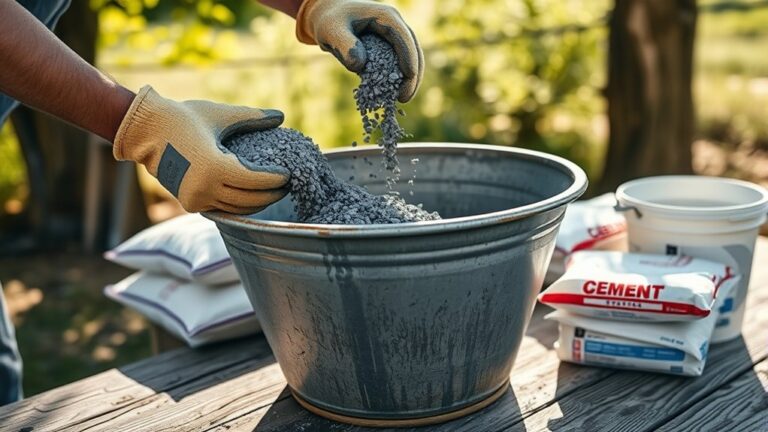
You can reduce concrete porosity by optimizing the water-cement ratio. This helps create a dense matrix with fewer capillaries. Proper curing plays a key role too because it ensures full hydration.
When hydration is complete, the pore size decreases, which boosts the concrete’s durability.
On top of that, tweaking the mix by adding supplementary materials can really make a difference. These materials help refine the pore structure and lower the permeability even more.
Optimizing Water-Cement Ratio
How does optimizing the water-cement ratio influence concrete porosity? By carefully controlling this ratio, you directly affect the density and durability of your concrete.
A lower water-cement ratio, typically below 0.45, creates a denser matrix with fewer capillaries, which greatly reduces porosity. Alongside this, proper mix design and curing are critical to enhancing impermeability.
You should focus on maintaining a low water-cement ratio to minimize capillary voids and permeability. Designing mixes with ideal aggregate grading and appropriate admixtures helps reduce internal voids.
Also, ensuring consistent curing promotes complete hydration, fills micro-pores, and strengthens the pore structure.
Together, these factors help produce concrete with low porosity, improving longevity and resistance to environmental degradation.
Importance Of Proper Curing
Why does proper curing play an essential role in reducing concrete porosity? Proper curing ensures continuous hydration of cement particles, which minimizes micro-pore formation and lowers overall porosity.
By maintaining ideal moisture content, proper curing prevents premature drying that increases permeability. When combined with a well-designed mix, proper curing produces a denser concrete matrix with fewer capillaries.
Techniques such as wet coverings, curing compounds, or moist curing seal micro-voids, directly enhancing water resistance. Furthermore, maintaining consistent curing for at least 7 to 14 days markedly refines the pore structure, making concrete less porous and more durable.
Without proper curing, concrete develops higher porosity, compromising strength and water resistance. So, you must implement proper curing to achieve durable, low-porosity concrete.
Role Of Mix Composition
Proper curing sets the foundation for reducing concrete porosity, but the mix composition plays an equally significant role in achieving a dense, durable matrix. You need a precise mix design to control porosity effectively by optimizing the water-cement ratio. This helps reduce pore size and overall voids.
Moreover, aggregate gradation directly influences matrix density by minimizing gaps and facilitating thorough compaction. Enhancing workability through admixtures allows you to lower water content without sacrificing performance, which further decreases porosity.
Key factors to focus on include:
- Optimized water-cement ratio in mix design to limit capillary pores
- Well-graded aggregates ensuring minimal voids and improved packing
- Use of admixtures to enhance workability and reduce required water
How Do Waterproofing Admixtures Work in Concrete?
When you add waterproofing admixtures to concrete, they chemically react with moisture and free lime within the mix to form insoluble crystals that fill micro-pores and capillaries, drastically reducing permeability. These crystals block water pathways, substantially limiting water ingress and enhancing durability.
Crystalline admixtures further enable self-healing by reactivating upon exposure to water, sealing fine cracks up to a specific width permanently. This self-sealing mechanism keeps permeability low throughout the concrete’s lifespan.
Properly selected waterproofing admixtures can reduce permeability by up to 95%, which is essential in conditions with high water tables or hydrostatic pressure. By incorporating these admixtures, you create a dense, durable concrete matrix that resists chemical attack and moisture penetration.
This ensures long-term waterproof performance without compromising the structural integrity of your concrete. It’s a smart way to protect your projects and increase their lifespan.
Construction Practices That Reduce Concrete Porosity and Improve Water Tightness
Although the materials and admixtures you choose play a critical role, construction practices profoundly influence concrete porosity and water tightness. Controlling porosity requires meticulous attention to procedures that minimize voids and prevent water ingress.
Key construction practices include ensuring thorough compaction and curing to reduce capillaries and permeability. Designing and detailing joints, water stops, and drainage systems helps mitigate seepage through construction gaps.
You can also apply surface treatments such as sealers or membranes to create secondary barriers against moisture penetration. These steps together make a big difference in improving the durability and water resistance of concrete.
Can Concrete Be Made Fully Waterproof?
Concrete contains millions of microscopic pores and capillaries that inherently allow water to pass through. Because of this porous nature, you can’t make concrete fully waterproof by conventional means alone.
While quality mix design and curing reduce permeability, they don’t eliminate porosity.
Waterproofing membranes and modern admixtures improve resistance but fall short of complete impermeability. To achieve highly water-resistant concrete, you can use crystalline admixtures. These react chemically with moisture, forming insoluble crystals that fill pore spaces and limit water ingress.
However, even crystalline admixtures don’t render concrete entirely waterproof. They considerably enhance water resistance but require supplementary waterproofing measures to approach full impermeability.
How Can You Test If Concrete Is Porous or Water-Resistant?
You can check how porous concrete is by doing a simple water absorption test. Basically, you weigh a concrete sample, then submerge it in water for 24 hours, and weigh it again to see how much water it absorbed. This tells you how permeable the concrete is.
Another quick way is just to look at the surface and see how it reacts when you pour water on it. If the water soaks in really fast, that usually means the concrete is pretty porous.
But if the water sits on top or soaks in slowly, that’s a good sign it’s more water-resistant.
Putting these two methods together gives you a pretty solid idea of how well the concrete can keep moisture out.
Water Absorption Test
How can you accurately determine if a concrete sample is porous or water-resistant? The water absorption test offers a precise method by measuring the percentage of water absorbed after submerging a dried specimen for 24 hours. This test quantifies porosity, which directly impacts concrete durability and its resistance to moisture penetration.
To perform the test, you dry and weigh the concrete specimen initially. Then, you submerge it in water for 24 hours. After that, wipe and reweigh it to calculate the water absorption percentage.
A water absorption rate below 5% typically indicates low porosity and a dense, water-resistant concrete. Higher values suggest increased permeability, which compromises durability. This test is essential for evaluating concrete’s suitability in waterproofing and moisture-sensitive applications.
It provides practical, analytical insights into its structural integrity.
Visual Inspection Indicators
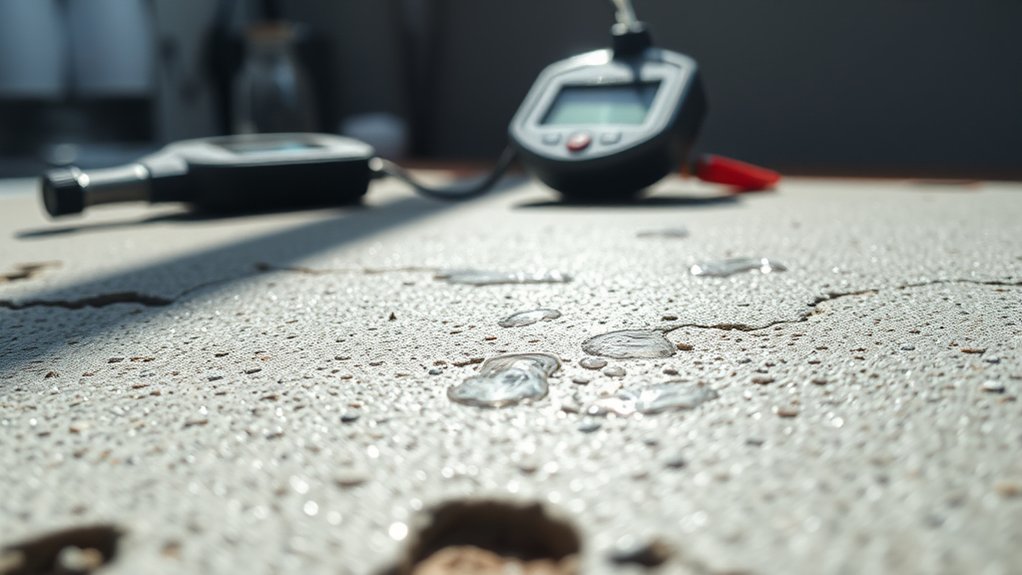
While the water absorption test provides quantitative data on porosity, immediate visual and surface-level assessments can offer quick insights into concrete’s water resistance. Begin with a surface inspection by placing a tablespoon of water on the concrete. Rapid absorption suggests high porosity, whereas water beading indicates resistance.
Next, examine the surface for visible cracks, uneven textures, or discoloration. These often signal porosity and potential water infiltration. You can also use tools like moisture meters or pin-type testers to quantify internal moisture levels. Higher readings usually mean increased porosity.
A dye penetration test can confirm porosity by showing how deeply a colored solution seeps into the material. These visual inspection indicators complement water absorption tests.
Together, they provide a thorough evaluation of concrete’s permeability and durability.
Why You Should Maintain Concrete for Longer Life
Why does maintaining concrete matter for its longevity? Proper maintenance, including concrete sealing and timely repairs, directly enhances durability by preventing water and chemical infiltration.
Neglecting these tasks accelerates structural deterioration and corrosion, which reduces the service life of your concrete. So, it really pays off to stay on top of it.
You should focus on regular cleaning and resealing to block moisture and harmful agents.
Also, prompt crack repair using sealants or injections helps protect rebar integrity.
And don’t forget routine inspections to identify and address early damage. Catching problems early means you can avoid costly repairs down the road.
Frequently asked questions
How Does Concrete Porosity Impact Thermal Insulation Properties?
You’ll find that concrete porosity directly impacts thermal conductivity and insulation efficiency. When pore distribution is well-controlled, trapped air within tiny pores reduces heat transfer, enhancing insulation.
But if the porosity is uneven or too high, it actually increases thermal conductivity. That means heat passes through more easily, which lowers the insulation efficiency.
To get the best performance, you need to carefully manage pore size and distribution. Sealing pores helps minimize unwanted heat flow and improves the overall insulating properties of concrete.
Can Additives Improve Concrete’s Resistance to Chemical Attacks?
Yes, additives substantially improve chemical resistance in concrete. When you use crystalline admixtures or silica fume, you enhance additive effectiveness by reducing permeability and pore connectivity.
This strengthens the concrete matrix against aggressive chemicals, boosting durability enhancement.
Furthermore, corrosion inhibitors slow steel reinforcement decay, extending structural lifespan. Properly selected and applied additives can increase chemical attack resistance by up to 95%.
This makes your concrete far more resilient in harsh environments.
What Role Does Concrete Porosity Play in Sound Absorption?
Concrete’s porous structure plays a critical role in sound absorption by enhancing sound dampening capabilities. When you use concrete with interconnected pores, it traps and dissipates sound energy, converting it into minor heat. This process improves acoustic performance considerably.
The higher the porosity, the better the material is at reducing noise transmission.
Are There Environmental Benefits to Using Porous Concrete?
You might think porous concrete won’t handle heavy rainfall well, but it actually excels in water management by allowing water infiltration. This reduces runoff and lowers the risks of urban flooding.
Using porous concrete means you’re choosing eco-friendly materials that promote groundwater recharge and help filter pollutants. Plus, it aids urban cooling by minimizing heat island effects.
These benefits make porous concrete a sustainable choice for enhancing urban infrastructure performance and environmental resilience. It’s a smart option if you want to support greener cities.
How Does Freeze-Thaw Cycling Affect Porous Concrete Differently?
Freeze-thaw cycling affects porous concrete by causing freeze damage through moisture migration within its pore structure. When water infiltrates interconnected pores and freezes, it expands, exerting pressure that damages pore walls and microcracks.
This repeated stress weakens the concrete’s integrity, accelerating deterioration like surface spalling.
You’ll find that denser pore structures with limited moisture migration resist freeze damage better. On the other hand, highly porous concrete suffers more significant structural degradation under freeze-thaw conditions.
Final Thought
Now that you know concrete isn’t a perfect fortress against water, you can tackle its porosity head-on. By optimizing mix design, curing methods, and construction practices, you’ll markedly reduce permeability and boost durability.
Remember, concrete’s resistance isn’t a myth. It’s a challenge you can control, like plugging tiny leaks in a dam before they become floods. Regular maintenance seals the deal, ensuring your concrete stands strong and lasts longer under pressure.
More Concrete Basics Guides
Buying Sand, Gravel or Ready Mix?Portage Aggregate & Supply carries triple-washed sand and gravel, and Tri County Concrete delivers ready mix across Greater Cleveland. Request a quote or call 440-582-1100.