How Cold Can You Pour Concrete – Overview
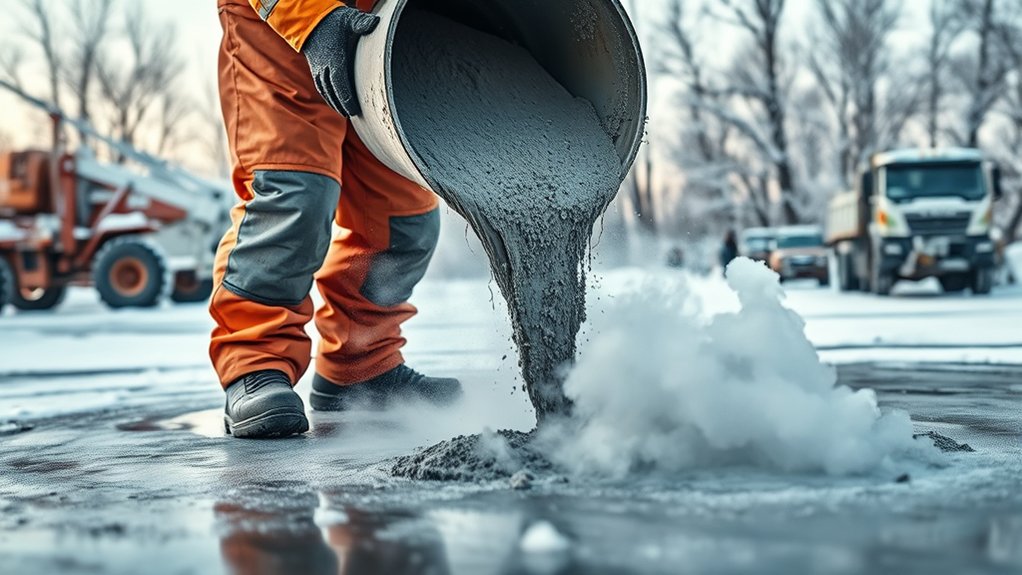
You can pour concrete safely down to about 40°F (4°C) if you take proper precautions like heating, insulation, and careful scheduling.
Below 50°F (10°C), you’ll need extra measures to prevent freezing and guarantee proper curing. Avoid pouring during rapid temperature drops or when nighttime temperatures fall below freezing.
Maintaining stable temperatures between 50°F and 70°F (10°C–21°C) is vital for strength and durability. Understanding these factors will help you manage cold-weather concrete pours effectively.
What Cold Temperatures Are Safe for Pouring Concrete?

Although you can pour concrete at temperatures above 40°F (4°C) with standard procedures, doing so below 50°F (10°C) demands additional measures such as heating and insulation to guarantee proper curing.
Pouring concrete below 50°F requires heating and insulation to ensure proper curing and strength development.
When dealing with concrete in cold weather, maintaining the curing process is critical to prevent freezing and ensure strength development.
The ideal temperature range for pouring lies between 50°F and 70°F (10°C to 21°C), where hydration reactions proceed effectively.
Pouring concrete below 40°F (4°C) without protective actions risks freezing before adequate curing, compromising structural integrity.
The American Concrete Institute advises postponing pours if temperatures are expected to drop below 40°F during curing.
How Freezing Weather Affects Concrete Strength and Durability
When concrete is exposed to freezing temperatures before it has gained enough strength, the water inside the mix expands and causes internal damage.
This expansion can lead to cracking, which seriously reduces the durability of the structure.
Freezing Impact On Strength
Since concrete gains strength through a curing process that relies on hydration, exposing it to freezing temperatures before it fully cures, typically below 50°F, can markedly reduce its structural integrity.
When water within the concrete freezes prematurely, it expands, causing internal stress and microcracking. This freezing-induced damage prevents the concrete from achieving its expected strength.
That leads to compromised load-bearing capacity and potential long-term structural weaknesses.
To avoid these problems, you need to use proper curing methods like insulating blankets or heated enclosures, especially when temperatures approach or drop below 40°F.
By preventing freezing during the critical early stages, you make sure the concrete hydrates properly and develops the strength it needs.
This way, you safeguard the concrete’s performance and durability under service conditions.
Durability Risks From Cold
If you pour concrete in freezing weather, you risk serious durability problems that compromise its long-term performance. Freezing temperatures cause water inside the concrete to freeze, expand, and create internal stresses, leading to cracking. When concrete freezes before it reaches adequate strength during curing, its structural integrity suffers.
Repeated freeze-thaw cycles make the damage worse, causing surface scaling and spalling. You need to ensure proper curing techniques and use insulation to keep temperatures above freezing during early hydration. This helps prevent strength loss and durability issues.
| Freezing Temperature | Effect on Concrete | Preventive Measure |
|---|---|---|
| Below 32°F | Water freezes, expands | Insulation, heating |
| Early Freeze | Reduced strength gain | Accelerated curing methods |
| Freeze-Thaw Cycles | Surface scaling, spalling | Sealants, surface protection |
Preparing Concrete Mixes for Cold Weather Pouring

When you’re getting ready to pour concrete in cold weather, it’s important to tweak a few things to keep everything on track. One key step is adjusting the water temperature and preheating the aggregates. This helps maintain the right mixing conditions so the concrete sets properly.
Also, adding accelerating admixtures can be a big help. They speed up the curing process, which lowers the chance of the concrete freezing.
Taking these steps ensures your concrete will gain strength effectively, even when the temperatures are low.
Adjusting Water Temperature
Although cold weather poses challenges to concrete curing, adjusting the water temperature in your mix plays a critical role in maintaining ideal hydration. You should use hot water, typically between 140°F and 160°F, to help sustain the concrete mix temperature during cold weather pouring. Carefully control the water temperature to avoid thermal shock, which can compromise the mix’s integrity.
In colder conditions, consider adjusting the water-to-cement ratio to offset reduced hydration rates. Preheating aggregates also assists in achieving and maintaining the desired concrete temperature.
Ensuring the concrete mix remains above 50°F during placement and initial curing is essential for best strength development.
Using Accelerating Admixtures
Adjusting water temperature helps maintain hydration, but accelerating admixtures provide an additional method to combat cold weather challenges in concrete curing.
By incorporating accelerating admixtures such as calcium chloride or non-chloride alternatives, you can considerably reduce setting times. This enables concrete to gain strength faster and resist freezing before full cure.
These admixtures allow for colder pour temperatures, sometimes as low as 20°F (-6°C), depending on your specific mix design and environmental conditions.
However, you must carefully control the dosage to avoid flash setting or compromising long-term strength. Proper mixing and monitoring are essential to guarantee ideal curing and durability in cold weather applications.
Using accelerating admixtures effectively enhances your ability to maintain concrete integrity despite low temperatures. It’s a handy tool to have when you’re dealing with those chilly pours.
Just remember, a little goes a long way, so keep an eye on the mix!
Preheating Aggregates
When pouring concrete in cold weather, preheating aggregates plays a crucial role in maintaining the mix temperature and guaranteeing proper curing. By warming aggregates to between 60°F and 120°F, you can raise the initial concrete temperature by up to 20°F. This helps accelerate strength development under low temperatures.
Preheated aggregates reduce the dependence on additional heating methods and chemical accelerators. That means better workability and more consistent curing.
Common heating methods include electric and gas-powered systems. These are carefully controlled to avoid overheating, which can cause moisture loss or particle damage. That would compromise concrete quality.
Properly managing preheated aggregates ensures the concrete mix retains essential thermal properties. This helps mitigate the adverse effects of cold weather. It also supports structural integrity during early curing stages.
Materials You Need to Protect Concrete in Winter

To guarantee proper curing and prevent damage during winter, you need specific materials that maintain heat and moisture around fresh concrete. Insulating blankets provide essential thermal protection by retaining heat and preventing freezing. Heated enclosures, including polyethylene covers, create controlled environments that sustain consistent curing temperatures.
These materials are critical to avoid temperature fluctuations that can compromise concrete strength. Furthermore, straw-plastic combinations serve as effective insulation barriers, minimizing heat loss. While external heating devices, such as propane or electric heaters, support curing, the focus here remains on materials that stabilize moisture and temperature.
Using insulating blankets and heated enclosures ensures the concrete cures properly by maintaining ideal thermal conditions during cold weather pours. This way, you can prevent structural defects caused by freezing or inadequate hydration. It’s all about keeping things steady so your concrete sets just right.
Heating and Insulating to Prevent Concrete Freezing
How do you effectively prevent concrete from freezing during cold weather pours? You employ heating and insulating strategies to maintain ideal curing temperatures. Use gas, propane, or electric heaters to raise both ambient and concrete temperatures before and during placement.
Immediately after pouring, apply insulating materials such as thermal blankets, straw-plastic sheets, or specialized concrete blankets to retain heat and prevent rapid temperature loss.
Furthermore, ground heaters or thermal blankets can warm the sub-base, preventing frost or ice contact with the concrete.
Proper insulation ensures the concrete temperature stays above 50°F for at least 72 hours, which is critical for hydration and strength development.
Monitoring Concrete Temperatures During Curing
Although heating and insulating are essential, you must also monitor concrete temperatures continuously during curing to guarantee ideal strength development. Use infrared guns or embedded thermometers to measure concrete temperature regularly, ensuring it remains between 50°F and 70°F.
Monitoring at multiple points helps detect uneven distribution and sudden drops that could slow curing or cause freezing. Keep a close eye on those changes to prevent any issues. Maintaining a detailed log of readings is key for effective management and timely corrective actions.
| Concrete Temperature (°F) | Curing Impact |
|---|---|
| Below 50 | Slowed curing, risk of freezing |
| 50 – 70 | Perfect strength development |
| Above 70 | Accelerated curing, possible defects |
| Sudden drops | Risk of thermal cracking |
Risks of Cracking and Weakening When Temperatures Drop Quickly
When temperatures drop rapidly after pouring, concrete faces a heightened risk of cracking due to slowed hydration and increased internal stresses. You need to understand how weather conditions directly affect concrete’s curing process and structural integrity. Rapid temperature declines, especially beyond 10–20°F within 24 hours, make internal stresses worse and promote freeze-thaw damage.
Here are some critical risks to keep in mind:
- Pouring concrete below 50°F slows hydration, which makes cracking more likely.
- Exposure to freezing temperatures before the concrete cures can cause significant cracking and strength loss.
- Freeze-thaw cycles caused by sudden weather changes weaken concrete’s durability and shorten its lifespan.
To avoid these problems, it’s important to maintain controlled temperature conditions. Using insulation or heating helps prevent quick temperature swings that can harm the concrete’s strength when the weather turns cold.
Scheduling Concrete Pours to Avoid Weather Risks
Managing the timing of your concrete pours plays a vital role in preventing temperature-related issues that can compromise curing and strength. Since weather affects concrete curing, you should schedule pours when outdoor temperatures consistently exceed 40°F. Avoid pouring during cold snaps or rapid drops over 10–20°F within 24 hours.
Nighttime temperatures must stay above freezing to prevent freezing during initial curing. Use weather forecasts to identify stable periods with temperatures between 50°F and 70°F for ideal results. Adjust scheduling based on local climate and forecast fluctuations to minimize risks.
| Condition | Recommendation |
|---|---|
| Temperature > 40°F | Safe to pour |
| Temperature drop > 10–20°F | Avoid pouring |
| Nighttime temperature < 32°F | Delay pour to prevent freezing |
| Stable 50–70°F period | Perfect curing conditions |
Frequently asked questions
How Long Does Concrete Take to Cure in Cold Weather?
In cold weather, concrete typically takes considerably longer to cure than in standard conditions. You should expect the initial set to extend from several days up to over a week when temperatures fall below 50°F.
Furthermore, full strength development, normally achieved in 28 days, may require extra curing time. To ensure proper hydration and strength gain, you need to maintain the concrete temperature above 50°F for at least 3 to 7 days during curing.
It might seem like a hassle, but keeping the concrete warm really makes a difference.
Can Additives Speed up Curing Without Compromising Strength?
You might think additives can cure concrete overnight like magic, and in a way, they do. Yes, accelerators like calcium chloride can considerably speed up curing without compromising strength when used correctly.
They enhance early hydration, allowing concrete to gain strength faster even in cold conditions.
However, you must carefully control dosage and combine additives with proper insulation to avoid durability issues or cracking. This way, you ensure ideal structural integrity.
It’s all about using the right amount and the right methods to get the best results.
What Are the Signs of Improperly Cured Concrete?
You’ll notice improperly cured concrete through surface cracking, scaling, or premature dusting. Uneven or weak areas may develop, compromising structural integrity. A higher water-to-cement ratio often results in a softer, more porous surface.
Discoloration, such as excessive staining or inconsistent coloring, also signals poor curing. These signs indicate that the hydration process was insufficient, affecting durability and longevity.
You must address curing methods promptly to avoid these issues.
Is It Safe to Use Recycled Water for Cold Weather Concrete?
Of course, you’d love to pour cold weather concrete with recycled water straight from the tap, right? But it’s only safe if you rigorously test and treat that water first.
You must warm it to avoid temperature drops that delay setting, and guarantee it’s free from contaminants like chlorides or sediments.
Without strict quality control, recycled water can weaken hydration and compromise durability in freezing conditions. So, don’t skip proper conditioning steps.
How Does Humidity Affect Concrete Curing in Cold Temperatures?
Humidity directly impacts concrete curing in cold temperatures by regulating moisture evaporation. You need adequate humidity to prevent rapid drying, which causes surface cracking and weakens hydration.
However, too much humidity combined with low temperatures can raise the risk of surface freezing and delay the setting process. It’s a bit of a balancing act.
Final Thought
Pouring concrete in cold weather requires careful control, much like steering a ship through icy waters. You have to keep an eye on temperatures and prepare your mixes with the right additives. Using heating and insulation is key to preventing the concrete from freezing.
Scheduling your pours thoughtfully and protecting the curing process are also important. These steps help keep the concrete strong and durable, even when it’s cold outside. With the right precautions, you can confidently pour concrete in chilly conditions without risking the structure’s integrity.
More Pouring & Curing Guides
Need Concrete in Greater Cleveland?Tri County Concrete delivers ready mix from plants in North Royalton and Twinsburg, Ohio. Request a quote or call 440-582-1100.